Facebook Ad Creative Testing: A Founder's Playbook
Facebook Ad Creative Testing: A Founder’s Playbook
Facebook ad creative testing comes down to three things. Test big ideas before small tweaks. Give each ad a fair shot at spend. Read the results against a business metric, not a vibe. Do those three and you stop guessing which ad is “the pretty one” and start learning which message actually moves people to buy.
We design for startups all day, so we’ve watched plenty of founders do the classic thing: launch eight ads, panic on day two, kill six, and declare that “Facebook doesn’t work for us.” 😅 (We have been that founder, at least in spirit.) This guide is the calmer version: a testing process you can run with a small budget, a small team, and a healthy fear of wasting money.
TL;DR
- Test angles (the argument you make), not just visuals. Five different messages with two visual takes each beat ten versions of one idea.
- Standard delivery is not an A/B test. Use Meta’s native Creative Testing tool when you need a balanced spend comparison.
- Budget roughly ten times your target cost per action per day at the ad-set level as a starting heuristic, then adjust to what you can afford.
- Watch leading indicators of fatigue (frequency above 3.0, three straight days of falling CTR, rising CPMs) before CPA spikes.
- Add two or three new ads a week instead of dumping a giant batch once a month.
Table of Contents
- Why creative is now your targeting
- Before you test anything: the pre-launch checklist
- What to test first: angles beat visuals
- Why normal ad sets are not real A/B tests
- Using Meta’s Creative Testing tool
- How much should you spend on testing?
- Creative fatigue: how to spot it before it costs you
- A worked example: your first two weeks
- Reading results without fooling yourself
- Our perspective: design is the testing multiplier
- Need creative that is worth testing?
- FAQ
- Sources
Why creative is now your targeting
You used to win on Facebook by slicing audiences into tiny interest buckets. Now the ad itself does most of the sorting. One industry write-up puts it bluntly: creative is the new targeting, because the story in your ad is how the system finds the people who care about it.
That changes what “testing” should mean. Swapping a button from blue to green is not a test of your strategy. Testing radically different messaging angles, customer personas, and formats is. If your ad for a scheduling tool leads with “save time” and another leads with “stop losing clients to no-shows,” you are not testing two ads. You are testing two different audiences and two different problems.
There is data behind diversifying, too. In a large Meta advertiser study of standard enhancements, ads that used them saw a 4% lower cost per result and 14% more incremental purchases than ads that didn’t, and diversifying creatives showed up to a 32% improvement in CPA. Treat those as Meta’s own numbers from a specific experiment, not a promise for your account. The direction is useful, though: variety helps.
Before you test anything: the pre-launch checklist
The most expensive testing mistake has nothing to do with creative. It’s testing an ad that was broken at launch.
A pre-launch review that works in consequence order is the sane way to do it: fix launch blockers first (broken tracking, wrong destination, missing disclosures) before anybody argues about visual polish. A pretty ad pointing at a 404 teaches you nothing, except how to burn $50.
Our version, in order:
- Does the link go where you think it goes? Click it on your phone, on mobile data, not Wi-Fi.
- Is tracking firing? Check that the event you’re optimizing for actually records.
- Does the ad make sense in two seconds? Can a stranger tell what you sell and who it’s for?
- Does the landing page match the promise? If the ad says “free audit,” the page should say it in the first screen.
- Are any required disclosures present?
- Only then: fonts, spacing, crop, color.
That same checklist source makes a point we love: a mockup is a quality-control tool, not a predictor of performance. Only live delivery data tells you what resonates. So stop polishing the thing for a week. Ship it, then learn.
If your landing page is the weak link, that’s a design problem and not an ad problem. Our piece on startup usability testing shows how to find friction with about five users per round.
What to test first: angles beat visuals
Here is the idea that will save you the most money. Creative fatigue is often misdiagnosed as a visual problem when it’s mostly a messaging problem. If your audience has already rejected your argument, a fresh color palette won’t change their mind.
The structure we like, drawn from this guide to beating creative fatigue, is to produce five different angles with two visual variations each, rather than ten visual versions of one idea. When one angle wears out, the others are still fresh.
What counts as an angle? Think of the reason someone would buy:
- Pain: “Your onboarding is losing people in step three.”
- Outcome: “Ship your investor-ready deck in a week.”
- Proof: a customer result, a number, a before-and-after.
- Objection: “No, it isn’t another template.”
- Identity: “For founders who treat design like a growth lever.”
Then give each angle two visual takes. Maybe one is a static image and one is a short video. Maybe one is a bold typographic card and one is a product screenshot. You now have ten ads, but only five real ideas, and your results are readable.
The order we’d test in
- Concept or angle (the argument)
- Format (static, video, carousel)
- Hook (first line or first three seconds)
- Visual execution (layout, color, imagery)
- Details (call-to-action wording, button, small copy)
Most startups jump to step 5 because it feels easy. Resist. Details only matter once you’ve found an angle worth polishing.
Why normal ad sets are not real A/B tests
Let’s clear up a common myth. Dropping three ads into one ad set and checking which spent the most is not an experiment. Standard delivery isn’t an A/B test: spend gets allocated unevenly and audiences overlap, because the system is optimizing as it goes. An ad that gets an early lucky streak snowballs. An ad that starts slow gets starved, even if it would have won with equal exposure.
That doesn’t make standard delivery useless. The same source describes two modes of learning:
| Mode | What it answers | Best for |
|---|---|---|
| Controlled test (native testing tool) | Which ad wins with balanced spend? | Clean comparisons of a few variants |
| Delivery-led learning | Which concepts does the algorithm find easiest to deliver at scale? | Reading real-world momentum across several distinct ads |
Use both. The controlled test tells you what’s promising. Delivery-led learning tells you what holds up once the machine takes over.
Using Meta’s Creative Testing tool
Meta’s native Creative Testing feature lets you compare up to five ad variations by stopping the platform from optimizing spend toward a single ad at the start. Each variant gets similar budget exposure, so you see what resonates instead of what the algorithm happened to favor. According to the same walkthrough, the tool currently requires the Highest Volume bid strategy and generally supports both daily and lifetime budgets. Features like this change often, so check Ads Manager for the current requirements before you plan around them.
A few ground rules we follow:
- Change one thing, or one concept, per variant. If every ad differs in six ways, you can’t say why one won.
- Keep audience and placements the same across the test.
- Pick a success metric before you launch. Purchases, leads, booked calls. Not “engagement,” unless engagement is the business goal.
- Let it run long enough to gather real conversions, not a day and a half of clicks.
- Write down your hypothesis. “We think the pain angle beats the outcome angle for cold audiences.” Future you will be grateful.
If you want a deeper walk-through of running fast tests with a designer in the loop, we wrote one: how to win ad creative tests in 3 to 7 days.
How much should you spend on testing?
There’s no universal number, and anyone who gives you one without asking about your margins is guessing. There is, however, a common operating heuristic: budget about ten times your target cost per desired action per day at the ad-set level. For a $20 target CPA, that works out to $200 a day for testing. The source frames it as a rule of thumb, not a law.
If $200 a day makes your stomach drop, you have options:
- Test fewer variants at once (two or three, not five).
- Optimize for an earlier event, such as add-to-cart or lead, when purchases are too rare to measure.
- Run shorter, sharper tests with a single hypothesis each.
The same framework raises a question many people skip: should you add new ads to a mature campaign, or launch a fresh one? New ads in a mature campaign can struggle to win impressions against established winners. If your new concept never gets served, you haven’t learned that it’s bad. You’ve learned that it was outgunned. A separate testing campaign avoids that, then you graduate winners into your scaling campaigns. It also helps to plan digital campaigns around growth so your paid tests feed into the rest of your marketing instead of living in a silo.
A simple structure many advertisers use: a testing campaign with a broad ad set and two or three creatives at a time, winners promoted to a scaling campaign, and results reviewed on a regular cadence. That’s the same shape one practitioner described in a Reddit thread on testing creatives, though your account and goals will bend it.
Creative fatigue: how to spot it before it costs you
Creative fatigue is what happens when people see the same creative over and over. Meta’s own analytics team describes it as the effect of repeated exposure to the same visual elements, and notes it differs from audience saturation. It’s closer to ad blindness, and fresh creative of equal or better quality can help even with the same audience.
In the same study of Meta’s platform, the mean number of prior exposures to a creative was 4.2, and over 19% of impressions were seen more than five times by the same user, per Meta’s enhancements analysis. Repetition is baked into the system, so you have to manage it on purpose.
Early warning signs
Don’t wait for CPA to spike. Leading indicators include:
- Frequency above 3.0
- CTR declining for three consecutive days
- Rising CPMs
These are signals, not verdicts. A frequency of 3.2 on a warm retargeting audience might be perfectly fine. A frequency of 3.2 on cold traffic with a falling CTR deserves a look. Another overview lists declining CTR, rising frequency, increasing CPA, and dropping quality rankings as the usual pattern, and warns that surface fixes only buy you days.
What to do about it
- Check whether it’s the angle. If the message is stale, no new color scheme will save it.
- Rotate in new angles, not just new thumbnails.
- Stagger launches. Adding two or three new ads each week is a more sustainable habit than batch-launching dozens once a month.
- Keep a pipeline. Plan next month’s concepts while this month’s are still winning.
A worked example: your first two weeks
Imagine a seed-stage startup selling project-management software to small agencies. Target CPA for a demo booking is $40. Here’s a realistic plan.
Week 1: concept test.
- Pick three angles: pain (“client work keeps slipping”), outcome (“know what ships Friday”), and objection (“not another bloated tool”).
- Make two visual takes of each: a static card and a short screen-recording clip.
- Run the three strongest in Meta’s testing tool, or in a separate testing campaign, with the same audience and one success metric: booked demos.
- Don’t touch anything for several days.
Week 2: read and iterate.
- Pick the winning angle. Check cost per demo, not just CTR.
- Make two or three new visual takes and two new hooks for that angle.
- Move proven winners into your scaling campaign.
- Queue two new angles for the next round.
Notice what you’ve done: five or six ads tested, one clear learning, and a pipeline for next time. No one panicked on day two. (Okay, maybe a little.)
Reading results without fooling yourself
Ads Manager’s breakdown tools help here. You can segment performance by individual creative at the ad set or ad level, and Search Engine Journal’s walkthrough shows where to find it.
A few habits that keep the read honest:
- Compare on the metric you chose in advance. Picking the metric after the fact is how every ad becomes a winner.
- Look at the whole funnel. A high-CTR ad that sends junk traffic is a loss dressed as a win.
- Don’t call it early. Small conversion counts swing wildly.
- Log everything. Angle, format, hook, result. A simple spreadsheet beats a fuzzy memory.
- Remember the mockup rule. Opinions in a review meeting are not data.
Our perspective: design is the testing multiplier
We’re a design partner for startups, so here’s our bias, stated plainly: the bottleneck in most creative testing isn’t the ad platform. It’s the supply of genuinely different, genuinely good creative.
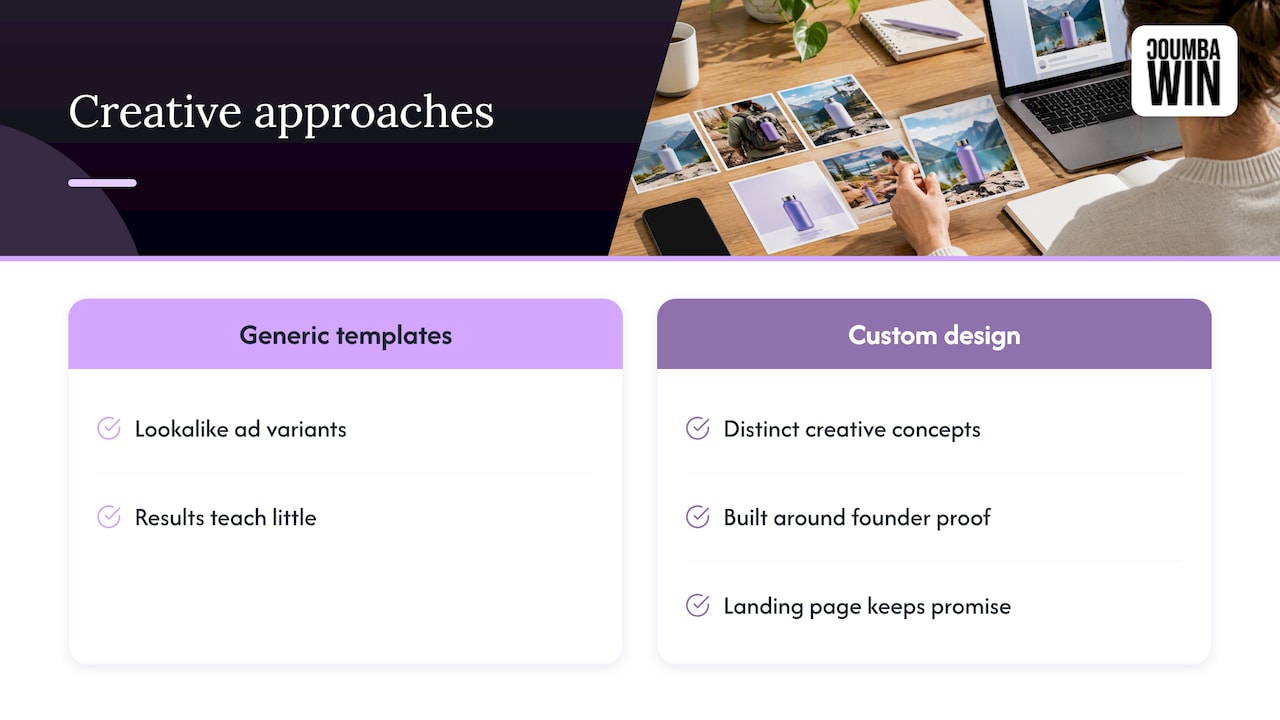
Testing only works if the variants are meaningfully different. Meaningfully different takes a clear brand point of view, a design system that lets you produce new concepts quickly without looking like five different companies, and a landing page that keeps the promise the ad made. Generic templates and AI-generated filler produce lookalike ads, and lookalike ads produce results you can’t learn from. That’s why we’re firmly on the side of custom, collaborative design built around what a founder is trying to prove.
We also think founders should be in the room. You know the objections customers raise on sales calls. You know which promise is true. A designer who sits with you on that turns “let’s try a new look” into “let’s test the claim our best customers repeat.” If your brand foundations are still shaky, start with our brand identity checklist for startups, because ads built on a fuzzy identity just spread the fuzz faster.
One last opinion: treat every test as a design brief for the next one. A winner tells you what to say more. A loser tells you what to stop saying. Both are cheap compared with a quarter of ads built on instinct.
— Coumba Evelyn
Need creative that is worth testing?
If your testing pipeline keeps running dry, that’s where we come in. We handle web design and development, UI and UX design, graphic design, pitch deck design, ad management, and more for startups, with a custom, founder-collaborative approach instead of templates. We can build the ad creative, the landing page it points to, and the brand system that lets you keep producing fresh angles without starting from scratch. Tell us what you’re trying to prove, and we’ll help you design the test.
FAQ
How many ads should I test at once?
Start with two to five, depending on budget. Meta’s native testing tool compares up to five variants, but fewer variants reach meaningful data faster on a small budget. If you can’t afford to give each ad enough conversions to read, cut the number of ads rather than cutting the budget per ad.
How long should a Facebook creative test run?
Long enough to collect a meaningful number of the conversions you chose as your success metric, which depends on your CPA and budget. Judging after a day or two usually means reacting to noise. Decide your stopping rule before you launch so you aren’t tempted to call it early.
What is creative fatigue, and how do I know it’s happening?
Creative fatigue is the decline in performance that comes from people seeing the same creative repeatedly. Common early signs are frequency above 3.0, CTR falling for three straight days, and rising CPMs. If you see them, try a new angle, not only a new visual.
Should I add new ads to an existing campaign or start a new one?
It depends. New ads in a mature campaign can have trouble winning impressions against established winners, so you may never get a fair read. Many advertisers run a separate testing campaign and promote winners into scaling campaigns afterward.
What should I test first: images, video, or copy?
Test the angle first, meaning the core argument of the ad. Format, hook, and visual execution come next, with small details like button wording last. Big differences in message give you readable results much faster than small cosmetic changes.
Sources
- Meta’s Creative Testing Tool: Setup, Strategy, and Results
- Standard enhancements (Meta advertiser study)
- Build a Meta creative testing process around your business goal
- Creative is the new targeting: 5 tips to maximise ad performance
- Facebook Ad Creative Checklist: Prelaunch Review
- How to Beat Creative Fatigue on Facebook Ads
- Meta creative testing guide (ShortVids)
- Creative fatigue and repeated exposures (Analytics at Meta)
- What Is Creative Fatigue on Meta?
- How To Evaluate Creative Performance in Meta Ads
- How to plan digital campaigns that drive organic growth