Win Ad Creative Tests in 3–7 Days for Practitioners and Designers
Win Ad Creative Tests in 3–7 Days for Practitioners and Designers
Creative testing is a data-driven process that finds which ad creative actually moves your KPI. It pits variations against a control, measures the metric tied to your business goal, and tells you which one earned the spend. The verdict is simple: test early, pick a KPI that maps to a real outcome, and kill the losers fast. Start today by grabbing one live campaign and running a 3 to 7 day monadic test with two or three creatives.
TL;DR:
- Running a few thousand impressions per variant provides a clear, directional idea of which creative is better for small to mid-sized campaigns.
- In-flight testing should focus on daily signals like click-through rate and cost per landing page view instead of constant relaunches that reset Facebook’s learning phase.
- The most critical elements to test first are the hero image or video and the headline, as they have the biggest impact on user engagement and CTR.
- Pre-launch concept tests help prevent costly mistakes, while post-launch measurements of brand recall reveal if the creative truly builds awareness.
- Using platform-native testing tools and maintaining a detailed test log maximizes the reliability and learnings from creative experiments.
Table of Contents
- What Are the Main Creative Testing Methods?
- When Should You Run Creative Tests?
- Which Ad Elements Should You Test First?
- How Do You Know When a Creative Test Has a Winner?
- How Big a Budget Do You Need for a Reliable Test?
- What Tools Do You Need to Run Creative Tests Well?
- How Coumba Win Design Turns Design Hypotheses Into Test Wins
- When Should You Stop Testing Creative and Fix Something Bigger?
- How Coumba Win Design Supports Test-Driven Creative Production
- Sources
- FAQ
What Are the Main Creative Testing Methods?
Ad creative testing isn’t one method. It’s three, and picking the wrong one for your situation wastes budget and time you don’t have.
A/B testing isolates a single variable. Same audience, same budget, same everything except one element (a headline, a thumbnail, a CTA button color). It’s the fastest way to answer a narrow question, and it’s why performance marketers lean on it when the deadline is next Tuesday.
Split or monadic testing goes bigger. Instead of tweaking one element, you run entirely different creative concepts against separate, matched audience segments and compare how each performs on its own terms rather than head-to-head. This is the right tool when you’re not tweaking a button. You’re deciding between two completely different creative directions, like a product-demo video versus a testimonial-style ad.
Multivariate testing changes several elements at once (image, copy, and CTA together) and requires enough volume to sort out which combination, not just which single change, drove the result. Creative testing done this way replaces gut instinct with a data-driven decision, but it eats through impressions quickly, so it’s mainly a tool for advertisers already running six figures a month or more.
Here’s how the same concept splits across setups:
- Meta Ads Manager: Use the built-in creative test feature inside a single campaign so the algorithm retains delivery learnings while comparing versions.
- A dedicated testing platform: Run monadic surveys where different respondent groups see only one creative, useful for pre-launch concept validation before a dollar of media spend goes out.
- Search or YouTube: Rotate ad variants manually and pull performance by asset, since native multivariate tools are less mature there than on Meta.
Pick the method that matches your question. Don’t run a multivariate test to answer an A/B question. It’s overkill, and it’ll take three times as long to get a readable answer.
When Should You Run Creative Tests?
Creative testing isn’t a one-time event tied to launch day. It happens in three distinct windows, and each one produces a different kind of answer.
- Pre-launch. Before spending a dollar on media, run concept tests using surveys or monadic panels to check message clarity and brand recognition. This step catches expensive mistakes early, since pre-testing with representative samples reduces the risk of a costly creative miss before it ever reaches a live audience.
- In-flight. Once a campaign is live, run tight learn-and-kill cycles. Watch early click and cost signals daily, but resist the urge to pause and relaunch constantly. Every relaunch resets the algorithm’s delivery learning, which is why testing inside one ad set, not across fragmented new campaigns, matters so much.
- Post-launch. After the campaign has run its course, step back and measure brand lift or recall over weeks, not days. This is where pre-testing, in-flight monitoring, and iterative refinement each carry distinct value: pre-testing prevents the misstep, in-flight monitoring shows you what’s happening right now, and post-launch analysis tells you what actually stuck with people weeks later.
Skip any one of these three windows and you lose a different kind of insight. Skip pre-launch and you’ll burn budget on a concept nobody understood. Skip post-launch and you’ll never know if the winning ad actually built brand memory or just generated cheap, forgettable clicks, which is why measuring brand awareness using AI analytics is crucial.
Which Ad Elements Should You Test First?
Not every element deserves equal attention. Some move the needle hard. Others barely register.
Rank your test priorities roughly like this:
- Hero image or video: Usually the single biggest driver of stop-scroll rate and CTR.
- Headline: Second-biggest lever, especially on feed placements where copy loads before the visual fully renders.
- Primary text: Matters more for consideration and conversion objectives than for pure awareness plays.
- CTA button and offer framing: Small visual element, outsized effect on click intent, especially “Shop Now” versus “Learn More” for cold audiences.
- Layout, branding cues, pacing, and audio: Lower individual impact alone, but they compound when tested together after the bigger levers are settled.
The atomic-versus-grouped decision comes down to budget. If you have enough spend to run five separate A/B tests sequentially, isolate one variable at a time. That’s how you get a clean, interpretable answer. If your budget is tight, group changes into two or three distinct creative concepts (monadic style) and accept that you’re testing a bundle, not a single lever.
For advertisers running under $50 a day, test the hero visual first. It’s the highest-leverage single change you can make, and testing anything smaller (like button color) at that spend level will take weeks to produce a readable signal.
Pro Tip: Keep a single running document that logs every test’s hypothesis, variable changed, and result. Six months in, that log becomes your most valuable creative asset, more useful than any individual winning ad.
How Do You Know When a Creative Test Has a Winner?
The metric you should watch depends entirely on the campaign objective, not on whatever number looks best in the dashboard.
- Awareness campaigns: Watch CTR and recall lift.
- Consideration campaigns: Watch landing page views and click volume.
- Conversion campaigns: Watch CPA and ROAS, full stop.
Early in a test, CTR and cost per landing-page view give you a directional read within the first day or two. But don’t call a winner off CTR alone. A creative can pull clicks and still convert at half the rate of a quieter-performing ad. Let the metric tied to your actual objective make the final call.
On sample size, a rough rule of thumb: don’t trust a result until you’ve cleared a few thousand impressions per variant at minimum, and ideally enough clicks (a few hundred) to smooth out daily noise. Below that, you’re likely looking at noise, not a real winner.
Creative can swing outcomes hard. Ad testing research from System1 and AdMap found that pre-testing can lift ad effectiveness by at least 20%, and that creative quality drives profit more heavily than media placement decisions alone.
That statistic cuts against a common assumption in performance marketing, which is that targeting and bidding strategy matter more than the ad itself. Creative is often the bigger lever, which is exactly why testing it systematically, instead of trusting a designer’s or copywriter’s gut, pays off.
How Big a Budget Do You Need for a Reliable Test?
There’s a real difference between a directional test and a statistically powered one, and most advertisers don’t need the second kind.
- Directional tests need roughly a few thousand impressions and a few hundred clicks per variant. That’s enough to spot an obvious front-runner, not enough to defend the result in a board meeting.
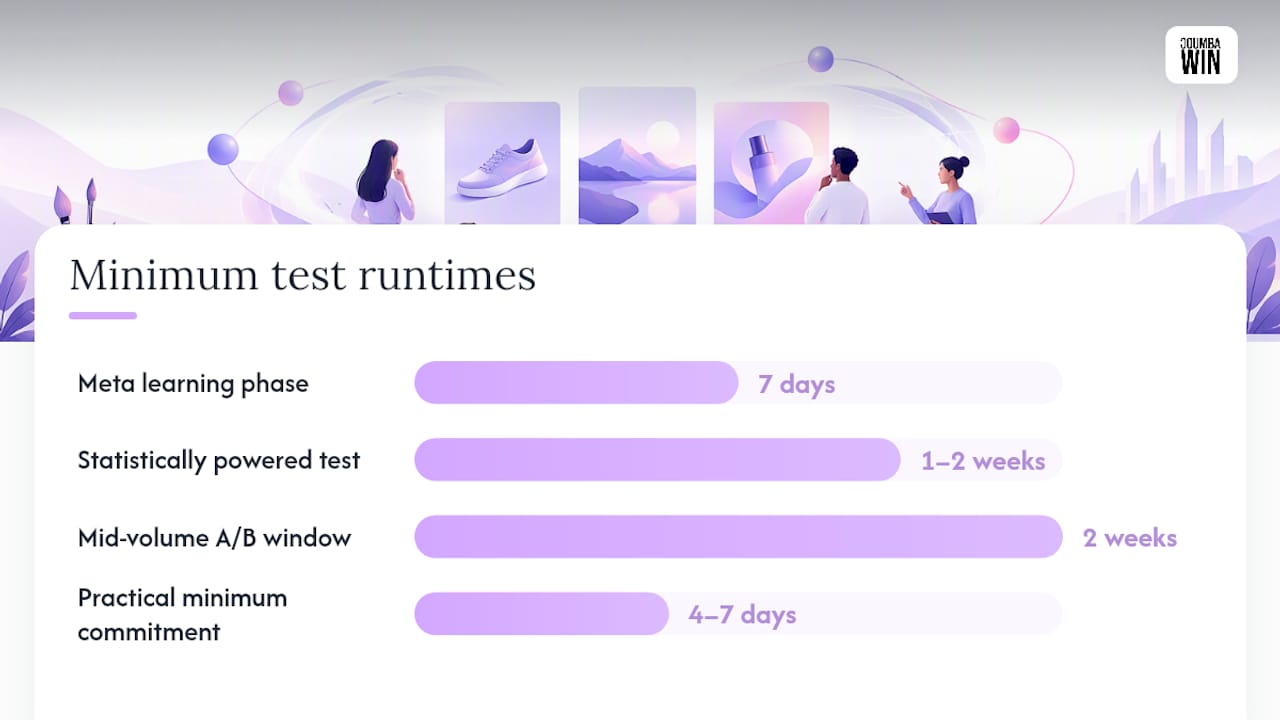
- Statistically powered tests typically need conversion counts in the low hundreds per variant, which for most small and midsize advertisers means running for one to two weeks minimum, not one to two days.
- Budget allocation by volume tier roughly breaks down as follows: low-volume advertisers (under $1,000/month) should stick to directional reads and accept some uncertainty; mid-volume advertisers ($1,000 to $10,000/month) can run legitimate A/B tests within two-week windows; high-volume advertisers (above $10,000/month) have the volume to run true multivariate tests and can afford to be pickier about statistical thresholds.
Platform learning phases complicate all of this. Meta’s algorithm needs roughly 50 conversion events per ad set within a week to exit the learning phase and stabilize delivery. Restart that clock with every new ad or budget change and your test data gets muddier, not cleaner. That’s why Meta’s own creative test tool is built to compare variants inside one campaign structure. It’s designed to preserve learning rather than fragment it across separate campaigns.
Practical moves that protect your budget: stagger creative launches by a day or two instead of dumping everything live at once, hold back a small control audience so you always have a clean baseline, and commit to a minimum run time (four to seven days) before you touch anything, even if the early numbers look tempting to react to.
What Tools Do You Need to Run Creative Tests Well?
Four tool categories cover most creative testing workflows, and each solves a different problem.
- Platform-native testing (Meta Ads Manager, Google Ads experiments) is free, keeps delivery learning intact, and should be your default starting point before adding a third-party layer.
- Dedicated ad-testing vendors bring survey panels and emotional-response measurement, which predicts brand impact better than click data alone, since emotional and brand metrics tend to forecast long-term effects more reliably than raw CTR.
- AI creative generators like AdCreative.ai speed up production and offer conversion scoring, but user reviews flag billing friction, including trials that auto-convert to paid plans and credit limits that punish high-volume testing. Read the cancellation terms before you connect a card.
- Research and survey panels validate messaging before launch, filling the pre-launch gap that platform tools can’t cover on their own.
Before launching anything, run this checklist: confirm conversion tracking fires correctly, link ad accounts to the right business manager, standardize a naming convention across creative versions, define your audience sample size, set a spend cap per variant, and build a report template so results are comparable test over test instead of scattered across ad hoc screenshots.
How Coumba Win Design Turns Design Hypotheses Into Test Wins
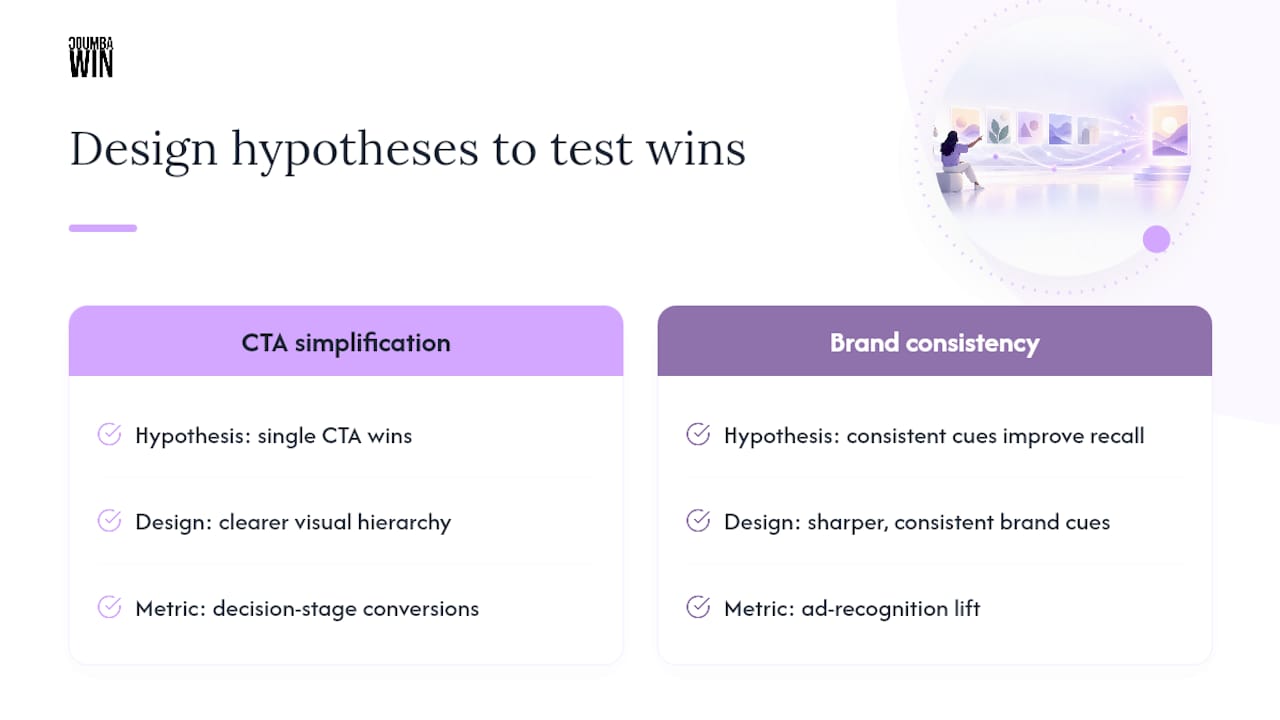
Every creative test starts with a hypothesis, and the strongest ones come from design decisions, not guesswork. For example, reworking user experience for an educational platform client often rests on the idea that clearer visual hierarchy reduces confusion at the point of decision. That’s the same logic behind a creative test hypothesis like “a single, unmistakable CTA will outperform a page with three competing calls to action.”
Refining brand narrative for a fashion client followed a similar pattern: sharper, more consistent brand cues were expected to improve how audiences recognized and recalled the brand. That’s directly testable as an ad-recognition lift once creative goes live. Design and testing aren’t separate disciplines. A good design hypothesis is a testable one, and the interactive design work behind a landing page often determines whether a winning ad creative actually converts once someone clicks through.
When Should You Stop Testing Creative and Fix Something Bigger?
Creative testing has a ceiling, and a lot of teams blow past it without noticing. If the offer is weak, the audience is mistargeted, or there’s no real product-market fit yet, no amount of creative iteration will save the campaign. Testing strategy should prioritize the biggest levers first, meaning audience, offer, and positioning, before you ever touch a headline.
Scale creative testing once those fundamentals are proven and you’re chasing incremental gains, not fixing a broken foundation. A central test log and a daily read of early signals keep teams from re-litigating decisions they already made. A workable cadence: one meaningful creative test running at all times, reviewed weekly, with results logged before the next one launches.
How Coumba Win Design Supports Test-Driven Creative Production
Running disciplined creative tests is only half the job. Someone still has to design, produce, and manage the ads that go into the test. Design teams often work closely with founders on ad management, UI and UX design, and landing page work built around testable hypotheses, not generic templates.
The collaboration starts with a brief where every design choice maps to something measurable: a clearer brand cue built to lift recognition, a single dominant CTA built to lift click-through to the landing page. You get design decisions that are structured to be tested, not just admired. If you want to see how that plays out, browse the Webflow project examples or check the full service list to start a conversation about your next campaign.
Sources
- Creative testing: Strategies for high-impact ad campaigns
- How to run a successful ad testing program
- Developing an effective marketing test strategy
- Set Up a Creative Test in Meta Ads Manager
FAQ
Can You Give Examples of Creative Ads Worth Testing?
Common examples include a product-demo video against a testimonial-style video, a static image ad against a short-form video, and a discount-led headline against a benefit-led headline. Each pair represents a distinct concept, not just a color swap, which is what makes them worth a split or monadic test rather than a simple A/B tweak.
How Much Does It Cost to Test Ads?
Cost depends on volume and method. A directional platform-native test can run on a few hundred dollars total, while a statistically powered test with proper sample sizes typically needs a budget that supports at least a couple thousand impressions and a few hundred clicks per variant over one to two weeks.
Is AdCreative.ai Legit?
AdCreative.ai is a legitimate creative generation and scoring tool used by real advertisers, but reviews flag billing issues, including trials that auto-convert to paid subscriptions. Read the cancellation terms closely and monitor credit usage before scaling up.
Is $10 a Day Enough for Facebook Ads?
Ten dollars a day is thin, but not necessarily useless for an early directional read. Practitioner tests running around $25 a day have surfaced high-CTR winners within 24 hours when the team watches early signals closely and kills weak performers fast, so treat anything under that as a slow, noisy signal rather than a dead end.