Logo Redesign Cost: What You'll Pay and What a Fair Quote Covers
Logo Redesign Cost: What You’ll Pay and What a Fair Quote Covers
A logo redesign costs whatever the work around the logo costs. The mark alone is the smallest part. Price moves with who designs it (a DIY tool, a freelancer or a studio), how much research and exploration come first, how many files and usage rights you get, and whether the logo is the whole job or the first piece of a bigger identity. A logo-only refresh can be a small project. A redesign that drags in a color system, type, guidelines and new collateral is a different animal.
We design for startups, so we see this from the buying side of the table all the time. Founders email us with “how much for a new logo?” and the honest answer is a question back: “New logo for what?” (Yes, we know. Annoying. Stay with us.) Below is how pricing actually works, what to demand in a quote, and how to decide whether you need a logo tweak or something bigger.
TL;DR
- Logo redesign cost depends on the provider type (DIY tool, freelancer, studio), the research and concepts included, and the files and rights you receive.
- A logo-only refresh is a much smaller job than a full rebrand. Decide which one you need before you ask for quotes.
- A good quote itemizes phases, names the number of concepts and revision rounds, lists file formats, and spells out usage rights and payment terms.
- Vague quotes (“includes revisions”) are where surprise charges hide. Get every deliverable in writing.
- If your logo is only a little off, a refresh that keeps your recognition is usually the smarter first step.
Table of Contents
- What actually sets the price of a logo redesign
- Logo-only refresh vs. full rebrand: the biggest cost swing
- What a logo redesign quote should include
- How to tell if a quote is fair
- The hidden costs around a logo redesign
- Retainer or project: which pricing model fits a redesign?
- Our perspective
- Want a logo that works across your whole startup?
- FAQ
- Sources
What actually sets the price of a logo redesign
Forget the sticker number for a second. A logo price is a bundle of decisions. Each one adds or removes hours, and hours are what you pay for.
A LogoMaker guide lists the usual budget drivers: custom illustration, hand-drawn work, custom typography, extra logo variations, brand guides, marketing materials, extra revisions, usage rights, file types, designer expertise, location and rush turnaround. Group them and you get five buckets.
1. Who does the work
There are three broad tiers, and they are not interchangeable:
- DIY tools and templates. Cheapest and fastest. You get something generic by design, because the same building blocks are available to everyone. Fine for a side project or a placeholder. Risky when investors, customers or a trademark filing are in the picture.
- Freelance designers. The widest spread by far, from beginners to seasoned specialists. You are paying for one person’s taste, speed and availability. Great when your scope is tight and you know what you want.
- Design studios. Higher price, broader team. You are paying for strategy, research, several people’s eyes and a system that holds together across your site, deck and packaging.
Most of the price gap between tiers is not “better drawing.” It is the thinking before the drawing, and the rigor after it.
2. How much discovery comes first
A logo built from a one-paragraph brief costs less than one built from competitor audits, audience interviews and positioning work. The second one usually lasts longer, because it solves a business problem instead of a taste problem. If you have already done the positioning homework, you can pay for less discovery. If you haven’t, expect it to be part of the bill (and be glad it is).
3. Custom work versus assembled work
Custom lettering, a drawn symbol or a built-from-scratch typeface takes real hours. A logo set in an existing typeface with a simple shape takes fewer. Neither is wrong. Simple marks often work better at small sizes. Just know which one you are paying for.
4. Deliverables
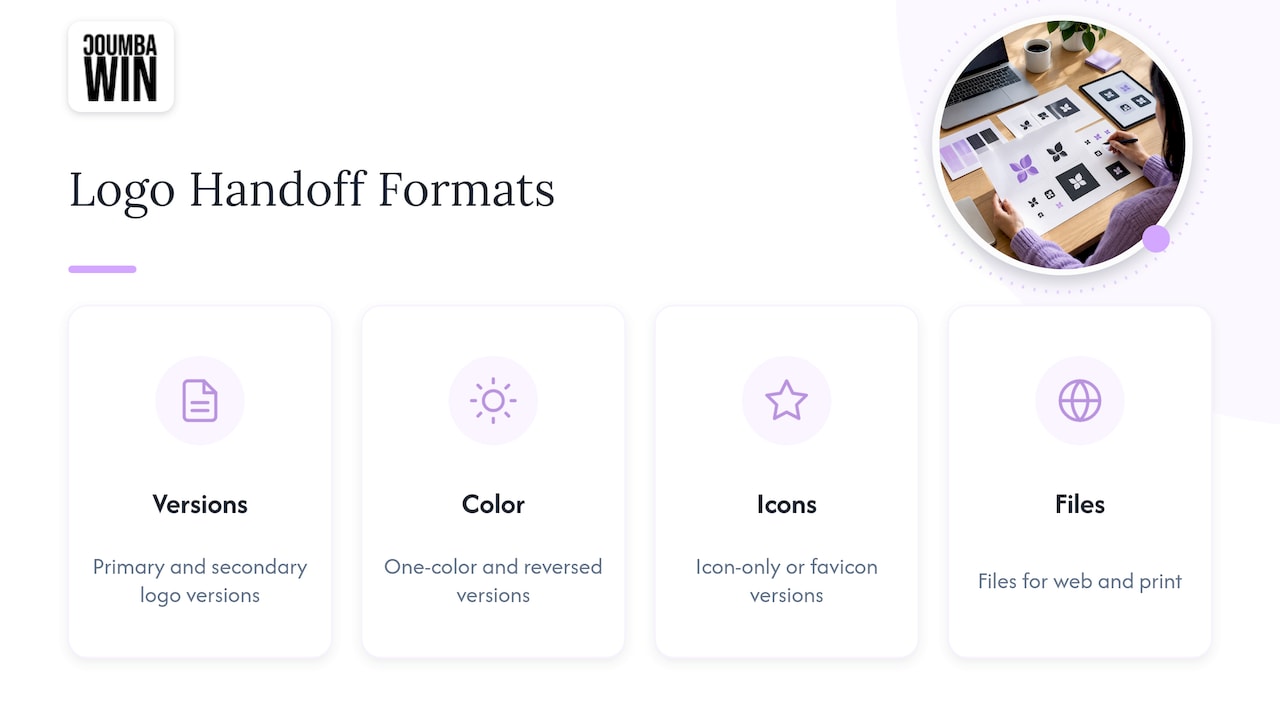
One PNG is not a logo system. A real handoff typically includes primary and secondary versions, one-color and reversed versions, icon-only or favicon versions, and files for web and print. More versions and more formats mean more production time.
5. Rights, revisions and rush
Revision rounds, ownership terms and timeline are all line items in disguise. Ask for a rush and you are asking someone to move other clients around. That costs.
Logo-only refresh vs. full rebrand: the biggest cost swing
This is the question that moves the budget more than any other. People say “logo redesign” when they mean three different things:
| What you’re asking for | What changes | What stays |
|---|---|---|
| Logo cleanup | Drawing quality, spacing, file set | Concept, colors, type, name |
| Brand refresh | Logo, color palette, typography, imagery style | Name, core positioning |
| Full rebrand | Strategy, name possibly, visual and verbal identity, often the website | Very little |
A cleanup is the lightest job. A refresh touches more of the system, so the price rises with it. A full rebrand includes strategy and rollout across every touchpoint, so it is a different category of project. We walk through how to choose in our post on brand refresh vs. a full rebrand.
Can you redesign a logo without changing the whole brand? Yes. If your name, positioning and audience are right but the mark looks dated, clunky or inconsistent, you can modernize the logo and keep the rest. The catch: a new logo sitting on an old, mismatched color and type system will look off. Plan at least a light pass on color and typography so the new mark has something to live with.
The flip side matters too. If the real problem is that customers misunderstand what you do, a prettier logo will not fix it. That is a positioning problem, and it belongs in a bigger scope.
What a logo redesign quote should include
Here is where a lot of founders lose money without noticing. Two quotes with the same total can cover wildly different work. Compare them line by line.
Guidance from a graphic design quote template guide says a professional quote should itemize the work (research, logo concepts, identity system, applications, brand guidelines and final artwork), give a timeline per phase, state the revisions included, define usage rights, and set payment terms and how long the quote is valid.
Here is a checklist you can paste into an email to any provider:
- Phases, itemized. Research, concepts, refinement, final files. If it is one lump sum with no phases, ask what is inside it.
- Number of concepts. Three directions? One? “A few” is not a number.
- Revision rounds, defined. A proposal guide from Cobrief recommends naming the number of concepts and revision rounds instead of vague wording like “includes revisions.” Also ask what counts as a round. WaffleInvoice’s guidance suggests treating a round as one consolidated set of feedback, with a stated hourly rate for anything extra.
- Final file formats. The same Cobrief guide names formats such as PNG, SVG and EPS. Ask for vector files and a version for light and dark backgrounds.
- Source files. WaffleInvoice notes that native source files may come in premium packages or be charged separately. Ask which applies to you before you sign.
- Usage rights and ownership. WaffleInvoice distinguishes full copyright transfer from unlimited licensing and from limited licensing by purpose, territory and duration. For a logo you plan to trademark and use for a decade, you generally want to own it outright. Get that in writing and, for anything high-stakes, have an attorney read the contract.
- Timeline per phase. Including what happens if feedback is late.
- Payment terms and validity. The ProposalForge guide describes half on acceptance and half on delivery as a common split, and 30 days as a common quote validity. Treat those as typical patterns, not rules.
Why the files and story matter more than founders expect
Once the logo exists, it has to show up everywhere: your site, your deck, your social posts, your swag. The mark is one piece of how people read your brand. If you want to see how the visual side builds into a bigger narrative, these visual storytelling tips are a good companion. And this is exactly why the file set in your quote matters: a missing icon version or reversed version means a scramble the first time you need one.
How to tell if a quote is fair
No one can hand you a universal “fair price,” because the scope differs so much. You can check fairness in other ways.
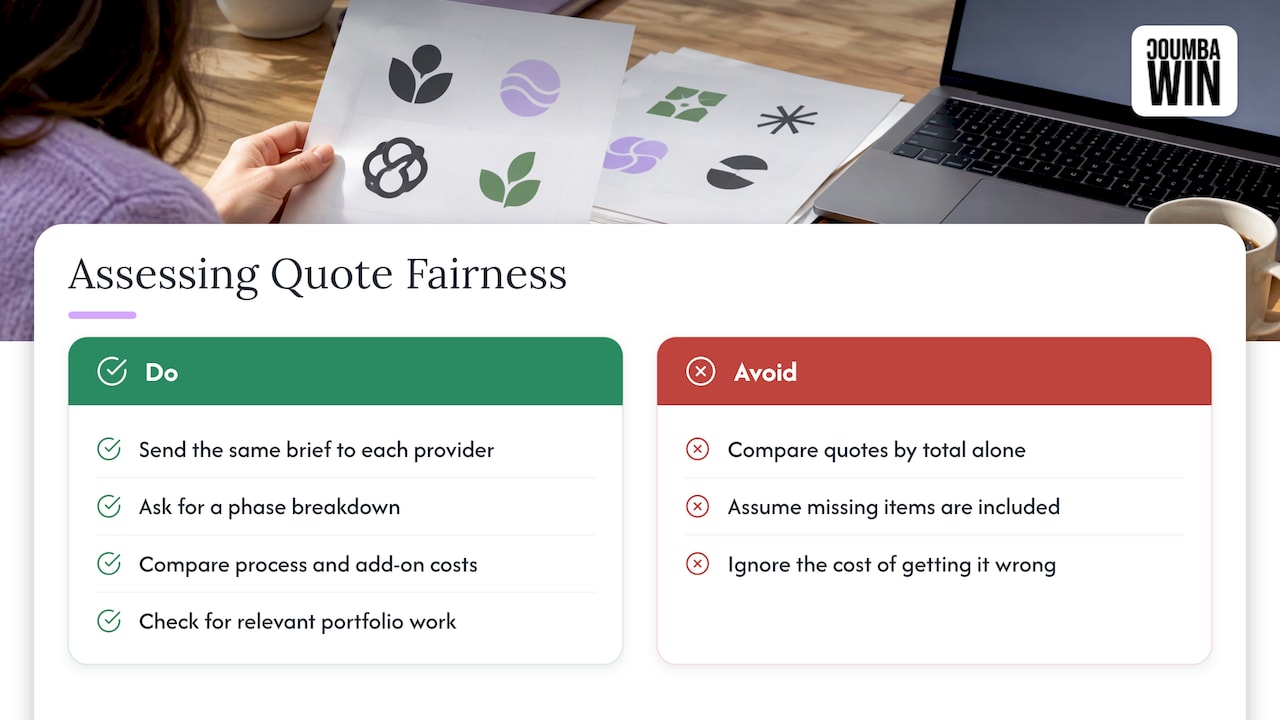
Match the quote to the scope. Write down what you need before you collect quotes: logo only, or logo plus colors, type and guidelines? Then send the same brief to every provider. Otherwise you are comparing apples to a fruit basket.
Look at the hours behind the number. Ask for a rough phase breakdown. If discovery, concepts, refinement and file prep are all there, the total makes sense. If the whole project is one line, ask why.
Compare the process, not just the total. A cheaper quote with one concept and one revision may cost more in the end than a higher quote with three directions and two rounds, once you pay for add-ons.
Check the portfolio for your situation. Has the designer solved a problem like yours? A pretty gallery of unrelated work is not evidence.
Watch for the missing line items. Source files, usage rights and a brand guide are the usual surprises. If they are absent, ask. Don’t assume.
Price the cost of getting it wrong. A logo you outgrow in a year means paying twice, plus reprinting, updating your site and redoing profiles. A slightly higher price for a logo that scales can be the cheaper path.
The hidden costs around a logo redesign
The design fee is rarely the whole bill. Plan for these:
- Website and app updates. Header, favicon, social images, email signatures, app icons.
- Print and physical items. Business cards, signage, packaging, merch. See our quick guide to print brand collateral for what to prioritize first.
- Decks and documents. Pitch deck, one-pagers, proposals.
- Legal. If you trademark your logo, filing and attorney costs sit outside the design fee.
- SEO and visibility. A logo change alone rarely hurts search, but renaming or changing your site structure can. If a name change is part of the plan, read our notes on keeping SEO and AI visibility through a rename.
- Your own time. Feedback rounds, stakeholder opinions, the “can we make it pop more” meeting. Time is money, even when it is not on the invoice.
A smart move is to gather references before the project starts. We use mood boards to align everyone early, and our post on building a branding mood board shows how many references to collect and how to cut them down. Aligned taste up front saves revision rounds later.
Retainer or project: which pricing model fits a redesign?
A logo redesign is usually a fixed-scope project. But many startups need design help after the logo ships: the site, the deck, ads, a launch kit. For that, an ongoing arrangement can make more sense than one-off quotes. If you are weighing a monthly arrangement against hourly work, our guide on converting design retainer quotes to hourly rates shows how to compare the two on equal terms.
Our perspective
We’ll be honest: the logo is the part everyone wants to talk about, and it’s rarely the part that makes or breaks a startup.
When founders come to us for a redesign, the best conversations start with “what is this logo supposed to do?” Win over investors? Look credible next to bigger competitors? Stop being mistaken for three other companies? Once that’s clear, the scope (and the price) gets clear too.
Here’s what we believe. A logo should be custom, and it should be built around your strategy, not dropped in from a template or generated in thirty seconds by an AI tool. We reject generic templates and AI-generated design on purpose, because a startup’s identity is one of the few things competitors can’t copy overnight. That is why we work closely with founders, not at arm’s length from them.
We also think a logo works best as part of a system. A mark that lines up with your site, your pitch deck and your Demo Day booth feels like a company that has its act together. A mark in isolation just feels like a drawing. So we scope redesigns around where the logo will actually live, and we say so in the quote.
Our advice: write down your goals, decide whether you need a cleanup, a refresh or a rebrand, and ask every provider the checklist questions above. A partner who welcomes those questions is a partner worth hiring.
Coumba Evelyn
Want a logo that works across your whole startup?
We’re a design partner for startups: custom branding, web design and development, UI/UX, pitch decks, print and graphic design, accessibility audits, SEO, email marketing and ad management. We don’t publish fixed prices, because the right scope depends on your goals, so the first step is a conversation about what you actually need.
If your logo needs a refresh and your site or deck needs to match, see everything we do on our main site, or look at our Webflow projects on our work page. If your site redesign is part of the plan, our piece on what a website redesign means for your business is a useful next read.
FAQ
How much does it cost to redesign a logo?
It depends on who does it and how much sits around the logo. DIY tools are the cheapest, freelancers cover a very wide range, and studios cost more because they add research, strategy and a full identity system. Get quotes against one written brief so you compare like with like.
Is a logo refresh cheaper than a full rebrand?
Usually, yes, because a refresh changes less. A cleanup of the existing mark is the lightest job, a brand refresh adds color, type and imagery, and a rebrand adds strategy and rollout across every touchpoint. Decide which one you need before you request quotes.
What should a logo redesign quote include?
At minimum: itemized phases, the number of concepts, defined revision rounds, final file formats, source-file terms, usage rights or ownership, a timeline, payment terms and how long the quote is valid. If any of these are missing, ask for them in writing.
Can I redesign my logo without changing my whole brand?
Yes. If your name and positioning still fit, you can update the mark and keep the rest. Plan a light pass on colors and typography too, so the new logo doesn’t clash with the old system around it.
How many revisions are normal?
Two to three rounds is common, according to invoicing guidance from WaffleInvoice. Make sure the quote defines what a round is and what extra rounds cost.