
Why UX Impacts Platform Retention for Startups
Why UX Impacts Platform Retention for Startups
User experience is the single most powerful driver of whether people stay on your platform or quietly disappear. Understanding why UX impacts platform retention is not optional for founders and product managers. It is the difference between a product that grows and one that hemorrhages users every month. Acquiring a new customer costs 5–7 times more than keeping an existing one, and consistent UX optimization can improve retention by up to 10.8% over three years. Those numbers should make every founder sit up straight.
Why UX impacts platform retention: the core mechanics
User experience, or UX, is the industry term for every interaction a person has with your product, from the first screen they see to the moment they decide to come back (or not). Retention is the percentage of users who return after their first visit. UX is the mechanism that connects those two outcomes.
Users do not consciously evaluate interface quality. They feel it. When a flow is confusing, they feel friction. When it is fast and clear, they feel confidence. That subconscious reaction is what drives the decision to return, not a rational checklist of features.

Here is the part that stings a little: 80% of companies believe they deliver a superior experience, but only 8% of users agree. That gap is enormous. It means most founders are operating on assumptions, not reality. Closing that experience gap is where retention gains actually live.
What UX factors most influence user retention?
Not all UX decisions carry equal weight when it comes to keeping users around. These are the factors that move the needle most:
- Onboarding experience. The path from signup to the first “aha moment” is the most fragile stretch of your user relationship. If users do not reach core value fast, they leave. Over 70% of users who abandon a product do so during onboarding because the product failed to show them why it matters quickly enough.
- Navigation clarity. If users cannot find a feature, that feature does not exist for them. Buried menus and unclear labels create frustration that compounds over time.
- Performance and speed. Speed is not a technical detail. It is a trust signal. Delays over 3 seconds cause nearly 53% of visitors to abandon a page entirely. That is not a bounce rate problem. That is a UX problem.
- Trust architecture. Trust is built through consistent, low-friction interactions over time. Navigation inconsistencies, broken states, and unexpected behaviors erode it fast.
- Feature discoverability. Users who find value in more parts of your product are harder to lose. Good UX surfaces the right features at the right moment.
Pro Tip: Map your user’s path from signup to their first meaningful action. Time it. If it takes more than two minutes, you have an onboarding problem that is costing you retention.
The role of UX in customer retention is not about making things pretty. It is about reducing the effort required to get value. Every extra click, every moment of confusion, every slow load is a small tax on your user’s patience. Eventually, they stop paying it.
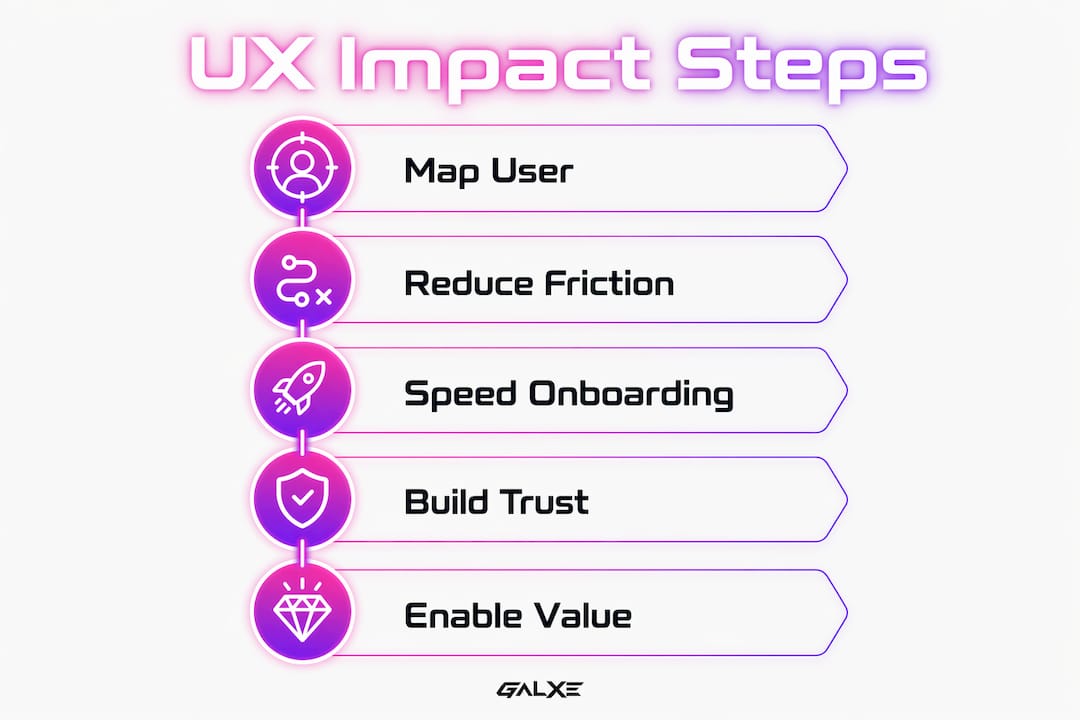
How UX friction causes churn: the pitfalls that push users out
Churn rarely announces itself. Users do not usually send a breakup email. They just stop showing up. Here is what drives them away:
- Cognitive overload from complex interfaces. When a screen asks users to process too much at once, they freeze or give up. High interaction cost is a silent churn driver that analytics rarely flag directly.
- Slow load times. Sub-second latency delays generate cognitive friction that degrades trust and causes long-term disengagement. Users associate slowness with unreliability, even when the underlying product is solid.
- Onboarding that skips the value moment. Showing users a feature tour is not the same as showing them why your product matters to their life. Onboarding that fails to connect quickly to core value is the leading cause of early abandonment.
- Buried or unclear navigation. When users cannot find what they came for, they assume it does not exist. They do not dig. They leave.
- Mismatched expectations. If your marketing promises one experience and your product delivers another, the trust damage is immediate and often permanent.
“Analytics alone show what users do, but not why they churn. Qualitative feedback reveals user intent and frustration, enabling targeted UX improvements that increase retention by 5–10%.”
That quote captures something most product teams miss. You can stare at a dashboard all day and still not know why users are leaving. The “why” lives in qualitative data, not click maps.
What measurable benefits do startups gain by prioritizing UX?
The financial case for UX investment is not abstract. It is direct and compounding.
Retention reduces your customer acquisition cost. When you keep more users, you spend less chasing replacements. That freed-up budget can go toward product improvement, which improves retention further. It is a flywheel, and UX is what keeps it spinning.
Lifetime value grows with retention. A user who stays for 12 months instead of 3 generates four times the revenue without any additional acquisition spend. That math changes the entire unit economics of a startup.
The experience gap is also a market opportunity. The disconnect between perceived and actual UX quality means most of your competitors are operating blind. Founders who invest in data-backed UX design capture users that competitors are losing. That is a real competitive advantage, not a talking point.
For startups thinking about digital retention strategies, UX improvements compound in ways that marketing spend simply cannot. A better onboarding flow keeps working for every new user, forever. A paid ad campaign stops the moment you stop paying.
Pro Tip: Run a retention cohort analysis by signup month. If early cohorts have significantly lower retention than recent ones, your UX improvements are working. If not, you have a signal that the product experience has not meaningfully changed.
The impact of UX on user satisfaction shows up most clearly in real-world case studies where design interventions directly moved retention metrics. Coumba Win Design has seen this pattern repeatedly with educational platforms: simplifying onboarding flows and improving navigation clarity produced measurable drops in early churn.
How to implement UX improvements that boost retention
Knowing UX matters is one thing. Knowing where to start is another. Here is a practical framework:
- Run qualitative feedback loops. Surveys at friction points prioritize UX fixes with the highest retention return. Ask users what confused them, not just whether they are satisfied.
- Design onboarding around the value moment. Identify the single action that makes users say “okay, I get it now.” Build your entire onboarding flow to reach that moment as fast as possible.
- Simplify navigation iteratively. Do not redesign everything at once. Remove one layer of complexity per sprint and measure the impact on engagement.
- Collaborate with engineering on performance. UX teams must work closely with engineering to minimize latency. A beautiful interface that loads slowly is still a retention liability.
- Build trust through consistency. Use a design system to keep visual and interaction patterns predictable. Inconsistency is a trust killer that users feel before they can name it.
Pro Tip: Do not wait for a major redesign to fix friction. Identify your top three drop-off points in your onboarding funnel and fix those first. Small, targeted changes often outperform full redesigns in retention impact.
Improving retention through UX is an ongoing practice, not a one-time project. The Coumba Win Design blog covers research-backed approaches to user testing and design iteration that help founders close the gap between what they think users experience and what users actually feel.
Key Takeaways
UX directly drives platform retention by reducing friction, building trust, and connecting users to core value faster than any marketing tactic can.
| Point | Details |
|---|---|
| Retention beats acquisition | Keeping a user costs 5–7 times less than acquiring a new one, making UX a direct financial lever. |
| Onboarding is the highest-risk moment | Over 70% of users who abandon a product leave during onboarding before reaching first value. |
| Speed is a trust signal | Load delays over 3 seconds cause nearly 53% of visitors to abandon, signaling unreliability. |
| Qualitative feedback closes the gap | Analytics show what users do; surveys at friction points reveal why they leave. |
| Consistency builds loyalty | A design system that keeps interactions predictable reduces churn caused by eroded trust. |
What I’ve learned about UX and retention that most founders miss
Founders often treat retention as a marketing problem. They run re-engagement campaigns, tweak their email sequences, and add new features. And then they wonder why the numbers barely move.
Here is what I have seen over and over: retention failures are almost always onboarding failures. Users do not leave because they forgot about you. They leave because they never fully arrived. They signed up, got confused or underwhelmed, and quietly moved on.
The other thing that surprises people is how much micro-friction matters. A button that is slightly hard to find. A form that resets on error. A loading spinner with no progress indicator. None of these feel like big deals in isolation. Together, they create a product that feels unreliable, even when the core functionality is excellent.
Qualitative feedback is the most underused tool in a product manager’s kit. Analytics tell you where users drop off. They do not tell you what the user was thinking in that moment. A well-placed survey question can unlock more retention insight than a month of A/B testing.
The startups that win on retention are not always the ones with the most features. They are the ones that made their core value undeniably easy to reach and trust.
— Coumba Evelyn
How Coumba Win Design helps startups build for retention
Coumba Win Design works with founders who know that design is not decoration. It is the mechanism that turns signups into loyal users.
If you are building a platform and watching your retention numbers stall, the answer is rarely more features. It is a cleaner onboarding flow, a faster experience, and a design system that makes every interaction feel reliable. The Style Guide gives your team the design foundations to build consistent, trust-building interfaces without starting from scratch every sprint. The Demo Day Kit helps you move fast when time is short. Both are built for founders who treat design as a growth lever, not an afterthought.
FAQ
Why does UX affect user retention so directly?
UX determines how easy it is for users to reach value on your platform. When the experience is frictionless and fast, users return. When it is confusing or slow, they do not.
What is the biggest UX mistake that causes early churn?
Failing to connect users to core value during onboarding is the leading cause of early abandonment. Over 70% of users who leave a product do so before completing onboarding.
How does page speed relate to retention?
Load delays over 3 seconds cause nearly 53% of visitors to abandon a page. Users associate slowness with unreliability, which erodes trust and reduces the likelihood of return visits.
How can product managers identify UX-driven churn?
Combine funnel analytics with qualitative surveys placed at key drop-off points. Analytics show where users leave; surveys reveal why, which is the data you need to fix the right problems.
How long does it take to see retention gains from UX improvements?
Targeted fixes to onboarding and navigation can show measurable retention improvements within one to two product cycles. Sustained UX optimization compounds those gains over time.