What Is User Experience Design? A Practical Guide

What Is User Experience Design? A Practical Guide
Most people think UX design means making things look pretty. That’s like saying architecture is just about paint colors. What is user experience design, really? It’s the practice of shaping every moment a person has with your product, from the first confused click to the satisfying “I did it!” at the end. UX design encompasses usability, usefulness, desirability, and emotional response, not just what things look like. If your product frustrates users, it doesn’t matter how gorgeous the interface is. They’ll leave.
Table of Contents
Key Takeaways
| Point | Details |
|---|---|
| UX is broader than UI | UX covers the full user journey and emotional experience, while UI focuses on visual interface elements. |
| Principles drive good design | User-centered thinking, iteration, and evidence-based decisions are the foundation of effective UX work. |
| Process matters as much as output | Research, prototyping, and usability testing are not optional steps; they’re what separates good UX from guesswork. |
| Real UX has measurable impact | Thoughtful UX design directly improves retention, trust, satisfaction, and business outcomes. |
| Edge cases reveal UX quality | How a product handles errors, onboarding, and accessibility tells you more about its UX than the happy path ever will. |
What is user experience design, exactly?
Let’s get the user experience definition locked in before we go anywhere else. UX design is the discipline of understanding what users need, how they think, and what frustrates them, then designing products and services that actually work for real humans in real situations. IBM describes UX as covering ease of use, accessibility, visual design, interface functions, and emotional impact, all aimed at meeting user expectations through navigation, responsiveness, and efficiency.
That’s a lot of ground. And that’s kind of the point.
UX vs. UI: the comparison everyone needs
Here’s where things get confusing for most teams. UI design (user interface design) is about the visual and interactive elements you can see and touch: buttons, typography, color palettes, screen layouts. It’s important work. But it’s one layer of a much bigger picture.
UX covers the entire user interaction and perception, including how a user feels about the experience, whether they accomplished their goal, and whether they’d come back. Think of UI as the instrument panel in a car and UX as the whole driving experience, including the traffic, the road quality, and whether you actually got where you were going.
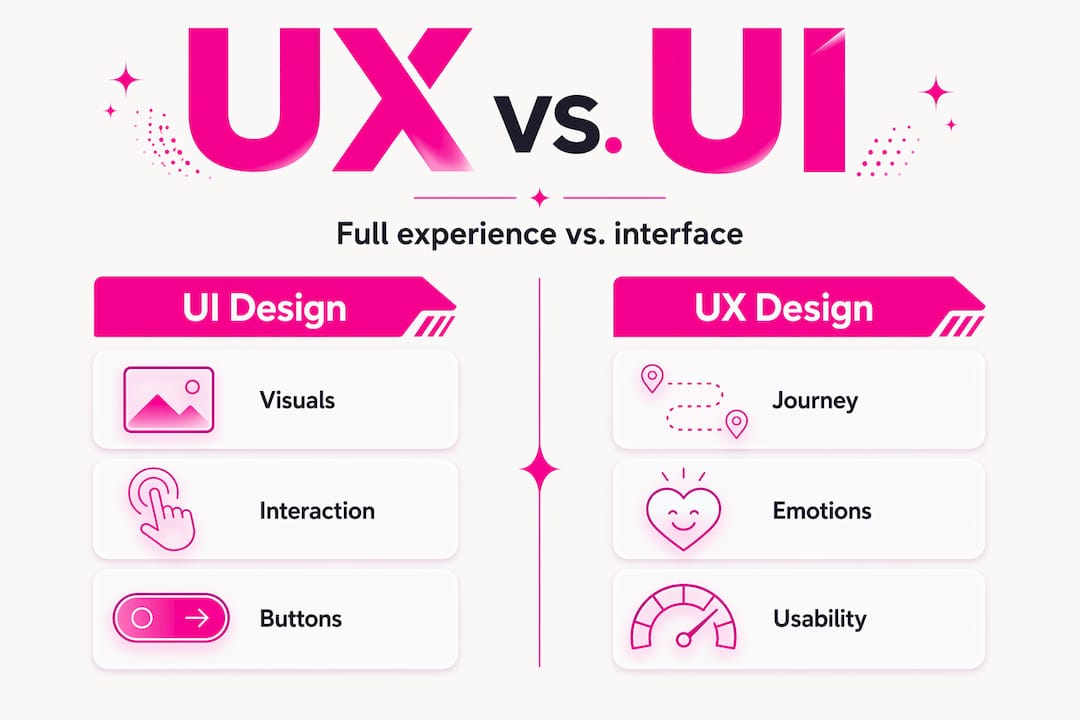
Here’s a quick comparison to make it stick:
| Dimension | UI Design | UX Design |
|---|---|---|
| Focus | Visual elements and interactions | Full user journey and satisfaction |
| Output | Screens, components, style guides | Research, flows, prototypes, strategies |
| Question it answers | “Does it look right?” | “Does it work for the user?” |
| Scope | Interface layer | End-to-end experience |
| Success metric | Visual consistency | User satisfaction and task completion |
The importance of user experience goes beyond aesthetics because a beautiful app that confuses users is still a bad product. UI without UX is decoration. UX without UI is invisible. You need both, but you have to understand they’re not the same thing.
Core principles of UX design
The principles of UX design aren’t a mystery, but they do require discipline to follow. Here’s what actually drives effective UX work:
-
User-centered thinking. Every decision starts with real user needs, not assumptions. ISO 9241-210 emphasizes understanding users, tasks, and environments as the foundation of any human-centered design process. This means doing the research before you start sketching solutions.
-
Iterative design. UX is not a one-and-done project. UX design is evidence-driven and iterative, cycling through research, prototyping, testing, and refinement until the product actually works for people. Think of it as a loop, not a line.
-
The five elements framework. Jesse James Garrett’s classic model breaks UX into five layers: strategy (user needs and product goals), scope (features and content requirements), structure (information architecture and interaction design), skeleton (interface and navigation layout), and surface (visual design). Each layer informs the next.
-
Accessibility and inclusion. Good UX works for people with disabilities, older users, people on slow internet connections, and users in noisy environments. If it only works perfectly in ideal conditions, it’s not actually good UX.
-
Designing for failure states. Designing for the whole experience means planning for error messages, onboarding confusion, accessibility edge cases, and what happens when things go wrong, not just the happy path where everything works perfectly.
Pro Tip: When reviewing your product’s UX, spend more time on the failure states than the happy path. How your product handles a wrong password, a slow connection, or a confused first-time user reveals more about your UX quality than a perfect checkout flow ever will.
The importance of user experience really shows up in these principles because they force you to think about real people in real situations, not idealized users in a vacuum.
How UX design actually works in practice
So what does the what is UX design process actually look like when a team sits down to do it? It’s messier and more iterative than most diagrams suggest, but it follows a recognizable pattern.
Research comes first. Before wireframes, before color palettes, before anything. Research methods include:
-
User interviews and surveys to understand goals, frustrations, and mental models
-
Field studies and contextual inquiry to see how people use products in their actual environments (not a lab)
-
Analytics review to find where users drop off or get stuck
-
Competitive analysis to understand what users already expect from similar products
ISO 9241-210’s context-of-use approach shifts evaluation from controlled lab settings to real-world scenarios involving different devices, environments, and interruptions. That shift matters enormously for test relevance.
Then comes structure and prototyping. Information architecture defines how content is organized and labeled. Wireframes sketch the layout without visual distraction. Prototypes make it interactive enough to test. None of these are precious documents; they’re tools for learning.

Then testing. Then iteration. Usability testing with real users uncovers problems that no amount of internal review will catch. You watch someone try to use your product, resist the urge to explain it to them, and take notes on where they get stuck. Then you fix it. Then you test again.
Pro Tip: If you’re a small team and can only do one UX research method, make it a five-person usability test. Five users will surface roughly 85% of your major usability problems, and watching real people struggle with your product is more persuasive to stakeholders than any report.
Common pitfalls teams hit along the way: skipping research because they “already know their users,” treating the first prototype as the final design, and confusing conversion rate optimization with UX improvement. True UX is problem-solving tied to user needs, not decoration or persuasion tactics. The best practices for UX design always circle back to one thing: validate your assumptions with real users before you ship.
You can explore design component systems as a practical way to build consistency into your UX workflow from the start.
Real-world UX design examples and their impact
Theory is great. Examples are better. Let’s talk about what good UX actually looks like in the wild.
Netflix’s “Skip Intro” button is one of the most cited user experience design examples for a reason. It solved a genuine user pain point by giving viewers control over something that was quietly annoying millions of people every single day. Nobody asked for it out loud. A good UX team noticed the behavior (people frantically clicking forward) and designed a solution. That’s UX thinking.
Google’s search autocomplete. Airbnb’s booking flow. The way your iPhone tells you exactly why Face ID failed instead of just showing an error. These aren’t accidents. They’re the result of teams obsessing over how to improve user experience at every touchpoint.
Effective UX design improves user satisfaction, loyalty, and business outcomes in ways that are genuinely measurable. Lower support ticket volume. Higher retention rates. Better conversion. Users who actually recommend the product to friends.
UX spans three levels of experience: the single interaction (did this button work?), the multi-step journey (did I complete my goal?), and the long-term relationship with a brand (do I trust this company?). Great UX operates at all three levels simultaneously.
“Experience design is fundamentally human-centered problem solving. Framing UX in terms of interaction, journey, and relationship helps teams communicate its scope beyond interfaces.” — Nielsen Norman Group
It’s worth distinguishing UX from customer experience (CX) here. CX covers every touchpoint a customer has with a company, including sales calls, packaging, and customer service. UX is specifically about the designed product or service experience. They overlap, they inform each other, but they’re not identical. A product with great UX can still have terrible CX if the support team is unhelpful.
My honest take on where teams go wrong with UX
I’ve watched a lot of teams approach UX like it’s a feature you add at the end, like a coat of paint on a finished house. And honestly? I get it. When you’re moving fast and shipping things, stopping to do user research feels like a luxury. It feels like something bigger companies do.
But here’s what I’ve learned after working with startups on design: the teams that skip UX research don’t save time. They spend that time later fixing things that confused users, rewriting onboarding flows, and wondering why their retention numbers are flat. The research phase isn’t overhead. It’s insurance.
I’ve also seen the opposite problem: teams that treat UX as a purely visual discipline and hand it off to whoever is “good at design.” UX is an evidence-based discipline, not a talent show. The best UX practitioners I know are obsessive about context, deeply curious about failure states, and genuinely comfortable saying “I don’t know, let’s test it.”
The other thing I’d push back on: the idea that UX is only for consumer apps. B2B software, internal tools, educational platforms, healthcare portals. These products often have the worst UX of anything out there, and the users of those products suffer for it every single day. Understanding users, tasks, and contexts is not a consumer-product luxury. It’s a basic requirement for any product that real humans have to use.
My advice for teams just starting out: pick one user flow, watch five real users try to complete it, and fix the three things that made you cringe. That’s your UX program. Start there.
— Coumba
Ready to build UX that actually works?
Understanding UX principles is step one. Applying them consistently across your product is where most teams need a real partner.
At Coumbawin, we work with startups and founders who know design is a competitive advantage, not an afterthought. From design systems and style guides that keep your product consistent at scale, to full product design partnerships that put user research at the center of every decision, we build UX that moves the needle. If you’re building something and want to get the experience right from the start, explore what Coumbawin does and let’s talk about what your users actually need.
FAQ
What is the user experience definition in simple terms?
User experience is the sum of everything a person thinks, feels, and does while interacting with a product or service. It includes usability, emotional response, accessibility, and whether users actually accomplish their goals.
What is the difference between user interface vs user experience?
UI design focuses on the visual and interactive elements of a product, like buttons, layouts, and typography. UX design covers the full experience a user has, including their feelings, their journey, and whether the product solved their problem.
Why does the importance of user experience matter for business?
Good UX directly improves user retention, satisfaction, and trust, which translate into measurable business outcomes like lower churn, higher conversion rates, and more referrals. Bad UX costs money in support, fixes, and lost users.
What are the core principles of UX design?
The core principles include user-centered research, iterative design, information architecture, accessibility, and designing for failure states. Every principle connects back to understanding real users in real contexts.
What does the UX design process look like in practice?
The UX design process typically moves through user research, information architecture, wireframing, prototyping, usability testing, and iteration. It’s a continuous loop, not a linear sequence with a definitive end point.
Recommended