User Dignity in UX Design: A 2026 Practitioner Guide

User Dignity in UX Design: A 2026 Practitioner Guide
User dignity in UX design is defined as the practice of respecting user autonomy, providing transparent interactions, and enabling error recovery at every touchpoint in a digital product. This isn’t just a feel-good philosophy. The role of user dignity in UX design has real legal and financial teeth: Epic Games paid a $520 million settlement for deploying manipulative dark patterns that violated user trust. Frameworks like the Digital Dignity Charter and thought leaders at the Interaction Design Foundation now treat dignity as a non-negotiable pillar of human-centered design. If you’re a UX designer, product manager, or developer, this guide gives you the principles, strategies, and practical tools to build products that actually respect the people using them.
What is the role of user dignity in UX design?
Dignity-first UX design is built on three core pillars: autonomy, transparency, and recovery. These aren’t abstract ideals. They are the structural difference between a product that earns loyalty and one that quietly bleeds users.
Autonomy means users make informed choices without manipulation. This rules out dark patterns like pre-checked consent boxes, hidden unsubscribe flows, and countdown timers that manufacture fake urgency. When a product respects autonomy, users feel in control. That feeling is the foundation of trust.

Transparency means users understand what a system is doing and why. Clear data usage disclosures, honest system feedback, and plain-language privacy notices all fall here. Opacity is a dignity violation. If your users can’t tell what your product is doing with their data, you’ve already broken the contract.
Recovery means users can undo mistakes without punishment. Recoverable mistakes and non-punitive error flows are not just good usability. They signal respect. A product that traps users in irreversible states treats them as targets, not people.
-
Audit every critical flow for autonomy violations: forced continuity, confirm shaming, and misleading opt-outs
-
Check all system messages for transparency: does the user know what just happened and why?
-
Test recovery paths under stress: can a distracted, tired user undo an accidental action in under three steps?
Pro Tip: Run your most important user flows through what the UX Magazine ethics team calls a “dignity stress test.” Ask: would this flow feel fair to a user who is exhausted, grieving, or using a slow device? If the answer is no, redesign before you ship.
How does prioritizing user dignity impact business outcomes?
Ignoring user dignity is not just an ethics problem. It is a financial and legal liability that compounds over time. The Epic Games case is the most visible example, but the FTC has ongoing litigation against multiple major companies for manipulative dark patterns that exploit user confusion and emotional vulnerability.
The concept of “trust debt” explains the long-term cost clearly. Trust debt accrues when dignity is sacrificed for short-term conversion gains. Every dark pattern, every hidden opt-out, every confirm-shame button adds to a balance that eventually gets called in through churn, negative reviews, and regulatory action. Short-term conversion lifts from manipulative design rarely survive the reputational damage that follows.
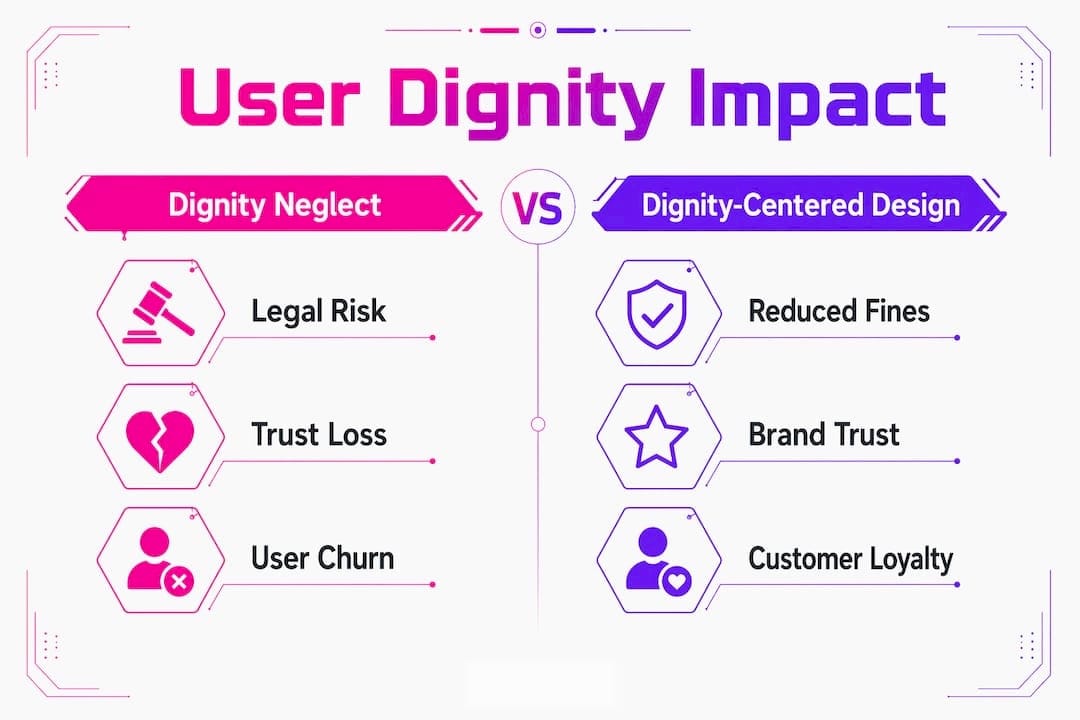
| Dignity Neglect | Dignity-Centered Design |
|---|---|
| FTC litigation and regulatory fines | Reduced legal exposure and compliance confidence |
| Trust debt and brand loyalty erosion | Long-term user retention and word-of-mouth growth |
| High churn from user frustration | Lower churn through genuine satisfaction |
| Negative press from dark pattern exposure | Positive brand perception and ethical reputation |
| ESG/DSG investor scrutiny | Alignment with emerging ethical investment criteria |
The business case for dignity is not soft. Investors increasingly screen for ESG and digital social governance (DSG) criteria, and products with documented ethical design practices carry lower risk profiles. Dignity-centered design transforms users from conversion targets into partners, and that shift shows up in retention metrics, NPS scores, and lifetime value.
What practical design strategies enhance user dignity?
The dignity audit is your most practical tool. A dignity audit assesses whether a design remains fair, legible, and humane under stress, exhaustion, or duress. You run it like a usability test, but you specifically simulate imperfect conditions: slow connections, emotional distress, cognitive load from multitasking.
Designing for the imperfect user is the mindset shift that makes dignity practical. Real-world users are distracted, tired, and sometimes using a cracked phone screen with one bar of signal. Your interface must accommodate that reality. Undo paths, clear confirmation steps, and forgiving error states are not edge case features. They are core design requirements.
Here’s what to actively avoid in your flows:
-
Confirm shaming: Opt-out language like “No thanks, I hate saving money” manipulates through emotional guilt. Neutral, objective language preserves agency and long-term trust.
-
Misleading urgency: Countdown timers and “only 2 left” notices that aren’t real exploit anxiety. They work once and destroy trust permanently.
-
Hidden opt-outs: Burying unsubscribe or cancel flows behind multiple screens is a dignity violation and increasingly a legal one.
-
Punitive error states: Error messages that shame users (“You entered this wrong AGAIN”) create anxiety and erode confidence in the product.
Healthy friction is the counterintuitive tool most teams underuse. Intentional confirmation steps protect users from impulsive or coerced decisions. A “Are you sure you want to delete this?” dialog is not friction for friction’s sake. It is a dignity feature that gives users a moment to reflect.
Pro Tip: Review every button label and opt-out message in your product for neutral language. Replace any phrasing that uses guilt, fear, or social pressure to influence a choice. The ethical UI principles framework recommends treating every micro-copy decision as a trust signal.
How does user dignity connect to inclusivity and ethical personalization?
Emotional accessibility is where dignity and inclusivity intersect most directly. Emotional accessibility means designing products that integrate assistive tools without stigma or clinical appearance. A screen reader that announces itself loudly, or a cognitive aid that looks like a medical device, signals to users that they are “other.” Dignified design makes these tools invisible and unobtrusive.
The risk of over-personalization is one of the least-discussed dignity issues in product design. Over-personalization that aggressively filters content can erode autonomy and replace genuine user curiosity with passive algorithmic compliance. When a recommendation engine only shows users what it predicts they want, it quietly narrows their world. That is a dignity problem dressed up as a feature.
| Ethical Personalization | Personalization to Avoid |
|---|---|
| Offer personalization as an opt-in with clear explanation | Pre-enable all personalization without user consent |
| Show users what data drives their recommendations | Hide algorithmic logic behind “magic” |
| Provide easy controls to adjust or reset preferences | Make preference changes difficult or buried |
| Maintain content diversity beyond predicted preferences | Filter all content to a narrow predicted profile |
| Allow users to see and delete their behavioral data | Retain behavioral data indefinitely without disclosure |
Belonging and emotional safety are design outcomes, not just accessibility checkboxes. When your UI components reflect diverse users, use inclusive language, and avoid stigmatizing flows, you signal that everyone is welcome. That signal builds the kind of loyalty that no conversion optimization trick can replicate. The UX usability research community consistently finds that users who feel seen and respected engage more deeply and stay longer.
Key takeaways
Dignity-first UX design requires autonomy, transparency, and recovery as structural foundations, not optional enhancements, because neglecting them creates measurable legal, financial, and trust costs.
| Point | Details |
|---|---|
| Three core pillars | Autonomy, transparency, and recovery define dignity-first UX and must be present in every critical flow. |
| Legal and financial risk | Dark patterns have triggered a $520M settlement and ongoing FTC actions, making dignity a compliance issue. |
| Trust debt is real | Sacrificing dignity for short-term conversions erodes brand loyalty and increases user churn over time. |
| Dignity audits work | Regularly testing flows under stress conditions reveals dignity failures before they reach users. |
| Inclusivity requires emotional accessibility | Assistive tools must integrate without stigma, and personalization must preserve user autonomy and curiosity. |
Why i think dignity is the design principle most teams are still faking
Here’s my honest observation after years of working with startups on product design: most teams say they care about user dignity, and then they ship a cancellation flow that requires six clicks and a phone call. The gap between stated values and actual design decisions is where trust goes to die.
The hardest part of embedding dignity into a product is not the design work itself. The hard part is convincing stakeholders that a slightly lower short-term conversion rate is worth the long-term loyalty gain. I’ve had that conversation more times than I can count, and the teams that get it right are the ones who frame dignity as risk management, not idealism.
Regulatory pressure is making this easier to argue. The Epic Games settlement and the FTC’s increasing appetite for dark pattern enforcement give designers a concrete business case that goes beyond ethics. When you can say “this pattern could cost us eight figures,” the conversation changes fast.
My practical advice: start with a dignity audit on your three highest-traffic flows. You will find something that surprises you. Then fix it, document the change, and measure the impact on trust signals like NPS and support ticket volume. That data becomes your internal case study for why dignity is not a nice-to-have. It is your product’s long-term survival strategy.
— Coumba Evelyn
Build dignity into your product from the start
If this article made you realize your product has some dignity debt to pay off (no judgment, we’ve all been there), the good news is you don’t have to figure it out alone.
Coumba Win Design builds products where respect for users is baked into every component and style decision, not bolted on after launch. Our style guide resources give your team a consistent foundation for ethical, transparent, and inclusive design. From micro-copy standards to accessible component patterns, we make it faster to ship products that users actually trust. Ready to see what dignity-centered design looks like in practice? Explore Coumba Win Design and let’s build something worth using.
FAQ
What is user dignity in UX design?
User dignity in UX design is defined as respecting user autonomy, providing transparent interactions, and enabling error recovery throughout a digital product. It is the ethical foundation of human-centered design practice.
What are dark patterns and why do they violate user dignity?
Dark patterns are manipulative interface techniques like confirm shaming, hidden opt-outs, and fake urgency that exploit user psychology to drive conversions. They violate dignity by removing informed choice and coercing behavior through deception.
How do i run a dignity audit on my product?
A dignity audit assesses whether your design remains fair, legible, and humane when users are stressed, distracted, or fatigued. Test your most critical flows under simulated imperfect conditions and check for punitive error states, manipulative language, and irreversible actions.
What is trust debt in UX design?
Trust debt is the cumulative damage to brand loyalty and user retention that results from repeatedly sacrificing user dignity for short-term conversion gains. It compounds over time and typically surfaces as increased churn and negative sentiment.
How does over-personalization harm user dignity?
Over-personalization that aggressively filters content based on predicted preferences can erode user autonomy and replace genuine curiosity with passive compliance. Dignified personalization gives users transparent controls and maintains content diversity beyond algorithmic predictions.
Recommended