
What Is Interaction Design? A Guide for Designers

What Is Interaction Design? A Guide for Designers
Interaction design (IxD) is defined as the practice of designing how users interact with digital products to help them achieve their goals effectively. It focuses on behavior, flow, and the quality of every interactive moment, not just how a product looks. Think of it as the difference between a door that clearly shows you where to push versus one that leaves you yanking the wrong side like a confused golden retriever. IxD sits within the broader user experience (UX) discipline, and Figma describes it as turning user behaviors and needs into practical design solutions for efficiency and satisfaction.
What is interaction design built on? Core principles and models
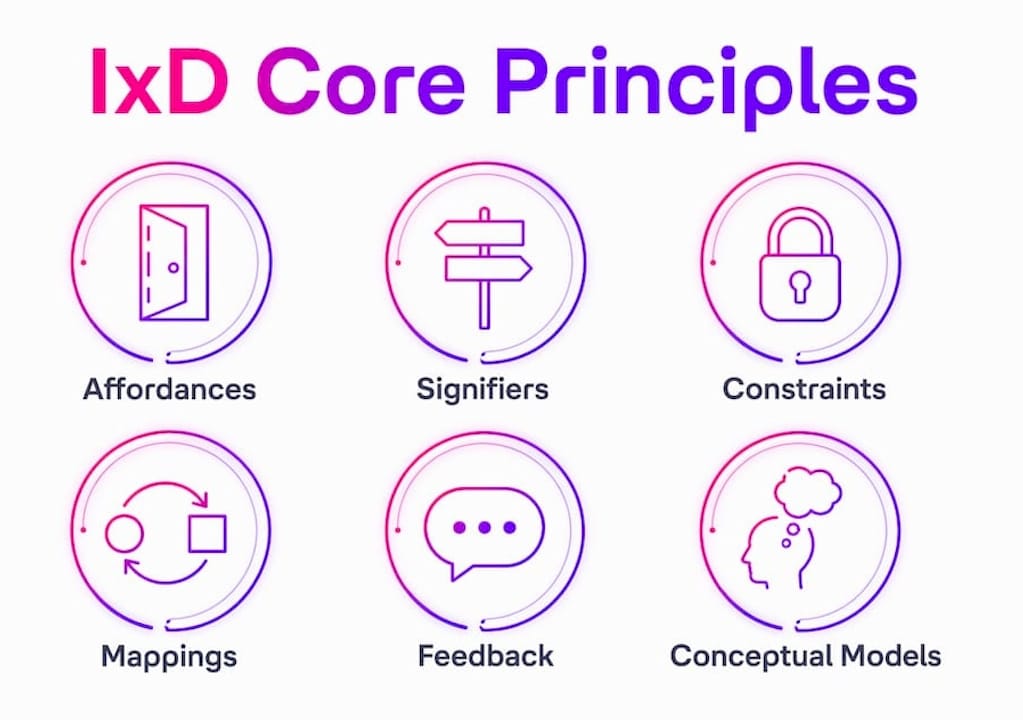
Two frameworks define how interaction designers think: Don Norman’s six principles and the five dimensions model. Together, they give you a vocabulary for designing products that feel obvious to use.
Don Norman’s six principles are affordances, signifiers, constraints, mappings, feedback, and conceptual models. These principles reduce user confusion by aligning what an interface can do with what users expect it to do. A button that looks pressable (affordance) with a label that says “Submit” (signifier) is a textbook example of Norman’s thinking in action. When a form shakes and turns red after a wrong password (feedback plus conceptual model), users instantly understand what went wrong without reading a manual.

The five dimensions model expands interaction design beyond screens. Each dimension represents a distinct aspect of interaction: words (labels, instructions), visuals (icons, typography), physical objects and space (device, environment), time (animations, transitions), and behavior (how the product responds to input). A designer who only thinks about visuals is missing four other dimensions that shape whether a product feels good to use.
| Framework | Components | Primary Purpose |
|---|---|---|
| Don Norman’s principles | Affordances, signifiers, constraints, mappings, feedback, conceptual models | Reduce confusion, align expectations |
| Five dimensions model | Words, visuals, physical objects/space, time, behavior | Cover all interaction aspects holistically |
Pro Tip: When auditing an existing product, run through all five dimensions one by one. You will almost always find that “time” (animations and transitions) and “behavior” (error states, loading feedback) are the most neglected.
How does interaction design differ from UX and UI design?
This is the question that trips up a lot of designers, so let’s get specific. UX design covers the entire end-to-end user journey, from awareness through task completion to long-term satisfaction. UI design handles the visual and layout layer: color, typography, spacing, and component styling. Interaction design zooms in on key touchpoints like clicks, taps, and transitions, defining how the product responds at each of those moments.
A useful mental model: UX is the city, IxD is the traffic system, and UI is the road markings and signage. You need all three, but they do different jobs. IxD is often nested inside UX, which is why many job descriptions blur the two. The real distinction is that IxD focuses on behavior and responses, not on the overall journey or the visual polish.
Here is where the three disciplines diverge in practice:
-
UX design maps user flows, conducts research, and defines the overall product experience from start to finish.
-
UI design creates the visual system: buttons, grids, color palettes, and component libraries.
-
Interaction design specifies what happens when a user taps a button, how an error message appears, how a menu opens, and how long a transition takes.
A product can have beautiful UI and solid UX strategy but still feel clunky if the interaction layer is ignored. That clunkiness is an IxD failure, not a visual one.
What are practical examples of interaction design in action?
Interaction design shows up in every digital product you use, usually in the moments you barely notice. That is actually the goal. When a mobile app’s delete button asks “Are you sure?” before wiping your data, that confirmation dialog is an IxD decision. When a progress bar fills during a file upload, that feedback loop is IxD. When a form auto-advances to the next field after you fill in a zip code, that behavior is IxD.
Common interaction design deliverables and touchpoints include:
-
Feedback states: Loading spinners, success messages, error alerts, and disabled button states.
-
Navigation flows: How users move between screens, including back navigation and breadcrumbs.
-
Gesture interactions: Swipe to delete, pinch to zoom, pull to refresh on mobile.
-
Transition animations: Screen fades, slide-ins, and micro-animations that signal state changes.
-
Error recovery paths: Clear instructions that help users fix mistakes without starting over.
Usability testing sessions for interaction design typically use scenario-based tasks and think-aloud protocols to catch problems. A tester narrates their thinking while completing a task, which reveals where the product’s behavior mismatches their mental model. These sessions run about one hour and surface issues that no amount of internal review will catch.
| Interaction type | Example | User outcome |
|---|---|---|
| Feedback state | Form validation error in red | User corrects input immediately |
| Gesture interaction | Swipe to archive email | Faster task completion |
| Transition animation | Slide-in menu | Spatial orientation maintained |
| Error recovery | Inline “forgot password” link | Reduced drop-off at login |
Pro Tip: Test your interactive components with real users before launch. Internal teams are too familiar with the product to notice the friction that stops new users cold.
Why does interaction design matter for digital products?
Proper interaction design improves usability, lowers error rates, builds user confidence, and creates experiences that feel satisfying rather than frustrating. These are not soft benefits. They directly affect whether users complete tasks, return to a product, and recommend it to others.
The benefits stack up fast when you get IxD right:
-
Fewer errors: Clear constraints and feedback prevent users from making wrong moves.
-
Faster task completion: Logical mappings and predictable responses reduce cognitive load.
-
Higher confidence: Users who understand how a product responds feel in control.
-
Better accessibility: Thoughtful interaction patterns support users with motor or cognitive differences.
-
Emotional satisfaction: Interactions that feel smooth and responsive create positive associations with the product.
“Interaction design is much more than UI aesthetics. It deals with behavior, flow, and how users interact at every touchpoint.” — UXPin
The most common misconception is that IxD is just “making things look nice.” Visual polish is UI’s job. IxD’s job is making sure the product reacts to user input in ways that feel logical, predictable, and forgiving. A product that looks stunning but responds unpredictably will lose users faster than one that looks plain but works exactly as expected.
Key Takeaways
Interaction design is the discipline that determines how a digital product behaves in response to user input, and getting it right is what separates products users love from products they abandon.
| Point | Details |
|---|---|
| Core definition | IxD designs product behavior and responses, not just visual appearance. |
| Two key frameworks | Don Norman’s six principles and the five dimensions model guide effective IxD practice. |
| IxD vs. UX vs. UI | UX covers the full journey, UI handles visuals, IxD owns the behavior layer. |
| Testing is non-negotiable | Think-aloud usability sessions reveal mental model mismatches that internal review misses. |
| Business impact | Good IxD reduces errors, speeds task completion, and builds user confidence. |
My honest take on where interaction design goes wrong
I have seen a lot of digital products where the visual design is genuinely gorgeous and the interaction layer is a complete afterthought. Founders and teams pour budget into brand identity and UI polish, then ship a product where the error states are broken, the loading feedback is missing, and the navigation makes zero spatial sense. That is an IxD problem, and it costs real users.
The pitfall I see most often is teams treating interaction design as a finishing step rather than a foundational one. You cannot bolt on good behavior after the fact. IxD decisions need to happen alongside UX research and before UI execution, not after. The digital strategy has to account for interaction quality from day one.
Aspiring interaction designers often ask me whether to learn the principles first or just start building. My answer: learn Don Norman’s six principles until they are second nature, then build constantly. The principles give you a framework for diagnosing why something feels wrong. Without them, you are just guessing. With them, you can look at a broken interaction and name exactly which principle it violates.
Voice interfaces and gesture-based interactions are raising the stakes for IxD right now. When there is no screen to fall back on, behavior and feedback are everything. The designers who understand the five dimensions model, especially time and behavior, are the ones who will handle those challenges well.
— Coumba Evelyn
How Coumba Win Design approaches interaction design
Building products that behave well is harder than it looks, and most teams find out the hard way after launch. Coumba Win Design works with startups to get the interaction layer right from the start, not as a patch job after users start dropping off.
The style guide system at Coumba Win Design documents interaction states, feedback patterns, and behavior rules alongside visual components, so your whole team ships consistent, predictable experiences. From button states to error recovery flows, every interaction gets defined before a single line of code is written. If you want to see what that looks like in practice, explore the work Coumba Win Design has done for startups building fast.
FAQ
What is interaction design in simple terms?
Interaction design is the practice of defining how a digital product responds to user actions like clicks, taps, and swipes. The goal is to make those responses feel logical, predictable, and satisfying.
What does an interaction designer actually do?
An interaction designer specifies product behavior: what happens when a user taps a button, how errors are communicated, how screens transition, and how feedback is delivered. They work between UX researchers and UI designers.
How does interaction design relate to UX design?
IxD sits inside UX as a focused discipline. UX covers the full user experience from start to finish, while interaction design zooms in on the specific moments where users and the product exchange input and response.
What are the five dimensions of interaction design?
The five dimensions are words, visuals, physical objects and space, time, and behavior. They prompt designers to consider every aspect of an interaction, not just what appears on screen.
How do you test interaction design quality?
Usability testing with think-aloud protocols is the standard method. Users complete scenario-based tasks while narrating their thinking, which reveals where product behavior mismatches user expectations.
Recommended