What Is a Brand Audit? A Practical Definition and Action Plan

What Is a Brand Audit? A Practical Definition and Action Plan
A brand audit is a structured, evidence-based evaluation of how your brand actually performs internally, externally, and in the eyes of customers, that ends with a prioritized action plan instead of a pile of observations. If you’ve ever sat in a meeting where three people describe your company three different ways, that’s not a “culture thing.” That’s a brand problem, and it’s exactly what an audit is built to catch.
Here’s why it matters, in plain terms: it keeps your brand aligned with what the market actually expects (not what you assumed five years ago), and it stops you from pouring cash into a rebrand or a campaign that’s solving the wrong problem. Shopify’s guide frames it as identifying strengths, weaknesses, and opportunities across your whole brand system, not just your logo.
Want to move today? Do this:
- Write down the one commercial question you need the audit to answer (growth stalled? confusing positioning?).
- Pull your quantitative data: Google Analytics, sales numbers, and whatever voice-of-customer feedback you have sitting in a spreadsheet.
- Block two weeks for a quick audit before committing to a full one.
A quick audit runs for a short duration and can be done in-house for the cost of your team’s time; a consultant-led version typically involves consultant fees. Coumba Win Design treats this as step zero before any redesign work begins.
Key Takeaways
A brand audit works because it turns scattered observations about your identity, messaging, and customer experience into one prioritized, owned action plan.
| Point | Details |
|---|---|
| Define the question first | State the commercial decision the audit must inform before reviewing any assets. |
| Cover all three areas | Evaluate internal culture, external identity, and customer experience together, not in isolation. |
| Match KPIs to tools | Use Google Analytics for behavior, SurveyMonkey or Typeform for feedback, and Brand24 for sentiment. |
| Budget realistically | Plan 1 to 2 weeks for a quick audit or 6 to 12 weeks for a standard one, per typical industry benchmarks. |
| Act on findings fast | Coumba Win Design converts audit findings directly into style guides, rebuilt sites, and prioritized design fixes. |
Table of Contents
- What Is a Digital Brand Audit and What Does It Cover?
- Why Run a Brand Audit and When Should You Do One?
- How Do You Conduct a Brand Audit Step by Step?
- What KPIs, Tools, and Templates Do You Need?
- How Long Does a Brand Audit Take and What Does It Cost?
- What Mistakes Should You Avoid During a Brand Audit?
- What Running These Audits Has Taught Me About Brands
- How Coumba Win Design Turns Audit Findings Into Growth
- Sources
- FAQ
What Is a Digital Brand Audit and What Does It Cover?
A digital brand audit looks at three things: how your team lives the brand internally, how it shows up externally, and how customers actually experience it. Miss one of these and you get a report that looks thorough but changes nothing.
Internal branding covers culture, stated values, and whether employees can actually articulate what the company stands for without checking a slide deck. External branding covers visual identity, messaging consistency, your website, and your social presence. It’s usually the flashiest part of an audit and the easiest to over-index on. Customer experience covers the full journey: pre-purchase perception, service quality, and what happens after someone buys. Brand24’s step-by-step guide makes the case that all three areas need to feed into one prioritized action plan, not three separate reports nobody reads.
What should you walk away with? Three deliverables: an evidence log (the raw findings, organized by area), a positioning test (does your stated position match what customers actually believe?), and a prioritized action plan with named owners and dates attached.
A brand audit and a marketing audit sound similar but answer different questions:
- A brand audit asks: does this brand still resonate, and is it consistent everywhere it appears?
- A marketing audit asks: are our campaigns and channels performing efficiently against spend?
- Overlap exists (both use analytics), but a brand audit digs into identity and perception; a marketing audit digs into execution and ROI.
The business question a brand audit answers is blunt: can this brand still win in its category, or has the market moved past it? You’ll need analytics, direct customer feedback, and a clear read on competitor positioning to answer that honestly.
Why Run a Brand Audit and When Should You Do One?
The benefits show up fast once you’ve run one: internal teams stop arguing about “what the brand voice is,” you surface growth opportunities you’d been sitting on, cross-channel consistency improves, and marketing spend starts converting better because it’s no longer guessing.
Signs you need one now:
- Growth has stalled even though your product hasn’t gotten worse.
- Sales, marketing, and product describe the company differently in customer-facing materials.
- Customers say they’re “confused” about what you actually do.
- Campaigns that used to convert are quietly underperforming.
Indeed’s overview of brand audits recommends running them on a regular cadence so small inconsistencies don’t compound into bigger positioning problems. A reasonable rhythm: quick pulse checks quarterly, a full audit every 12 to 24 months.
Certain events should trigger one outside that schedule regardless of timing: a rebrand, a merger, a pivot in your product or market, or a founder transition. If any of those just happened to you, don’t wait for the calendar. Run the audit now, while the evidence is fresh and the stakes are still manageable.

How Do You Conduct a Brand Audit Step by Step?
This is the part most guides gloss over: a workable, sequenced process a small team can actually execute without hiring a research department. Follow it in order. Skipping steps 1 and 2 is the single most common reason audits fail to produce change.
1. Define the commercial question and scope. Before you touch a single logo file, write down the business decision this audit needs to inform. Inkbot Design’s six-stage method opens with exactly this step, because an audit without a question just becomes a consistency checklist nobody acts on.
- Ask: “What decision are we trying to make?” (Reposition? Redesign? Fix messaging?)
- Deliverable: a one-paragraph audit brief, signed off by whoever owns the budget.
2. Inventory your assets and channels. List every touchpoint: website, social profiles, sales decks, packaging, email templates, even your Slack status if you’re a startup that leans casual.
- Tools: a shared spreadsheet works fine at this stage.
- Deliverable: an asset gap register showing what exists, what’s outdated, and what’s missing entirely.
3. Gather quantitative data. Pull traffic, conversion, and sales numbers before you form any opinions.
- Ask: where are people dropping off, and does that match your assumptions?
- Tools: Google Analytics for site behavior, plus whatever CRM or sales data you already track.
- Deliverable: a data summary sheet with three to five headline numbers.
4. Collect qualitative feedback. Numbers tell you what’s happening; people tell you why.
- Ask customers directly what they think you do and why they chose you over an alternative.
- Tools: SurveyMonkey or Typeform for structured surveys, plus five to ten short customer interviews if you can swing them.
- Deliverable: a voice-of-customer summary highlighting recurring language and complaints.
5. Run competitor and positioning tests. Compare your stated position against how two or three direct competitors present themselves.
- Ask: if you removed our logo, could a customer tell our messaging apart from a competitor’s?
- Deliverable: a positioning map or simple comparison grid.
6. Synthesize the findings. This is where most in-house attempts fall apart. Take the evidence log, the data summary, and the voice-of-customer notes, and look for where they disagree with each other. Digital Polo’s framework treats this synthesis step as the difference between a report and a plan.
7. Build the prioritized action plan. Every fix gets an owner, a timeline, and a way to measure whether it worked. No exceptions.
Here’s a quick impact-versus-effort example to rank what you find:
- High impact, low effort: Rewrite homepage headline that misrepresents your actual offer.
- High impact, high effort: Rebuild the customer onboarding sequence.
- Low impact, low effort: Update outdated social bios.
- Low impact, high effort: Full visual rebrand when the core issue is messaging, not design (skip this one for now).
Pro Tip: Audit strategy before assets. Teams that start by picking apart the logo almost always end up redesigning something that was never the actual problem. Fix the “what we say and why” before you touch the “how it looks.”
If you’re running a two-week quick audit, compress steps 1 through 4 into week one, and steps 5 through 7 into week two. Bring stakeholders in at step 1 (to agree on the question) and step 7 (to sign off on ownership), not in between. A design asset inventory built now also makes every future audit faster.
What KPIs, Tools, and Templates Do You Need?
You can’t audit a brand on vibes. You need numbers, and you need the right instrument for each one.
Core KPIs to track:
- Brand awareness (aided and unaided recall)
- Brand consideration and preference against named competitors
- NPS or CSAT for post-purchase sentiment
- Website engagement: sessions, bounce rate, time on page
- Conversion rate broken out by channel
- Share of voice relative to competitors
- Sentiment trends (positive, neutral, negative mentions)
- Brand equity proxies, like price premium tolerance or repeat purchase rate
Match the tool to the question:
- Google Analytics for on-site behavior: where people land, where they bounce, what converts.
- SEMrush or Ahrefs for competitive SEO visibility and keyword-share comparisons.
- Hotjar for session recordings and heatmaps that reveal why a page underperforms, not just that it does.
- SurveyMonkey or Typeform for structured voice-of-customer surveys.
- Brand24 for social listening, share-of-voice tracking, and sentiment monitoring. Brand24’s own methodology leans on this for exactly that purpose.
Advanced teams are also layering AI-driven analytics on top of these standard tools to spot awareness patterns faster; AI-powered brand measurement approaches can flag shifts in perception before they show up in quarterly reports.
Templates worth building before you start: an asset inventory spreadsheet, an evidence log (one row per finding, tagged by area), a positioning test brief, and a prioritized action-plan template with columns for owner, deadline, and success metric.
For valid results, pull at least 90 days of analytics data and aim for 50 or more survey responses before drawing conclusions. Smaller samples make for interesting anecdotes, not decisions.
How Long Does a Brand Audit Take and What Does It Cost?
Timelines scale with depth, and pretending otherwise is how projects blow their deadlines.
- Quick audit: 1 to 2 weeks. Good for a gut check or pre-campaign sanity test.
- Standard audit: 6 to 12 weeks. Digital Polo’s framework notes most standard audits land around six weeks for many brands.
- Deep strategic audit: 3 or more months, usually tied to a rebrand or a major market shift.
Cost ranges depend heavily on who’s doing the work. In-house audits cost your team’s time (real, but easy to underestimate). Independent consultants typically charge day rates that add up fast on a multi-week engagement. Agency-led audits price by project scope and usually include research, synthesis, and a presented action plan.
Choose in-house when you need speed and already have capability for data analysis within your team. Choose external help when you need objectivity, your team is too close to the brand to see its blind spots, or the decision at stake is expensive enough that a fresh set of eyes is worth the fee. Either way, agree on budget and scope with stakeholders before the first interview is scheduled, not after.
What Mistakes Should You Avoid During a Brand Audit?
Most failed audits share the same three or four mistakes, and they’re avoidable once you know to watch for them.
- Auditing visual assets before defining the commercial question (you’ll redesign the wrong thing).
- Skipping stakeholder buy-in, so findings get shelved instead of funded.
- Collecting data but never synthesizing it into a decision.
- Treating the audit as a one-time event instead of a recurring discipline.
A founder we’ve worked alongside came in convinced their issue was “the logo looks dated.” The audit surfaced something different: customers loved the visual identity but couldn’t explain what the product actually did. The fix was messaging, not design, and it cost a fraction of a full rebrand.
Implementation checklist: assign an owner to every finding, set a timebound deadline, define one leading indicator per fix, and put a follow-up review on the calendar before you close the project out.
Pro Tip: Pick one leading indicator per action item (like homepage bounce rate or survey-based recall) and check it 30 days out. Waiting for quarterly reports to validate a fix means you find out too late if it didn’t work.
A good audit converts research into a prioritized plan with owners, timelines, and measurable outcomes, not just a list of inconsistencies.
What Running These Audits Has Taught Me About Brands
Every founder expects the audit to confirm what they already believe. It rarely does. The most common surprise is realizing the internal story (what the team believes the brand stands for) and the external story (what customers actually perceive) have quietly drifted apart, sometimes for years, without anyone noticing because nobody was measuring it directly.

Here’s the encouraging part: a small, honest audit beats a large audit you never finish. Pick the one finding with the highest impact-to-effort ratio, fix it, measure it, and let that result build momentum for the next round. You don’t need a research department to get real signal. You need strong brand fundamentals and the discipline to act on what you find instead of filing it away.
How Coumba Win Design Turns Audit Findings Into Growth
Running the audit is half the work. Turning findings into a brand that actually performs is where most teams stall out, and it’s where Coumba Win Design steps in. We build strategic brand audits, website evaluations, and prioritization workshops specifically for founders who need the gap between “what we found” and “what we shipped” closed fast, not filed away for next quarter.
Our process starts where the audit leaves off: we take your evidence log and positioning findings and turn them into a working design system, a rebuilt website, or updated brand assets, whichever the audit points to as highest impact. If the audit flagged inconsistent visual identity across channels, our style guide work gives your team a single source of truth instead of five slightly different logo files floating around. If it flagged a confusing site experience, that’s a direct handoff into a redesign built around what customers actually said they needed.
Ready to see what a founder-focused audit-to-action process looks like? Start a project with Coumba Win Design and get a discovery call on the calendar.
Sources
- How To Do a Brand Audit To Keep Your Business Competitive (2025)
- How to Do a Brand Audit? The 10-Step Guide 2026 | Brand24
- Brand Audit: Definition, Process, Checklist and Examples
- Inkbot Design — How To Conduct A Brand Audit: 6-Stage Method
- Brand Audit Guide: How to Audit Your Brand in 2026 (Free Framework) — Digital Polo Blog
FAQ
What is the purpose of a brand audit?
A brand audit exists to give you an honest, evidence-based read on whether your brand still matches market expectations, then convert that read into a prioritized plan for fixing what’s off.
What is a brand audit example?
A common example: a startup notices stalled growth, runs a two-week quick audit, discovers its website messaging doesn’t match what customers say they value, and rewrites the homepage headline as the first prioritized fix.
What are the 6 steps to conduct a brand audit?
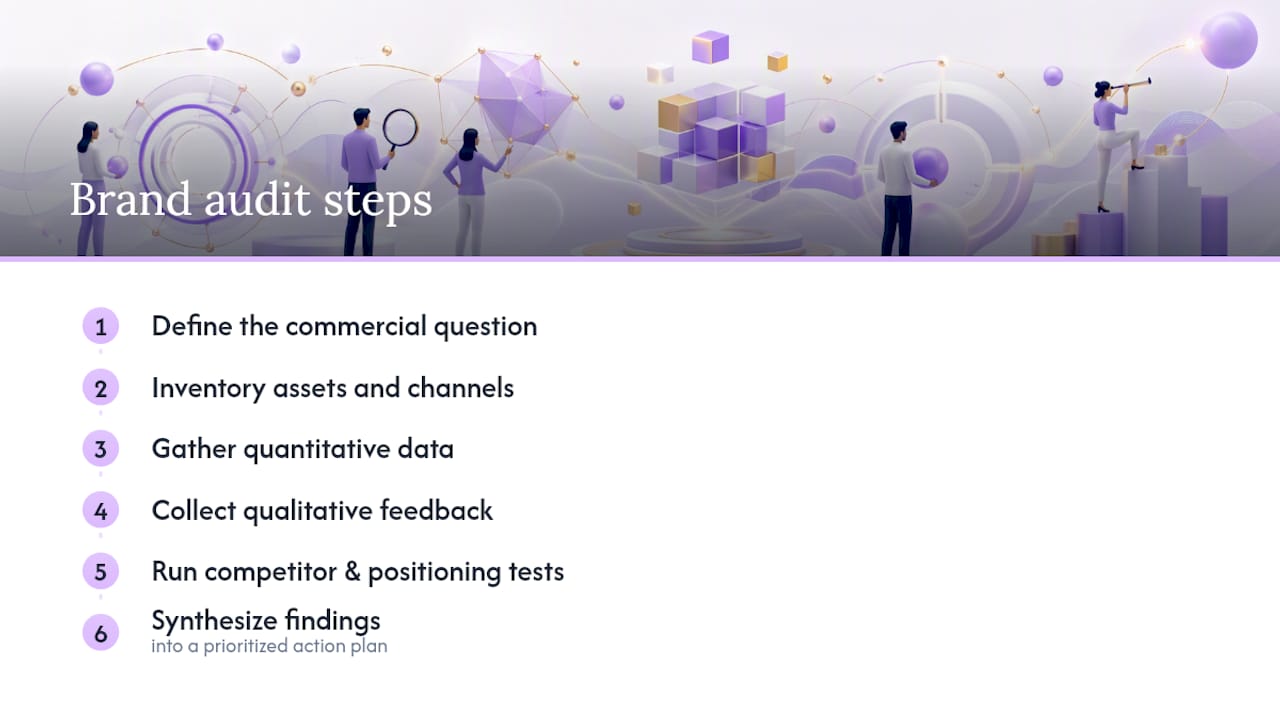
Define the commercial question, inventory assets and channels, gather quantitative data, collect qualitative feedback, run competitor and positioning tests, then synthesize findings into a prioritized action plan.
What is the difference between a brand audit and a marketing audit?
A brand audit examines identity, perception, and consistency across touchpoints; a marketing audit examines campaign and channel performance against spend and ROI.