What Does a Design-Forward Startup Mean for Founders

What Does a Design-Forward Startup Mean for Founders
A design-forward startup is defined as a company that places design at the center of its product, brand, and user experience from day one. Not as decoration. Not as a polish pass before launch. As infrastructure. Designer-founded startups achieve product-market fit about 30% faster than engineering-led startups and report lower customer acquisition costs in their first 18 months. That stat alone should make every founder sit up straight. The industry term for this approach is “design-driven” or “design-centric” startup, and it describes a company where design thinking shapes decisions at every level, from the first user interview to the cap table pitch deck.
What does a design-forward startup mean in practice?
A design-forward startup treats design as a core business function, not a finishing touch. Think of it like this: if your engineering team builds the engine, your design function is the chassis, the dashboard, and the road map all at once. Without it, you’ve got a fast car going nowhere useful.
The most visible characteristic of a design-centric startup is user empathy baked into every decision. Founders and product teams run structured user interviews before writing a single line of code. They test assumptions with low-fidelity prototypes rather than fully built features. Design thinking’s core principles, including radical empathy, ideation, prototyping, and testing, reduce market risk by turning abstract challenges into user-validated solutions.

Messy design reflects underlying strategy debt. Founders who let visual and interaction inconsistency pile up are signaling something deeper: unclear priorities, rushed decisions, and a product that users will eventually abandon. Good aesthetic governance, on the other hand, signals operational maturity.
What are the defining characteristics of design-first companies?
Design-first companies share a recognizable set of traits. They are not just “pretty” startups. They are operationally disciplined in a specific way.
Here is what separates them from the pack:
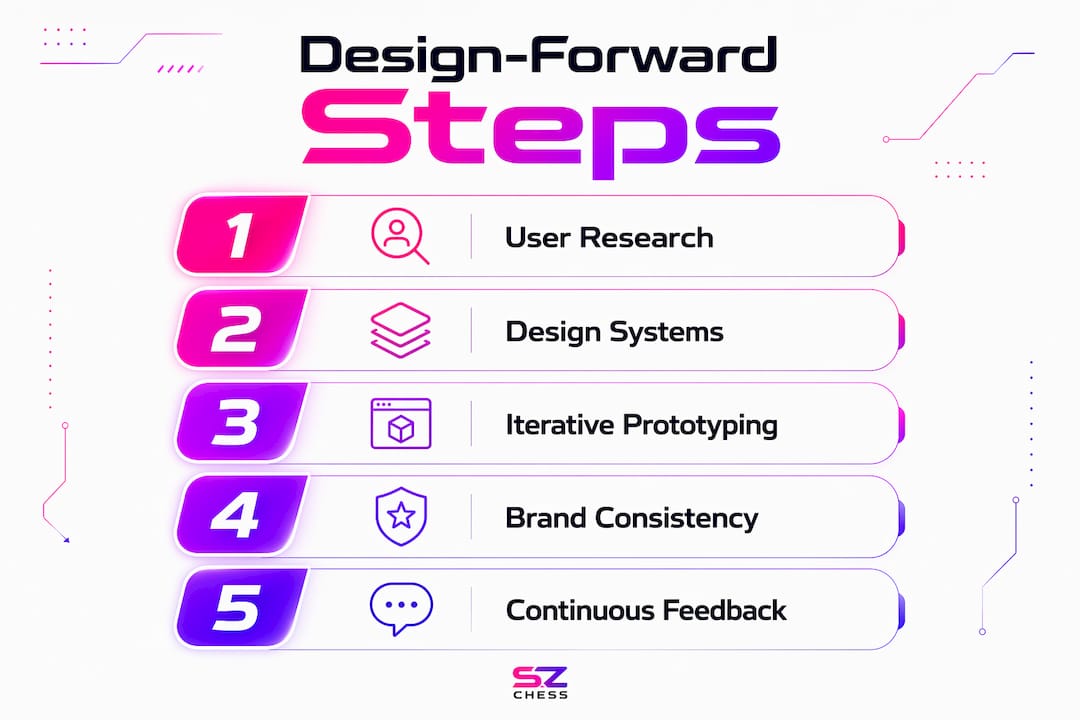
- User empathy as a starting point. Every feature begins with a documented user need, not a founder assumption. Teams run empathy interviews, map user journeys, and identify friction points before building anything.
- Continuous iteration as a cultural norm. Iterative prototyping means building low-fidelity versions, testing with real users, and refining rapidly. Bad ideas die early. Resources go toward what actually works.
- Visual storytelling embedded in the team. Strong storytelling skills improve communication clarity for pitches, sales, and recruitment. Founders who think visually communicate more clearly to investors, customers, and new hires.
- Brand consistency as a scalable asset. A design system, not just a style guide, governs how the product looks and behaves across every touchpoint. This reduces friction for users and speeds up the team’s ability to ship.
Pro Tip: Build your design system before you hit 10 employees. Retrofitting brand consistency onto a 30-person team is like trying to repaint a moving bus.
Design-forward startups also treat their brand identity as a living system, not a one-time deliverable. The logo is the least important part. The tone of voice, the onboarding flow, the error messages: those are where brand actually lives.
How does design impact product-market fit and customer acquisition?
Design directly accelerates the path to product-market fit. The mechanism is straightforward: when you start with deep user research, you build fewer features nobody wants. Fewer wasted sprints means faster signal on what actually resonates.
“Aesthetics are no longer superficial but operational. Design-forward startups use visual and interaction consistency as governance that steers product and business decisions.” Startupik
Early user interviews and prototypes act as a risk mitigation tool. A founder who spends two weeks interviewing 20 users before building saves months of engineering time. That is not a soft benefit. That is a direct reduction in burn rate.
Design also shapes the metrics founders obsess over: onboarding completion, conversion rates, and retention. Startups that embed design systems, feedback loops, and trust signals into their product see measurable improvements in signup completion and support load. A confusing onboarding flow does not just frustrate users. It inflates your customer acquisition cost because you keep paying to replace the ones who churn.
| Design Practice | Business Impact |
|---|---|
| Early user interviews | Reduces wasted feature development |
| Iterative prototyping | Shortens time to validated product decisions |
| Consistent onboarding design | Improves signup completion and reduces churn |
| Trust signals and visual consistency | Lowers support volume and increases conversion |
| Design system governance | Speeds up shipping and reduces team friction |
Incorporating users early and continuously in the design process leads to more intuitive products and stronger market fit. That is not a hypothesis. It is the operational reality of every design-centric startup that has scaled past its first product cycle.
What methodologies and tools do design-forward startups use?
Design-forward startups do not just “do design.” They operationalize it through specific methodologies and tools that make design repeatable, scalable, and measurable.
The core methodology is design thinking, structured around five stages:
- Empathize. Conduct in-depth user interviews, shadowing sessions, and surveys. Superficial adoption of design thinking limits benefits and risks reinforcing existing biases. Go deep or go home.
- Define. Synthesize research into a clear problem statement. This is where most startups skip ahead and pay for it later.
- Ideate. Generate a wide range of solutions before committing to any. Quantity before quality at this stage.
- Prototype. Build the lowest-fidelity version that can answer your key question. A sketch on paper beats a coded feature for early validation.
- Test. Put the prototype in front of real users. Document what breaks, what confuses, and what delights.
On the tools side, design systems using Figma, Storybook, and design tokens enable teams to maintain consistent visual and interaction patterns at scale. Figma handles collaborative UI design. Storybook documents component libraries for engineering teams. Design tokens standardize color, spacing, and typography across platforms. Together, they turn design from a bottleneck into a shared language.
Pro Tip: Use design tokens from the start. Changing your brand color across a product built without tokens is a week-long nightmare. With tokens, it is a 10-minute update.
Tools like Framer also let founders build interactive prototypes without engineering support, which is a game-changer for testing ideas fast. Check out mobile UX best practices to see how these tools apply specifically to mobile-first products.
How to build and scale brand identity as a design-forward founder
Brand identity is not your logo. It is the sum of every impression your company makes, from your website headline to your invoice template. Founders who treat it as a one-time design task end up rebuilding it from scratch at Series A.
Here is how to build brand identity the design-forward way:
- Start with a visual language, not just a logo. Define your color palette, typography, and imagery style before you design anything else. These decisions should reflect your user’s world, not just your personal taste.
- Write your tone of voice down. Literally. A one-page document that describes how your brand sounds in emails, error messages, and social posts saves enormous time as your team grows.
- Apply consistency across every touchpoint. Brand consistency across product, website, and onboarding enhances trust and supports scalable design as a governance layer. Users notice inconsistency even when they cannot name it.
- Evolve your brand with user data. Your brand is not static. Run A/B tests on messaging. Track which visual styles drive higher engagement. Let real user behavior guide brand evolution, not just internal preference.
- Align brand vision with company culture. Your brand is a promise. If your internal culture does not match what you project externally, users and employees both feel the disconnect.
The design partner role in a startup is precisely to hold this brand vision steady while the company moves fast. Without that anchor, brand identity drifts, and trust erodes with it.
Key Takeaways
A design-forward startup succeeds because it treats design as infrastructure, not decoration, embedding user research, brand consistency, and iterative prototyping into every stage of growth.
| Point | Details |
|---|---|
| Design is infrastructure | Treat design systems and brand consistency as operational assets, not aesthetic choices. |
| Faster product-market fit | Designer-founded startups reach product-market fit 30% faster by starting with user needs. |
| Iteration kills bad ideas early | Low-fidelity prototyping and user testing reduce wasted engineering time and burn rate. |
| Brand consistency builds trust | Consistent visual and interaction systems reduce friction and improve conversion metrics. |
| Tools make design scalable | Figma, Storybook, and design tokens let small teams maintain quality as they grow. |
Why I think most founders misread what “design-forward” actually means
Here is my honest take after working with dozens of startup founders: the biggest mistake is confusing “design-forward” with “design-heavy.” Founders hear the term and immediately think they need a beautiful website and a custom typeface. That is not it.
What actually moves the needle is the process, not the pixels. I have seen startups with gorgeous branding fail because they never talked to a real user. And I have seen scrappy, rough-around-the-edges products win because the founder obsessed over the user’s actual problem. Design-forward means you start with empathy and let that drive every decision downstream.
The other misconception I keep running into is that design is a luxury for later. “We will hire a designer when we raise.” That thinking is expensive. The cost of retrofitting a design system onto a product built without one is brutal. The cost of rebuilding brand trust after inconsistent early impressions is worse. Investing in bold design early is not a vanity spend. It is risk management.
My advice to founders in 2026: treat your first design decisions the way you treat your first hires. They set the culture. They are hard to undo. And they compound over time, for better or worse.
— Coumba Evelyn
How Coumba Win Design helps founders build design-forward startups
Founders who are ready to treat design as a competitive advantage need more than a freelancer with a Figma account. They need a partner who understands growth.
Coumba Win Design works directly with startup founders to build bold startup websites and scalable design systems that hold up under the pressure of fast growth. From the first brand sprint to a full component library, the work is built to ship fast and stay consistent. The Demo Day Kit gives founders pitch-ready design assets in 14 days, and the reusable component library means your team spends less time reinventing UI patterns and more time building product. If you are serious about design as infrastructure, this is where to start.
FAQ
What does design-forward startup mean?
A design-forward startup is a company that integrates design as a core strategic function from the beginning, using user research, iterative prototyping, and brand consistency to drive product and business decisions.
How does design thinking differ from regular product development?
Design thinking adds structured empathy and rapid prototyping before any building begins, which reduces the risk of building features users do not want and shortens the path to product-market fit.
What are the key characteristics of design-first companies?
Design-first companies practice continuous user research, maintain consistent brand systems, use iterative prototyping, and embed visual storytelling into their communication and culture.
Do design-forward startups actually grow faster?
Designer-founded startups achieve product-market fit about 30% faster than engineering-led startups and report lower customer acquisition costs in their first 18 months.
What tools do design-forward startups use?
Design-forward startups commonly use Figma for collaborative UI design, Storybook for component documentation, Framer for interactive prototyping, and design tokens to maintain visual consistency across platforms.
Recommended