8–12 Week Trade Show Swag Ideas That Earn Meetings for Startups

8–12 Week Trade Show Swag Ideas That Earn Meetings for Startups
Skip the cheap tchotchkes. The best trade show swag ideas are useful desk gear, industry-specific tools, printed playbooks, and appointment-linked experiences that survive the hotel room, not another stress ball that dies in the recycling bin at the airport. The rule is simple: match the item to the buyer’s role and gate anything premium behind a demo, a scan, or a booked meeting. Get the cost bands and deployment rules right and swag stops being clutter and starts being pipeline.
TL;DR:
- Swag should be useful, industry-specific, and designed to last at least six months for a meaningful impact.
- Budget recommendations vary from $300 to $3,500 depending on the show’s size and expected qualified traffic.
- Qualify attendees before giving premium swag, with cold visitors receiving basic items and hot prospects earning exclusive, tracked gifts.
- Proper activation strategies, such as personalization and timed demos, enhance engagement and justify the swag investment.
- Digital tokens like QR codes and NFC tags are ideal for international shows or limited baggage space, offering measurable lead attribution.
Table of Contents
- Best Trade Show Swag Ideas by Category (With Cost Bands)
- What Should Your Budget Look Like by Booth Tier?
- How Should You Qualify Who Gets What Swag?
- What Activations and Logistics Actually Work on the Floor?
- How Coumba Win Design Chooses and Kits Swag for Startup Booths
- Are There Legal Rules Around Trade Show Giveaways?
- Get a Turnkey Swag Kit Instead of Building One From Scratch
- When You Should Skip Swag Entirely
- Sources
- FAQ
Best Trade Show Swag Ideas by Category (With Cost Bands)
Every item on your table should answer one question: will this person still be using it in six months? Here’s how the smartest booths break it down.
- Desk and daily use. Insulated tumblers, quality notebooks, and desk mats keep your logo in front of someone every single workday. These consistently deliver strong long-term impressions when reserved for qualified leads rather than dumped in an open bin. Expect moderate per-unit costs for items above dollar-store quality.
- Tech accessories. Portable batteries, braided cable kits, phone stands, and NFC keytags appeal directly to attendees who are already glued to their phones between sessions. Budget $8 to $25 depending on branding complexity.
- Apparel and rep items. Polos, quarter-zips, and hats on your own team create a cohesive presence on the floor, and a handful given selectively to top prospects reinforce brand recall. Allocate a moderate budget per piece for quality apparel items.
- Printed playbooks and checklists. An ROI worksheet or an integration diagram tucked inside a notebook cover gets kept because it’s useful, not because it’s free. One smart tactic: print the integration diagram directly into the cover so the reference and the pitch are the same object.
- Industry-specific tools and samples. Material swatches, calibration cards, or sample kits speak directly to technical buyers who ignore generic swag entirely.
- Sustainable and novel items. Seed-paper notecards, recycled fabric wraps, or a coffee cart activation add texture without inflating the budget, and they play well with attendees who actively screen for eco friendly swag ideas.
- Digital-first tokens. QR cards linking to gated reports or a personalized config export cost almost nothing to produce and travel well for international or baggage-restricted shows.
What Should Your Budget Look Like by Booth Tier?
Cost bands only work if you tie them to how big the show is and how many qualified conversations you expect to have. A validation-stage regional meetup does not need the same swag budget as a flagship industry conference, and pretending otherwise is how marketing teams end up with 400 leftover tumblers in a storage closet.
| Booth tier | Budget range | Suggested mix |
|---|---|---|
| Tier C (validation) | a few hundred dollars | Mostly micro band, light standard mix |
| Tier B (regional) | several hundred to low thousands | Standard band core, small hot-tier reserve |
| Tier A (flagship) | several thousand and up | Full spread across all four bands |
A widely cited planning rule is to order roughly 20% more of your micro and standard items than your expected traffic count, since floor traffic estimates are never exact. Order 5 to 10 physical samples of any new premium item before committing to a full production run.
How Should You Qualify Who Gets What Swag?
Giving the best item to random walk-bys quickly exhausts budget without pipeline impact. Build your distribution around three simple tiers:
- Cold. Anyone who walks up gets a badge scan and a micro-band item, stickers, a QR card, or a printed one-pager. No exceptions, no upsell.
- Warm. Attendees who complete a short demo or answer a qualifying question at the booth unlock standard-band items, kept “behind the counter” and handed over once the interaction happens.
- Hot. Prospects who book a working session, redeem an NFC tag, or get flagged pre-show as a target account earn hot-tier or premium items, sometimes mailed as a half-kit before the event even starts.
Gating mechanics matter as much as the items themselves. A QR or NFC redemption flow (NTAG213 chips with a QR fallback work well for tracking) lets you tie every handout to a CRM record instead of guessing at attribution later.
Pro Tip: Build a CRM field for “swag tier given” before the show, not after. Retrofitting attribution from memory two weeks later never works.
Every scan or redemption should trigger a tag in your CRM, a note on the item given, and a follow-up sequence with the right digital deliverable attached, whether that’s the gated report, the config export, or a calendar link for the next call, supported by practical nurture sequence ideas to use after attendees redeem a QR token or claim a printed playbook.
What Activations and Logistics Actually Work on the Floor?
The items matter less than what happens around them. On-the-spot personalization, someone monogramming a tumbler or hand-lettering a notebook while the attendee waits, turns a giveaway into a small event. That wait becomes its own kind of social proof, since a line at your booth pulls in more foot traffic than an empty table ever will, and personalization measurably increases perceived value compared to a pre-branded item grabbed off a table.
A few activation tactics worth building into your booth plan:
- A coffee or refreshment station near the booth entrance, which extends dwell time without costing much per attendee.
- A live demo draw where attendees who complete a walkthrough get entered for a bigger prize.
- Limited-run enamel pins or patches that create a small collector’s itch, especially at recurring industry shows.
- A personalization line for tumblers, notebooks, or apparel, timed so the wait itself becomes visible activity at your booth.
None of this works if fulfillment falls apart in the final weeks. Build your timeline backward from the show date:
- Lock item selection and request samples 10 to 12 weeks out.
- Get decoration proofs approved (logo placement, color matching) 8 to 10 weeks out.
- Place full production orders 6 to 8 weeks out to leave buffer for reprints.
- Confirm shipping to the venue or drayage warehouse 2 to 3 weeks out.
- Kit and stage everything on-site the day before doors open.
Pro Tip: Always request a physical sample before a full production run, even on items you’ve ordered before. Vendors change materials and print processes more often than you’d think, and a color shift you catch on 5 samples is a lot cheaper than catching it on 500 units.
For international shows or anywhere baggage space is tight, lean on digital-first alternatives: QR cards linked to gated reports, webinar passes, or a personalized export attendees can claim from their phone. These travel-friendly tokens cut shipping costs and give you direct UTM-based measurement that a pile of tote bags never will.
How Coumba Win Design Chooses and Kits Swag for Startup Booths
We treat swag the same way we treat every other design decision for a startup: ICP first, everything else second. If an item doesn’t map to a specific buyer role or a specific stage in the funnel, it doesn’t make the kit, no matter how good it looks on a shelf.
For Demo Day kits, that’s meant printing integration diagrams directly inside notebook covers so investors and buyers walk away with a reference tied to the actual product, building simple ROI maps as leave-behinds, and reserving working-session passes for founders who book a follow-up call on the spot instead of handing them out to anyone who stops by.
Good swag should feel like an extension of the brand’s actual product experience, not an afterthought bought in bulk the week before the show.
That’s the same design cohesion we apply across branding and platform work, where the goal is always outcome-driven design rather than decoration. If you want to see the full kitting approach, our Demo Day Kit page breaks down exactly what’s included.
Are There Legal Rules Around Trade Show Giveaways?
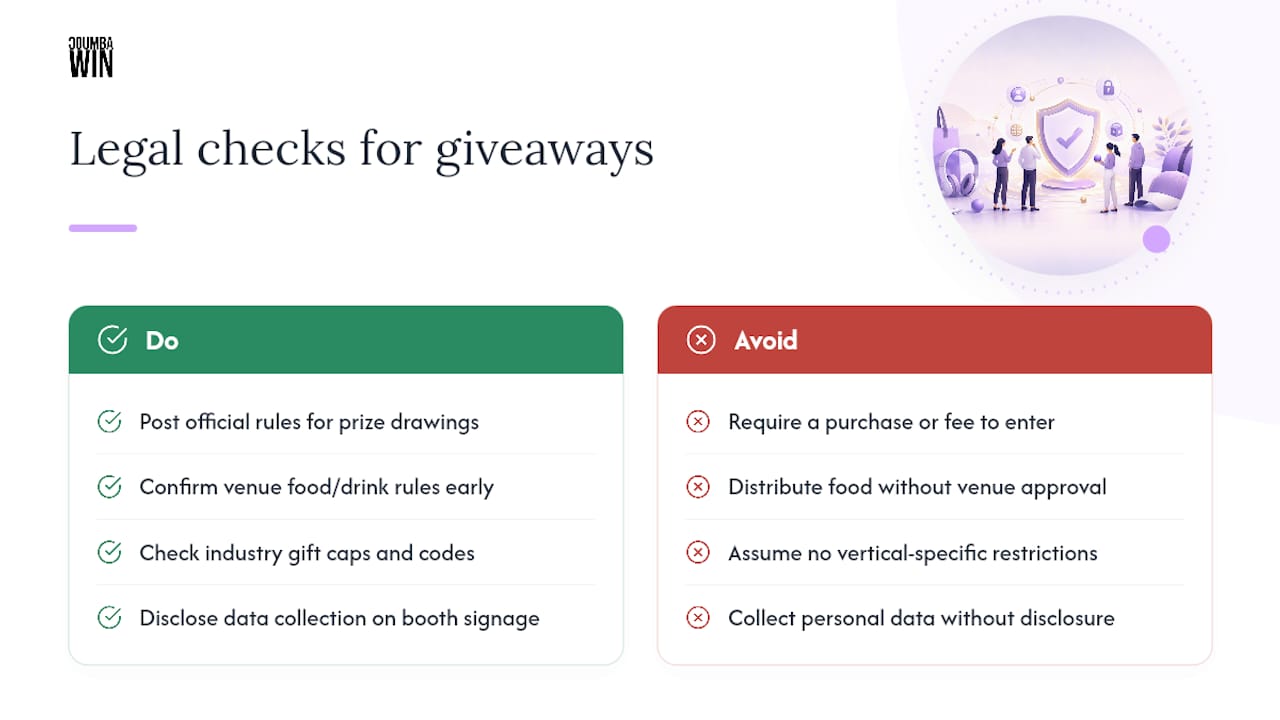
Yes, and most teams never check them until something goes wrong. Giveaways involving a random drawing, raffle, or “enter to win” mechanic can legally count as a sweepstakes in the United States, which triggers disclosure requirements: official rules, no-purchase-necessary language, and odds disclosure in some states. If your booth activation includes any kind of prize drawing tied to a badge scan, post the rules where attendees can see them, and skip anything that requires a purchase or fee to enter, since that shifts the activation into lottery territory, which carries its own separate legal restrictions.
Food and drink giveaways carry their own considerations. Convention centers frequently restrict outside food and beverage distribution or require a permit, so confirm with the venue and general contractor well before your fulfillment deadline, not the week of the show.
If your industry is regulated, healthcare, finance, legal services, check whether your professional body restricts gifts to certain buyer types. Pharmaceutical and medical device shows, for example, often cap the value of items given to healthcare providers under industry codes of conduct. B2B software and hardware shows rarely have this issue, but it’s worth a five-minute check against your specific vertical before you finalize orders.
Lastly, if any item collects personal data (an NFC tag tied to an email capture, a QR code linked to a lead form), make sure your booth signage discloses what’s collected and how it’s used. A short line on a table tent covers most basic compliance expectations without slowing down your line.
Get a Turnkey Swag Kit Instead of Building One From Scratch
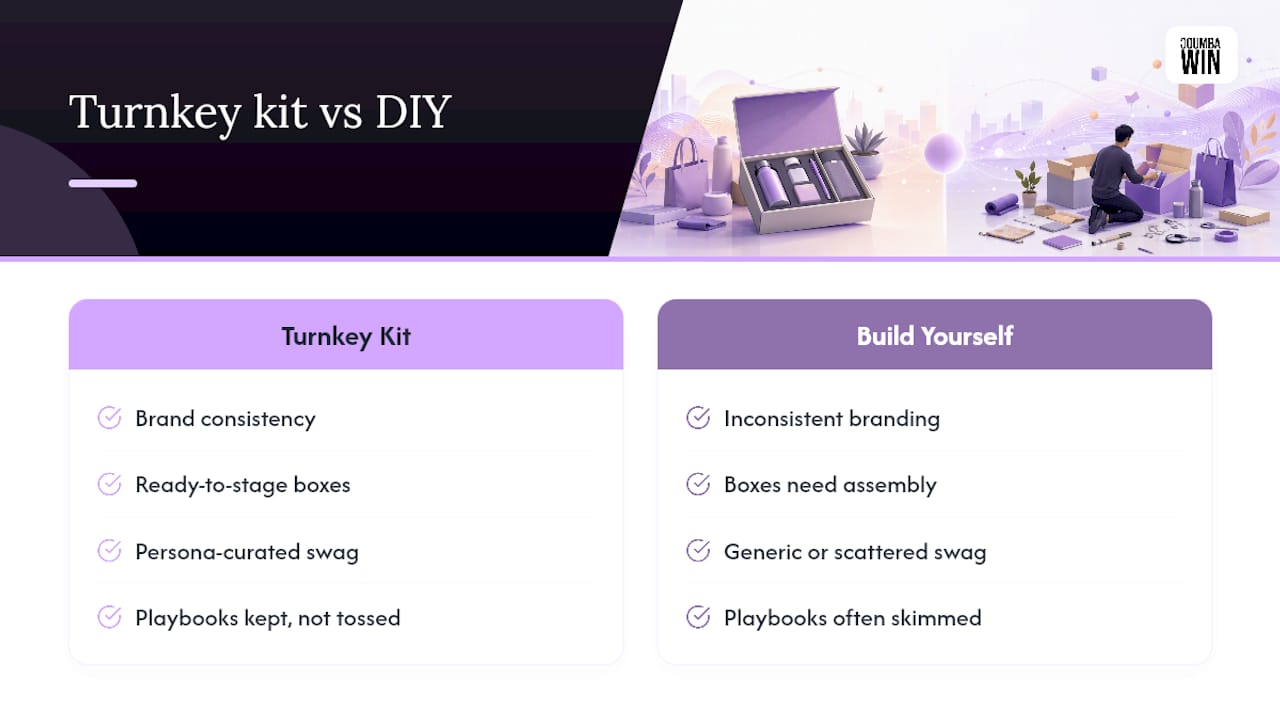
There are services that serve as an alternative to piecing together vendors, decorators, and shipping logistics on your own for every show. Instead of chasing five different suppliers for notebooks, apparel, and printed playbooks, you can get one coordinated Demo Day Kit built around a brand system, not a generic catalog.
Such kits may cover branding applied consistently across every physical item, printed playbooks designed to be kept (not skimmed and tossed), curated swag selected by persona and funnel tier, and full kitting so boxes arrive at the venue ready to stage, not ready to assemble at the last minute. If you’re weighing swag against other conversion tools for the show, our breakdown of interactive website features that convert is worth a read alongside your swag plan.
Request a sample from a past kit, book a quick consult to walk through your booth tier and budget, or check component options if you want modular pieces rather than a full package. Start at Coumbawin to see what fits your next show.
When You Should Skip Swag Entirely
Sometimes the smartest swag decision is no swag at all. Skip physical items when ICP density at a show is thin, when your booth traffic is mostly students or job seekers, or when the show’s format (a pure networking mixer, a virtual event) makes physical items pointless. Put that budget into demo staffing, targeted pre-show outreach to named accounts, or experience-linked passes instead. Cheap freebies at the wrong show don’t build pipeline. They just build landfill.
— Coumba Evelyn
Sources
- Trade Show Giveaway Ideas 2026 | ExhibitionsVoice Blog
- 20 Trade Show Swag Ideas: From Rep Apparel to Giveaways | Moxie
- Trade Show Giveaway Ideas That Actually Work | Pure Exhibits
FAQ
What Are the Best Trade Show Swag Ideas for a Tight Budget?
Micro-band items like stickers, seed-paper cards, and QR tokens run $0.50 to $3 per unit and still work well for cold-tier attendees when paired with a printed playbook for warmer leads.
How Much Should I Budget per Trade Show Attendee?
Budget depends on booth tier: Tier C shows run $300 to $500 total, Tier B shows run $800 to $1,500, and flagship Tier A shows typically need $2,000 to $3,500 or more across all cost bands.
Should I Give the Same Swag to Every Booth Visitor?
No. Reserve hot-tier and premium items for warm and hot leads who complete a demo or book a meeting, and keep cold-tier visitors to micro-band items like stickers or QR cards.
How Far in Advance Should I Order Trade Show Swag?
Plan for 8 to 12 weeks of lead time to cover sampling, decoration proofs, production, and shipping before the show date.
Are Digital Swag Tokens Better Than Physical Items?
For international or baggage-restricted shows, QR cards and NFC tags cut shipping costs and give direct UTM-based measurement that physical items can’t match on their own.