Startup SEO Strategy: A Practical Plan for Founders
Startup SEO Strategy: A Practical Plan for Founders
A good startup SEO strategy comes down to five moves: pick goals tied to revenue, target searches that real customers type, build a clean site that Google can crawl, publish genuinely helpful pages, and measure everything in free tools. Do those in order, stay consistent, and search becomes a channel that keeps paying you back long after you hit publish. 🎯
We’re a design team, and yes, we have strong opinions about SEO (we’re the nerdiest wingwoman your website will ever have). Here’s the plan we’d hand a founder over coffee, minus the jargon pile-up.
TL;DR
- Set SMART goals tied to business outcomes (demo requests, signups), not vanity traffic.
- Target low-volume searches where you solve the exact problem. They convert better and are easier to win.
- Get the foundation right early: crawlable links, clear titles and headings, a sitemap, and Search Console.
- Publish people-first content with real expertise, and give journalists and customers something worth citing.
- Expect months, not weeks. Budget for the long game and review the plan every few months.
Table of Contents
- Why startups should care about SEO early
- How long it takes and what it costs
- Step 1: Set goals that mean something
- Step 2: Research your audience and keywords
- Step 3: Build the site so search engines can read it
- Step 4: Publish content people actually want
- Step 5: Earn authority and links
- Step 6: Measure, learn, repeat
- A starter roadmap for your first 90 days
- Common startup SEO mistakes
- Our perspective
- Where we can help
- FAQ
- Sources
Why startups should care about SEO early
Paid ads stop the second your card does. Organic search doesn’t work like that: optimized pages can keep bringing in visitors as they age. Ahrefs’ startup guide puts it simply: SEO attracts valuable search traffic by making your site more visible for relevant keywords, and that traffic can grow over time.
There’s an investor angle too. Working SEO into your go-to-market plan early can help build a lasting acquisition funnel and show investors you’re thinking beyond short-term ROI. When someone asks about your cap table and your growth plan in the same breath, “we have a compounding channel” is a nice thing to say.
And the honest part: SEO is slow. It’s a long-term strategy that needs ongoing investment in people, content and tools. If you need leads next week, pair it with something faster. If you’re building for the next two years, start now.
How long it takes and what it costs
Let’s rip off the bandage. Returns may take months or even years, because content has to be found, indexed and then earn its way up the results. A brand new domain starts with no history, so the first stretch is mostly about laying foundations.
On budget, one industry estimate for startups and small businesses with 5 to 50 full-time employees and under $50 million in annual revenue is roughly $1,000 to $5,000 per month (that figure is from 2022, so treat it as a ballpark, not a quote). Your real number depends on how much you do in-house and how competitive your space is.
Bootstrapped? You can do a surprising amount with free tools and a couple of focused hours each week. We’ll get to that.
What about the 80/20 rule?
You’ll see “80/20 rule for SEO” thrown around. There’s no official Google definition, so think of it as a gut check: a small share of your pages and queries will probably drive most of your results. Find those, and put your energy there instead of spreading it across fifty half-finished posts.
Step 1: Set goals that mean something
Start with business outcomes. SMART goals (Specific, Measurable, Attainable, Relevant, Time-bound) keep SEO tied to what the company actually needs.
Compare:
- Weak: “Get more traffic.”
- Better: “Earn 40 demo requests per quarter from organic search by the end of Q3.”
The second one tells you which pages matter (the ones that lead to a demo), what to track (conversions, not just visits) and when to judge it. Write two or three goals, max. If you can’t connect a goal to revenue or runway, cut it.
Step 2: Research your audience and keywords
Good keyword research starts with customer problems, not tools. Ask yourself:
- What is my buyer trying to fix when they open Google?
- What words do they use (not the words we use in our pitch deck)?
- What would they type before they know we exist, while comparing options, and right before they buy?
That maps neatly to a funnel: awareness, consideration, selection. Revisit it every few months, since personas, features and search terms change as you grow.
Free ways to find keywords
You don’t need a pricey subscription on day one. Try:
- Google’s autocomplete and the “People also ask” boxes for your core topics.
- Forums and communities where your customers complain out loud.
- Your own sales calls and support inbox. Founders ignore this goldmine constantly.
- Search Console data once your site has a few weeks of impressions.
Go small and specific
Here’s the startup cheat code: low-volume searches where you solve the exact problem. A query with 30 monthly searches from someone who badly needs your product beats a 10,000-search head term you’ll never rank for. The keyword behind this very article has tiny volume and low difficulty, and the person typing it is exactly who we want to talk to.
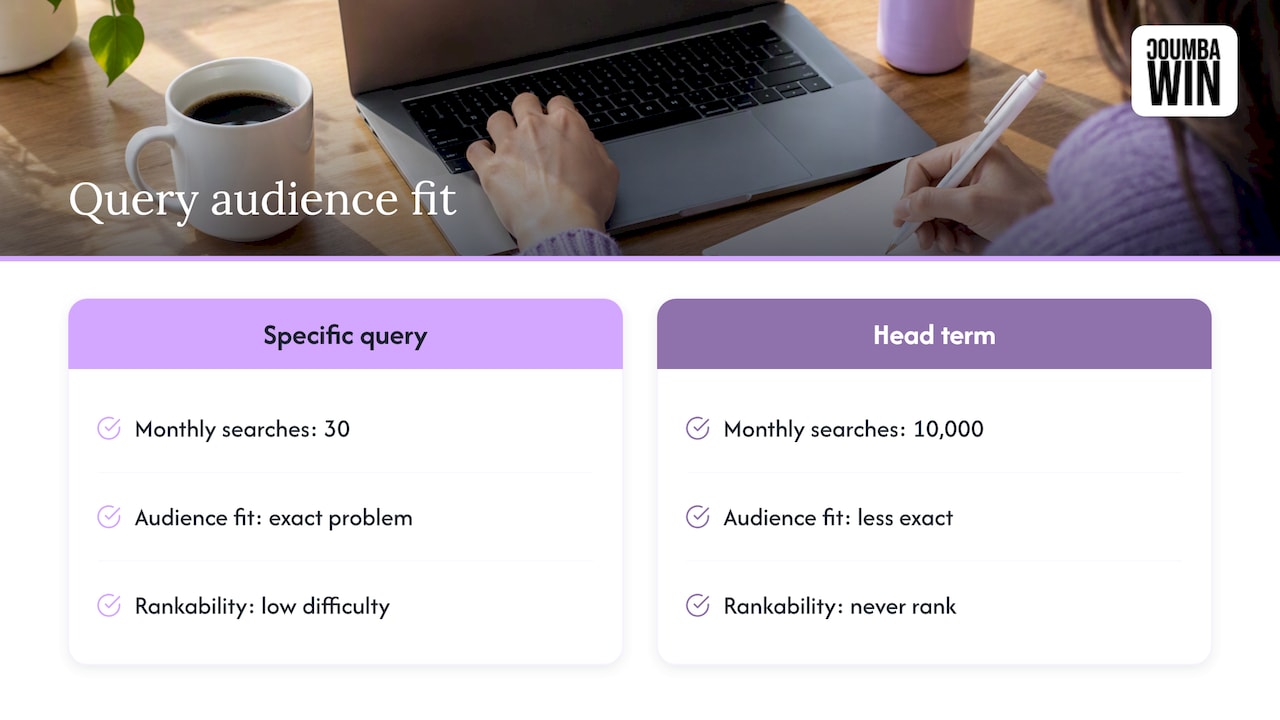
Map one primary query to one page. Add the related questions people ask (like how to plan SEO for a new website) as sections within it.
Step 3: Build the site so search engines can read it
This is where design and SEO shake hands. Structure decisions you make in week one are painful to undo in month twelve. We’ve written about why website structure affects growth and about design-first site architecture that avoids indexation crashes if you want the deeper dive.
The essentials:
- Crawlable links. Google’s Search Essentials call for making links crawlable, so use real links rather than buttons that hide the destination.
- Words people use, in prominent places. The same guidance recommends placing them in titles and main headings. Your H1 should say what the page is about, plainly.
- A sitemap. Sitemaps help search engines discover your URLs, and they can be especially useful for new sites with few external links. That’s most of you.
- A logical hierarchy. Home, a handful of core pages, then supporting content grouped by topic. If a founder can’t explain your navigation in one breath, Google won’t love it either.
- Search Console from day one. Google notes that a Search Console account helps you monitor and optimize how your site performs in Search.
For the nuts and bolts of getting crawled and indexed, our technical SEO basics post walks through it. And if you already have a site and are about to move it, read our site migration checklist before you touch a single URL.
Don’t obsess over perfect scores
Performance matters for users, so keep pages fast and usable on mobile. But a missing 100 on a speed test is rarely the thing standing between a new startup and traffic. Fix the obvious, then spend your hours on content and clarity.
Step 4: Publish content people actually want
Google’s automated systems prioritize helpful, reliable, people-first information. The same page notes that E-E-A-T (experience, expertise, authoritativeness, trustworthiness) is not itself a specific ranking factor, but it’s a useful lens for asking whether your page deserves trust.
The same guidance cautions against extensive automation and summarizing other people’s content without adding value. Translation: a stack of generic, machine-spun posts is not a strategy. You have something competitors don’t: first-hand knowledge of the problem you solve. Use it.
What to publish first
A simple starter lineup:
- Core product or service pages. One per offer, written around the problem it solves.
- Problem-first guides. “How do I fix X?” posts that show your expertise and answer the exact question.
- Comparison and alternative pages by type. Help buyers weigh approaches (in-house vs. agency, tool vs. service) honestly.
- Proof. Case studies, numbers, screenshots, quotes from real customers.
Depth matters too. Search Engine Land’s guide on semantic depth argues that covering a topic thoroughly, beyond a single keyword, is increasingly a baseline for visibility in modern search and across AI platforms. In practice: answer the follow-up questions your reader will have, and name the related concepts.
If you want a broader view of planning content for the long haul, this overview of a long-term SEO content strategy covers the planning side well.
A quick “is this page good?” test
Before you hit publish, ask:
- Would a customer learn something here they couldn’t get from the top three results?
- Is there a clear next step (a demo, a signup, a related page)?
- Is there at least one thing only your team could have written (data, a story, a screenshot)?
If the answer to the last one is no, hold the post. 🙃
Step 5: Earn authority and links
Links from other credible sites remain a major way to signal that your pages are worth surfacing. New startups don’t have a big brand to lean on, so you have to give people a reason to mention you.
One example from the travel world: Search Engine Land reported that an in-house SEO team at HomeToGo used localized, data-driven stories aimed at audiences and journalists to increase its chances of media mentions and backlinks. You don’t need their scale to borrow the idea.
Practical options for a young company:
- Publish original data from your own product or a small survey.
- Create a clean, downloadable media kit so journalists can cover you without chasing you (we wrote about media kit design for founders).
- Get listed where your customers already look: relevant directories, partner pages, investor portfolios.
- Share expertise in podcasts, panels and guest articles where your audience hangs out.
Skip anything that promises hundreds of links for a tiny fee. Quality and relevance win, and shortcuts tend to cost you later.
Step 6: Measure, learn, repeat
Track a short list of numbers:
| What to track | Why it matters | Where to see it |
|---|---|---|
| Organic traffic | Shows whether visibility is growing | Search Console, analytics |
| Keyword rankings | Shows movement on your target queries | Search Console, rank trackers |
| Conversions | Ties SEO to revenue | Analytics goals or events |
| AI visibility | How often your brand is mentioned and cited in relevant AI answers | AI-visibility features in SEO tools |
The first three are the classics, and Ahrefs’ startup guide also recommends watching AI share of voice, which it describes as the percentage of relevant prompts where your brand is mentioned and your pages are cited. It’s an emerging metric, so treat it as directional.
On depth, the semantic depth guide mentioned above uses unique queries per page as a metric and suggests aiming for 25% to 100% growth after filling content gaps. Nice to watch, not a promise.
Set a review rhythm: a quick look monthly, a real strategy refresh every few months. Personas shift, features ship and search results change, so your plan should too. Our startup SEO audit checklist is built to fit into an afternoon, which makes the quarterly check-up painless.
A starter roadmap for your first 90 days
New domain, no history, small team? Here’s a sane sequence. (For the extended version, we put together a 90-day launch plan for a brand new domain.)
- Weeks 1 to 2: Set goals, install Search Console and analytics, and map your site structure.
- Weeks 3 to 4: Fix titles, headings and internal links on your core pages. Submit your sitemap.
- Weeks 5 to 8: Publish your first three to five problem-first pages, each targeting one specific query.
- Weeks 9 to 12: Start outreach, add proof (case studies, data), and review what Search Console shows.
Then repeat, double down on what’s working, and prune what isn’t.
Common startup SEO mistakes
- Chasing big keywords too early. Win the small ones first.
- Rebranding or redesigning without an SEO plan. Names, URLs and structure changes can wipe out visibility, as we covered in SEO for brands renaming and redesigning.
- Publishing for volume. Ten helpful pages beat a hundred forgettable ones.
- Ignoring design. A page that ranks but confuses people won’t convert. Layout, clarity and trust signals are part of SEO’s payoff.
- Giving up at month three. This one hurts the most, because the compounding usually starts right after most people quit.
Our perspective
We see the same pattern with founders: they treat SEO as a writing task and design as decoration, and then wonder why traffic doesn’t turn into customers.
We think they’re one job. The way your site is structured decides what Google can understand. The way your pages look and flow decides whether a visitor trusts you enough to act. Bold, custom design isn’t a coat of paint on top of your SEO. It’s how your search traffic becomes pipeline.
That’s why we steer startups away from generic templates and AI-generated filler. Your competitors can copy a template in an afternoon. They can’t copy a site built around how your customers think, with pages that answer real questions in your voice.
If you’re planning a new site or a redesign, bring SEO into the conversation on day one. It’s far cheaper than retrofitting it later.
Coumba Evelyn
Where we can help
If you’d rather spend your hours on product and customers, we build the foundation for you: custom websites and Webflow builds designed with search structure in mind, plus UX, SEO optimization and accessibility audits for startups that want growth, not just a pretty homepage.

See what we offer on the Coumba Win site, or browse our Webflow development work to see how we approach it.
FAQ
How long does startup SEO take to work?
Plan for months, and sometimes longer. Optimized content has to be indexed and earn rankings before it brings in measurable visitors, and returns can take months or years. Track impressions and rankings early, since those usually move before traffic and conversions do.
How should I build an SEO plan for a new website?
Start with goals, then pick specific, problem-based keywords. Set up a crawlable structure with a sitemap and Search Console, optimize titles and headings on your core pages, and publish helpful content around one query per page. Review the results every few months and adjust.
Can I do startup SEO with no budget?
Yes, to a point. Search Console is free, and autocomplete, “People also ask” and customer conversations will get you a solid keyword list. What you’ll spend instead is time, so protect a few focused hours each week for it.
Is SEO still worth it with AI search?
We think so. Google still stresses helpful, people-first content, and the same depth and clarity that help you rank are what get your brand cited in AI answers. Keep an eye on AI visibility alongside classic rankings.
Sources
- SEO for Startups: How to Grow Search Visibility on a Budget
- Why SEO is a great investment, not just a cost
- Why SEO Must Be a Consideration for Early Funding Phases
- How to Create an SEO Strategy
- SEO for startups: a guide for founders and engineers
- Google Search Essentials
- What Is a Sitemap, Google Search Central
- SEO Starter Guide: The Basics, Google Search Central
- Creating Helpful, Reliable, People-First Content
- Semantic depth in SEO: Go beyond keywords to rank higher
- How one in-house SEO team is taking on industry incumbents
- SEO Content Strategy Guide for Maximizing Organic Growth