Series A Rebrand: When, Why and How to Do It Right
Series A Rebrand: When, Why and How to Do It Right
A Series A rebrand makes sense when the company you’ve become is bigger than the brand you launched with: new markets, new products, a new buyer, a bigger team to recruit. It doesn’t make sense just because you have cash and a vague itch. Do it for strategic reasons, stage it in phases, and set your measurements before launch. That’s the whole game, and the rest of this post is how to play it without losing your mind (or your runway) 😅.
TL;DR
- Rebrand at Series A when your name, story or look is narrower than your real business, not because a logo feels “seed-stage”.
- Run strategy and identity together, test early with rough ads, and treat the website as the proof point, not an afterthought.
- Treat the funding announcement as a multi-audience brand moment: investors, hires, customers and partners all read it.
- Set a baseline before launch (traffic, demo sign-ups, inbound inquiries, recruiting interest) so you can tell what worked.
- Keep refining after launch. The best rebrands are iterated, not unveiled once and abandoned.
Table of Contents
- What a Series A rebrand actually is
- Why startups rebrand around their Series A
- Signs your brand no longer fits
- Rebrand or refresh? Pick your scope
- How to plan the rollout
- Turn the funding announcement into a brand moment
- What to consider for your brand and digital experience
- Keep improving after launch
- How to tell if your rebrand is working
- Our perspective on Series A rebrands
- Want a partner for your rebrand?
- FAQ
- Sources
What a Series A rebrand actually is
First, a quick level-set. A Series A is a startup’s first major institutional venture round, raised after it has shown market viability and early traction at the seed stage, and it’s typically the first priced round, according to Carta’s fundraising guide. Companies use the money to scale: product development, market expansion, operations, sales and marketing, and hiring. Forbes noted in 2023 that these rounds commonly land between $10 million and $20 million, though it varies by company and market conditions.
So a Series A rebrand is simply the moment when you update your name, visual identity, messaging and website to match the company you’re now building, not the one you pitched at pre-seed. Sometimes that’s a full rename. More often it’s a sharper story, a stronger identity system and a website that finally does its job.
The key word is match. Your first brand was probably built in a weekend by a founder who also fixed the Wi-Fi. It did its job. Now there are more people to convince, and they’re skeptical in new ways.
Why startups rebrand around their Series A
Funding changes who’s looking at you. Suddenly you’re talking to enterprise buyers, senior candidates, press and the next round of investors, all at once. A few forces tend to collide at this stage.
You’ve outgrown the original idea. Forbes reported on October 13, 2022 that US-based Xiao Chi Jie rebranded while raising a $10 million Series A. The reasons were concrete: it had expanded nationally, broadened its products beyond street food, and reached an audience well beyond the local Chinese community. The brand needed to fit the new reality.
Your product has grown up. First Round Review’s account of Vanta’s path to product-market fit describes the company broadening its ambitions from SOC 2 compliance to trust management, including trust reports and security status pages. When your product story gets bigger than your original category, your brand has to stretch with it.
A new category or line demands a new name. Forbes reported that Rebelstork became REBEL on March 11, 2025, alongside an expansion into home goods, after securing a Series A in fall 2024. A name tied to one product line gets awkward once you sell something else.
The mission changed. Forbes says Uncharted Power rebranded in 2016 as it pursued larger infrastructural solutions to bring cost-efficient energy to the developing world.
Perception lags reality. The Vanta story also touches on a mismatch between how the market perceived the company’s stage and where it actually was. If prospects see a scrappy side project and you’re a funded team with real customers, that gap costs you deals and candidates.
Notice the pattern? Every example is strategic, not cosmetic. Geography, products, audience or mission changed first. The brand followed.
Signs your brand no longer fits
This is where we get to rely on our own experience working with founders rather than a study, so take it as practical judgment, not gospel. Here are the signals we’d look for:
- You keep explaining the name. If every intro call starts with “so, we’re not just X anymore,” the name is narrower than the business. TGC Capital Partners makes the same point: a rebrand can be justified when the original name is narrower than the company’s ambition.
- Your voice talks to the wrong buyer. Playful and scrappy worked for early adopters. Now the person signing the contract wants confidence and clarity. The same source flags a brand voice that no longer fits the buyer as a legitimate trigger.
- You’re heading into new regions. Geographic expansion can expose linguistic or cultural problems with a name or tagline. Better to learn that on a whiteboard than in a launch campaign.
- Your pitch deck and website tell different stories. If your investor deck looks like a different company from your homepage, something’s off.
- Recruiting feels harder than it should. Candidates check your site and socials before they say yes. If the experience undersells you, you’re paying a tax on every hire.
- Your site converts poorly despite good traffic. Sometimes it’s not the brand, it’s the experience. We’ll get to that.
If you tick two or three of these, you probably have a real brand problem. If you tick none and just feel bored of your logo, hold your horses. Boredom is not a strategy (we say this lovingly, as people who redesign our own stuff constantly).
Rebrand or refresh? Pick your scope
Not every Series A company needs the full works. Here’s a simple way to think about it.
| Scope | What changes | Good fit when |
|---|---|---|
| Messaging refresh | Positioning, tagline, website copy, deck narrative | The product evolved but the name and look still work |
| Identity refresh | Logo refinements, color, type, templates, plus messaging | The look feels junior, but the name still fits |
| Website and product experience upgrade | Site structure, UX, conversion paths, UI consistency | Traffic is fine, sign-ups and demos lag |
| Full rebrand | New name, identity, voice, site, collateral | Market, product or mission changed materially |
Rippling’s story is a useful reminder that you can mix and match. In its account of an in-house rebrand, the team replaced a website redesign it judged inadequate, yet kept the logo work. Scope is a choice, not a package deal.
If you’re still working out your foundations, start with a clear positioning statement. It’s the thing every other decision hangs off, and it’s much cheaper to get wrong on paper than in a design system.
How to plan the rollout
Here’s a sequence that holds up well for a funded startup with a small team and a big to-do list.
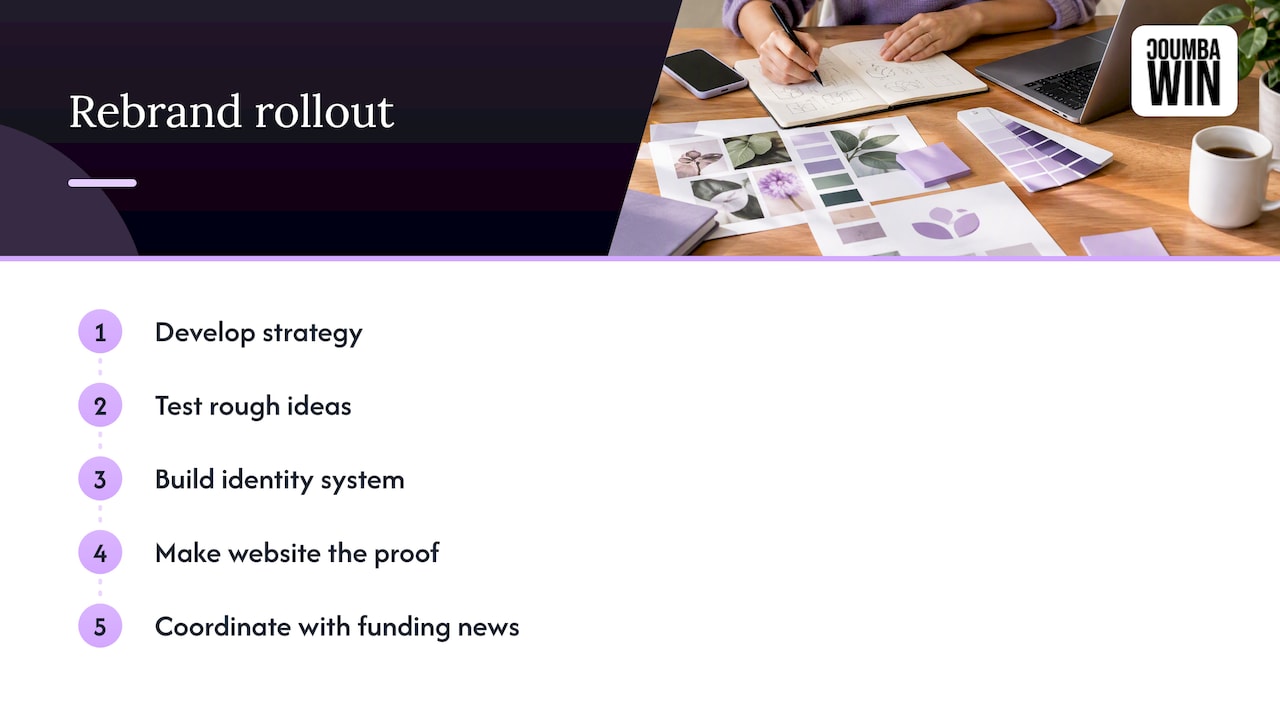
1. Start with strategy, not swatches
Decide who you’re for now, what you do better than anyone, and how you want to be described in one breath. Rippling’s team developed strategy and identity in tandem rather than one after the other, which kept the story and the visuals from drifting apart. If you need a structure, our six-step brand messaging framework is a good place to begin, and brand storytelling for early-stage companies helps turn the framework into an actual narrative.
2. Test rough ideas before you polish
Rippling tested rough digital ads to learn about audience and creative before committing. You don’t need a huge budget to do the same. A handful of simple ad variations tells you which message lands before you build a whole system around it. Our Facebook ad creative testing playbook walks through the mechanics.
3. Build the identity as a system
Logo, color, type, illustration or photography style, templates for decks, social and email, and rules for using them. A system saves you from design chaos once you’ve got ten new hires making slides. If you’re building from the ground up, this founder’s guide to brand identity covers the essentials.
4. Make the website the proof
Your site is where the new brand either clicks or falls flat. Rippling abandoned a $40,000 website rebuild it considered inadequate, then rebuilt and optimized the site around demo sign-ups. The lesson isn’t “spend more”, it’s “don’t ship something you don’t believe in just because it’s already paid for” (sunk cost is a nasty roommate).
Design the site around the one action you want, and use story to get people there. Two of our posts go deeper: website storytelling techniques for startups and improving website conversion rate through design. If you want to add motion or interactivity, see interactive website features that convert.
5. Sequence the launch around your funding news
The announcement and the rebrand can reinforce each other, which is a gift if you plan for it. More on that next.
Turn the funding announcement into a brand moment
A funding post isn’t just “we raised money, yay.” A Forbes Communications Council piece argues an announcement should speak to investors, employees, partners, prospects, influencers and policymakers, and can be used to build category credibility and drive website traffic.
In the example it describes, a $14 million Series A announcement used a new tagline, leadership and partnership proof, thought-leadership planning, embargoed outreach, rehearsed interviews, and customer and analyst access. According to the company, the result was more than 96 pieces of coverage, 407 million impressions and at least 50% more inbound prospective-customer inquiries. Those are the company’s own figures, and your mileage will vary, but the preparation habits transfer nicely.
A practical checklist:
- Have the new site live (or at least the key pages) before the news drops, because curious readers will click through within minutes.
- Write one core message and make sure every spokesperson says it the same way.
- Line up third-party proof: customer quotes, partner mentions, advisors.
- Prepare versions for each audience. A candidate cares about different things than a procurement lead.
- Decide in advance which numbers you’ll watch afterward.
Also, a small but real consideration: after a round, the job is to deploy capital. SVB’s write-up of Versatile after its $20 million Series A says the company focused on expanding its customer base, increasing revenue per customer, retaining customers and growing headcount. Your rebrand should serve those same goals, not sit off to the side as a vanity project. And since SVB notes that roles and responsibilities change as a startup grows, decide early who owns the brand internally. “Everyone” is not an owner.
What to consider for your brand and digital experience
This is the part where I put on my nerdiest wingwoman hat. A few things founders tend to overlook at this stage:
Accessibility. More customers means more people using assistive tech. Color contrast, keyboard navigation and readable type belong in the brand system from day one. An accessibility audit before launch is far cheaper than retrofitting.
Pitch materials. Your deck is a brand artifact. Next-round investors will compare it with your site, so make them siblings.
Product UI. If the marketing site looks sharp but the app looks like 2021, users feel the whiplash. Align UI patterns, tone of voice in microcopy and onboarding with the new identity.
Search and findability. A new name or restructured site can tank organic traffic if redirects, metadata and content aren’t handled carefully. Plan the SEO migration alongside the design.
Email and ads. Templates and creative should be ready at launch, not three weeks later.
Flexibility. Pick a system that can grow. If your next two years include a new product line, make sure the architecture of your name and visuals can handle it.
Keep improving after launch
Launch day isn’t the finish line. Rippling’s team kept refining the brand after launch, and its later website iteration produced a 50% increase in organic sales leads, per its own account. Notably, the company cautioned that the rebrand alone shouldn’t get credit for its valuation rising from $270 million at Series A to $1.35 billion at Series B. Good rebrands help; they don’t do magic.
Ongoing optimization is mostly about content and testing: which pages bring qualified visitors, which headlines get demo requests, which stories pull people deeper. A routine of data-driven content planning keeps that going without eating your whole week.
How to tell if your rebrand is working
Set a baseline before launch, then pick outcomes by audience. The Forbes Communications Council piece suggests tracking:
- Coverage quality and volume
- Website traffic
- Inbound customer and partner inquiries
- Qualified pipeline
- Demo or sign-up conversion
- Recruiting interest
- Investor engagement
Digital case studies add organic traffic, sessions, direct traffic, sign-ups and careers-page engagement. You don’t need every metric. Choose five, write down today’s numbers, and check at 30, 60 and 90 days. Expect some noise: a funding announcement, a seasonal dip and a product release can all muddy the data, so note what else happened in each window.
Our perspective on Series A rebrands
We’ve seen the same story play out with founders: the product got better, the team got sharper, and the brand stayed stuck in the garage. That gap is expensive, because it shows up in every pitch, every hiring conversation and every sales call.
Our view is that design is a competitive advantage, not decoration. That’s why we work closely with founders, build custom solutions instead of generic templates or AI-generated design, and tie the creative to outcomes like conversions, investor confidence and faster sales cycles.
A Series A rebrand works best when strategy, identity, website and pitch materials get built as one connected system by people who understand startup pace. That’s the kind of partnership we like: bold, practical and fast when it needs to be.
Coumba Evelyn
Want a partner for your rebrand?
If you’re staring at a Series A and a brand that no longer fits, we can help with the pieces that matter most: custom branding, web design and development, UI and UX design, pitch deck design, accessibility audits, SEO optimization, email marketing and ad management. We also build in Webflow, and you can see examples on our Webflow development work page.
We’d love to hear what you’re building. Tell us where your brand feels stuck, and we’ll tell you honestly what we’d tackle first. Start at coumbawin.com.
FAQ
What does it mean if a startup is Series A?
Series A is a startup’s first major institutional venture financing, usually its first priced round, raised after it has proven viability and early traction at the seed stage. The money typically goes toward product development, market expansion, sales and marketing, and hiring.
Should every startup rebrand after raising a Series A?
No. Rebrand when your name, voice or visuals no longer match your market, products, audience or mission. If the brand still tells your story accurately, a messaging or website refresh may be enough. The strongest rebrand reasons are strategic, not cosmetic.
How long does a Series A rebrand take?
It depends on scope. Rippling’s in-house team documented a four-month rebrand, and it kept refining afterward. A messaging and website refresh can move faster, while a full rename with a new identity system takes longer. Build in time for testing and for the launch itself.
How do I know if my rebrand is working?
Capture a baseline before launch, then track outcomes by audience: website traffic, demo or sign-up conversion, inbound inquiries, recruiting interest and investor engagement. Check at regular intervals, and don’t credit the rebrand with everything, since other changes happen at the same time.
Sources
- Series A funding: How to raise your first priced round (Carta)
- Learn The Five Most Important Terms In A Series A Funding Round (Forbes)
- Viral TikTok Frozen Dumplings Company Xiao Chi Jie To Rebrand (Forbes)
- Vanta’s Path to Product-Market Fit (First Round Review)
- Rebelstork Rebrands As REBEL (Forbes)
- Uncharted Power Founder Jessica O. Matthews (Forbes)
- Rebranding for Growth (TGC Capital Partners)
- How We Pulled Off an In-House Rebrand in Four Months (Rippling)
- Leveraging A Funding Round Announcement (Forbes Communications Council)
- Metrics That Matter: Startup Metrics, Goal Setting and Accountability (SVB)
- How to Use Series A Funding to Drive Growth (SVB)
#SeriesA #Rebrand #StartupBranding #FounderLife