90 Day Launch Plan for Brand New Domain SEO, for Founders

90 Day Launch Plan for Brand New Domain SEO, for Founders
Three things matter before anything else on a fresh domain: get it fully crawlable and verified in Google Search Console, publish a handful of pages that actually match search intent, and start collecting a few real backlinks while you watch impressions climb. Skip any of those three and everything else you do is basically decoration. Do them in order, and you’ll have a legitimate shot at visibility inside three to six months.
TL;DR:
- Ensuring the domain has no spammy history, enabling HTTPS, removing noindex tags, and setting proper canonical tags are critical before launch.
- Submitting only your top five to ten key URLs to Search Console and prioritizing server-side rendering for important pages help improve indexing speed.
- Target keywords should be low difficulty under 30 with at least 100 monthly searches, focusing on long-tail questions with high intent, mapped one per page.
- Launching with five to ten well-structured, internal linked pages that clearly state your offering produces organic growth within three to six months.
- Building genuine backlinks through partnerships and relevant mentions, tracked consistently, outweighs bulk link approaches and supports early domain trust.
Table of Contents
- Pre-Launch Checklist: What to Fix Before You Flip the Switch
- Technical Essentials: Crawlability, Rendering, and Speed
- Keyword Selection for a Brand-New Domain: A Realistic Method
- Content Scope and Internal Linking: What to Publish First
- How to Earn Your First Backlinks and Brand Mentions Ethically
- Your First 90 Days: A Prioritized Schedule
- Mistakes That Quietly Kill New-Domain SEO
- Domain Age vs. SEO Impact: Myths and Realities
- Establishing Domain Authority and Trust Signals Early
- Avoiding Common Penalties and Spam Associations With New Domains
- Designing a Launch That Helps Your SEO
- When You’d Rather Have a Design Partner Handle Launch
- Sources
- FAQ
Pre-Launch Checklist: What to Fix Before You Flip the Switch
I’ve watched too many founders launch a beautiful site that Google can’t even see. Before you announce anything, run through this list. It’s not glamorous, but it’s the difference between “indexed on day three” and “why is nobody finding us.”
Before launch:
- Check the domain’s history using the Wayback Machine and a backlink tool. A previously spammy domain can carry penalty baggage you never signed up for.
- Enable HTTPS across the entire site, not just the homepage.
- Remove any
noindextags left over from staging. This is the number one silent killer of new-site SEO. - Set canonical tags to sensible defaults so you’re not accidentally telling Google to ignore your own pages.
On launch day:
- Generate a clean XML sitemap that lists only real, indexable pages.
- Write (or check) your robots.txt file so it explicitly allows crawlers into important sections.
- Verify your site in Google Search Console using both the domain property and the URL prefix method, so you’re covered no matter how someone links to you.
- Install GA4 and confirm that at least one conversion event fires correctly before you drive a single visitor to the site.
That last step trips up more people than you’d think. A practical 2026 launch plan leans on crawlability, a tight set of high-intent pages, and consistent publishing instead of chasing broad, competitive terms you have zero chance of winning yet. That’s the whole philosophy in one sentence.
Technical Essentials: Crawlability, Rendering, and Speed
Your site can look flawless to you and still be invisible to Google. The gap is almost always technical.
Start with robots.txt. Open it and read every line like a skeptic. A stray Disallow: / from a developer’s testing phase is one of the most common causes of indexing failure, and it’s embarrassingly easy to miss because the site still looks fine in a browser.
Next, use URL Inspection inside Search Console on your five most important pages. This tells you exactly how Googlebot renders each page, not how it renders in Chrome on your laptop. If the tool shows a blank or broken layout, you have a rendering problem, not a content problem.
- Prefer server-side rendered HTML for your cornerstone pages. It’s the safest bet for anything you want ranked fast.
- Client-side rendering (heavy JavaScript frameworks) is acceptable for interactive dashboards or logged-in areas, but risky for pages you need indexed quickly.
- Add basic structured data (Organization, breadcrumbs, FAQ schema where relevant) so search engines understand what they’re looking at.
- Monitor Core Web Vitals weekly for the first month. Fix major LCP, CLS, or INP problems before they compound.
A checklist approach that verifies the domain, confirms sitemap and robots.txt accuracy, and favors server-side rendering for critical pages, before submitting URLs, tends to outperform a “publish everything and hope” strategy.
Pro Tip: Submit only your five to ten most important URLs to Search Console at launch, not your entire sitemap. Flooding the queue with thin or parameterized pages signals a messy site and can slow discovery of the pages that actually matter.
Keyword Selection for a Brand-New Domain: A Realistic Method
Forget the keywords with 50,000 monthly searches. You cannot win those yet, and chasing them wastes your best content on a fight you’ll lose.
- Filter for keyword difficulty under 20 to 30, with a floor of roughly 100 monthly searches and clear buyer or informational intent behind it. New domains do best targeting this exact band, especially with question-based queries that carry high intent.
- Favor long-tail and niche phrases over generic head terms. “How to choose a domain registrar for a startup” beats “domain registrar” every time on a new site.
- Map one keyword to one page. Two pages competing for the same query just split your own authority and confuse Google about which one to rank.
- Prioritize answerability. A page that answers a specific question in the first 100 words has a real shot at a featured snippet or an AI Overview citation, and that visibility compounds faster than a mid-page ranking ever will.
Write these keywords down in a spreadsheet before you write a single page. It sounds tedious. It saves you from building the wrong site.
Content Scope and Internal Linking: What to Publish First
You don’t need fifty pages. You need the right five to ten.
- Homepage that states clearly what you do and for whom.
- Three to seven cornerstone pages, each answering one specific question your keyword research surfaced.
- About, contact, and trust pages (privacy policy, terms) that signal a real, accountable operation.
Each cornerstone page should carry one clear H1, a concise intro that answers the core question in the first two sentences, and two to three contextual internal links pointing to related pages on your own site. That internal linking pattern is how crawlers learn which pages matter most to you.
A tight launch of five to ten well-optimized pages, paired with regular measurement, tends to produce measurable organic movement within three to six months across many niches. That’s the number to anchor your expectations on. Don’t publish thirty thin pages hoping volume wins. It doesn’t. A site with clear information architecture and a handful of deep, well-linked pages consistently outperforms a bloated one with the same total word count.
How to Earn Your First Backlinks and Brand Mentions Ethically
Link building on a new domain is where most people either panic or cheat. Neither works.
- Start with genuine partnerships and relevant niche directories, not mass directory submissions.
- Contribute real value on resource pages and in community spaces (a well-placed, honest Reddit answer in a relevant subreddit counts more than you’d expect).
- Pitch a timely, data-backed story to a niche publication or industry newsletter. One strong editorial mention often outweighs a dozen low-quality links.
- Track every earned link inside Search Console or a backlink monitor so you notice patterns, not just totals.
A new site’s early visibility leans heavily on earned links and brand mentions, so prioritize editorial coverage and partnerships over anything that smells like bulk link acquisition.
Pro Tip: A sudden spike of 50 links in one week from unrelated, low-quality domains looks exactly like a link scheme to Google’s systems, even if you did nothing wrong. Slow, steady, and relevant beats fast every time on a brand-new domain.
Your First 90 Days: A Prioritized Schedule
- Week 0 to 1: Run the full technical checklist, submit your sitemap, verify Search Console, and publish your core pages (homepage, cornerstones, trust pages).
- Weeks 2 to 6: Add supporting long-tail content, tighten internal linking between pages, and begin outreach aimed at five to ten quality mentions.
- Month 2: Start watching impressions and click-through rate in Search Console. Impressions climbing with a flat CTR usually means your titles or meta descriptions need work, not your content.
- Month 3: Double down on the two or three pages already gaining traction. Add depth, examples, and internal links pointing to them from newer content.
This sequencing matters more than raw effort. A well-architected site with a clean sitemap and deliberate internal linking lets Google discover new content naturally, which means fewer manual URL Inspection requests and less babysitting on your end.
Mistakes That Quietly Kill New-Domain SEO
The fastest way to sabotage yourself: leaving a staging noindex tag live at launch, or a robots.txt line that blocks the exact pages you need ranked. Both happen more often than agencies like to admit. A close second is submitting a sitemap full of thin, duplicate, or parameterized URLs, which dilutes crawl attention across pages that don’t deserve it. And buying links, or triggering a sudden unnatural spike in referring domains, invites exactly the scrutiny a new domain can least afford.
Domain Age vs. SEO Impact: Myths and Realities
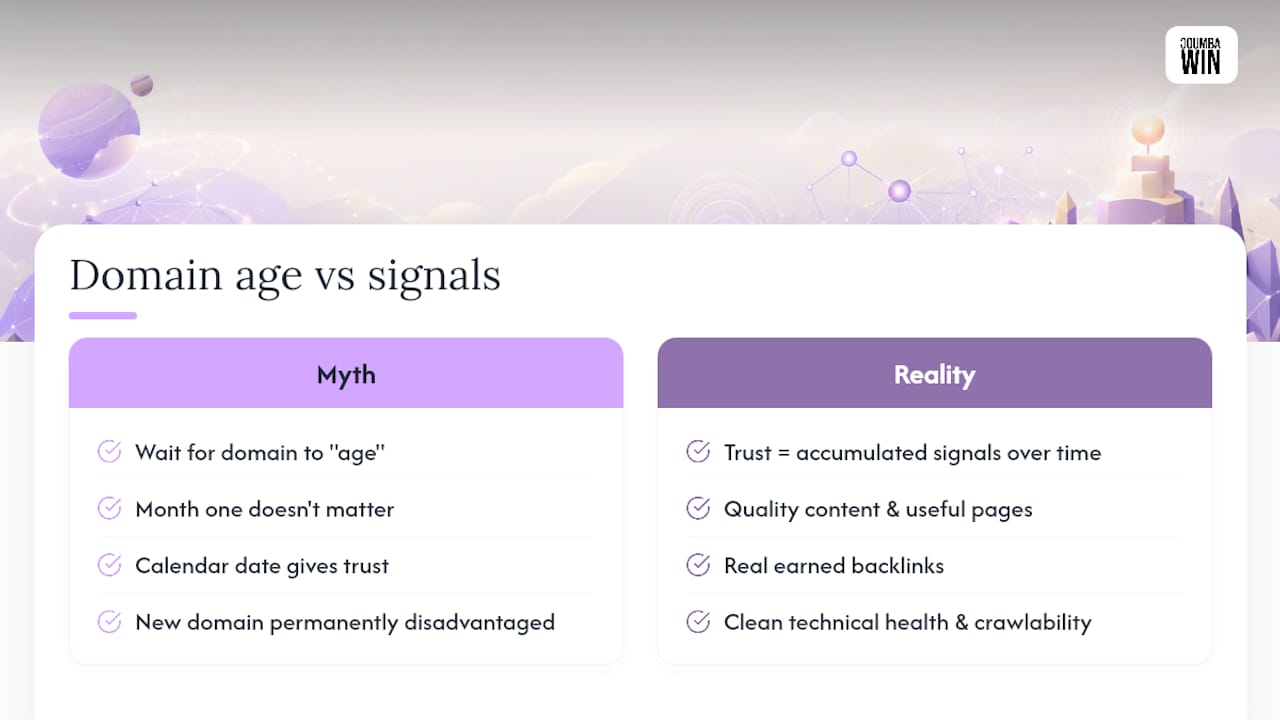
Here’s the myth: your domain needs to “age” before Google trusts it, so nothing you do in month one really counts.
Here’s the reality: age itself isn’t the mechanism. What actually matters is the accumulation of signals over time, quality content, real backlinks, consistent technical health, user engagement. A brand-new domain with sharp technical execution and a handful of genuinely useful pages can out-rank a five-year-old domain that’s been neglected. Age correlates with trust because older sites have usually had more time to accumulate those signals, not because a calendar date carries inherent weight.
This distinction changes how you should spend your energy. Instead of waiting out some invisible probation period, put your time into the things that actually build trust faster: clean technical foundations, content that answers real questions completely, and a few earned mentions from sites Google already respects. Most of the highest-impact SEO work on a new domain happens before launch, in your keyword-to-page mapping and your crawlability choices, not in some mysterious waiting game after.
There’s a related myth worth killing here too: that a new domain is permanently disadvantaged against established competitors. It’s disadvantaged against competitors with better signals, full stop. Fix the signals, and the age gap matters far less than most guides suggest.
Establishing Domain Authority and Trust Signals Early
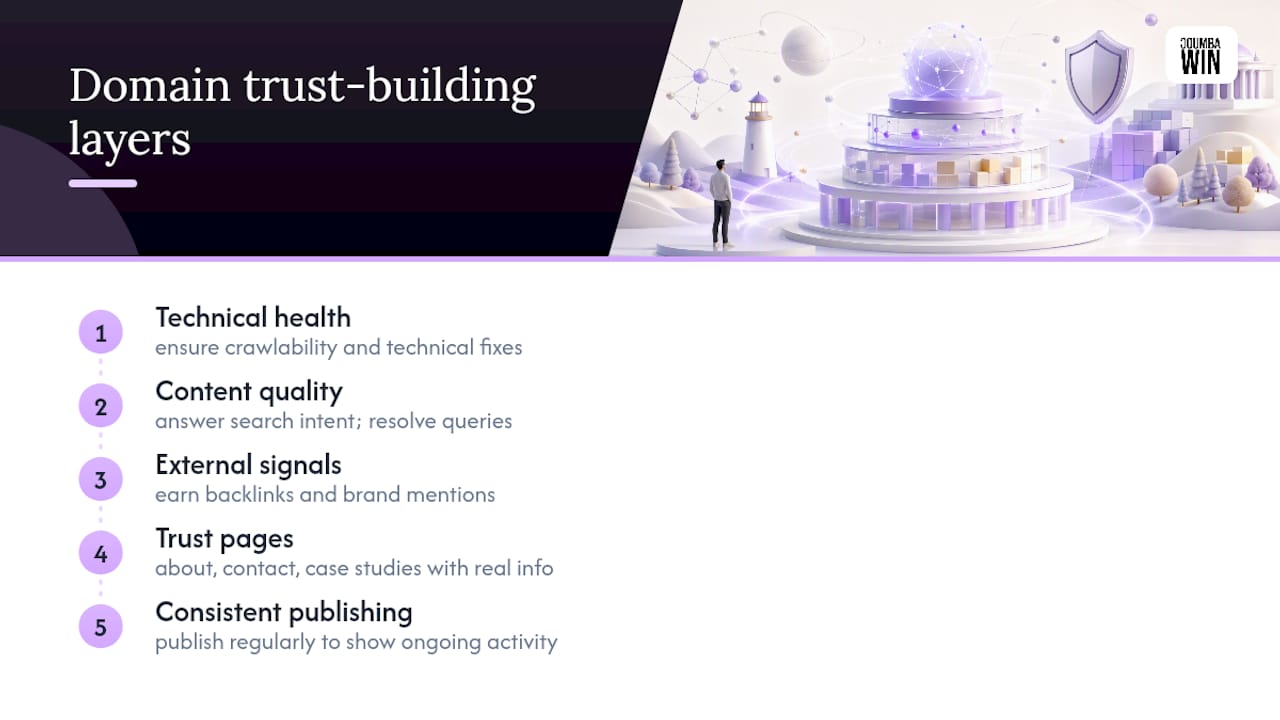
Domain authority isn’t a single number Google hands out. It’s a composite impression built from consistent signals: who links to you, how users behave on your pages, how technically sound your site is, and whether your content actually answers what people search for.
You build that impression in layers. Technical health comes first, because a site Google can’t crawl properly never gets the chance to earn trust from anything else. Content quality comes next, pages that genuinely resolve a search query outperform pages that just mention a keyword. Then come external signals: real backlinks from relevant sites, brand mentions in press or forums, and consistent publishing that shows you’re not a one-and-done project.
Visible trust pages matter more here than people expect. An about page with real names and a real story, a contact page with an actual address or phone number, and case studies or examples of your work all give both users and search systems something concrete to evaluate. Sites that skip these in favor of pure landing-page minimalism often struggle to convert either visitors or crawlers into believers.
Ranking systems in 2026 put real weight on backlinks and brand mentions specifically, treating each one as a trust signal that helps both traditional search rankings and newer AI-driven search surfaces. Every mention you earn, even a small one, is doing more work than it looks like on the surface.
Avoiding Common Penalties and Spam Associations With New Domains
New domains get flagged more easily than established ones, mostly because spam networks tend to launch, exploit, and abandon domains quickly. Google’s systems have learned to watch new domains a little more closely as a result.
The practical fix starts before you even register the domain. Check its history using the Wayback Machine and a backlink toxicity checker. A domain that previously hosted a spam network can carry latent penalty signals into your ownership, even if you had nothing to do with its past.
Once you’re live, avoid anything that mimics spam behavior: sudden bursts of low-quality backlinks, thin auto-generated pages published in bulk, or aggressive keyword stuffing in titles and meta descriptions. Publish consistently and honestly instead. A slow, steady content and link profile reads as legitimate. A sudden explosion of either reads as manipulation, whether or not that was ever your intent.
Designing a Launch That Helps Your SEO
Design and SEO aren’t separate disciplines on a new domain. They’re the same problem viewed from two angles. Clear information architecture tells both users and crawlers where to find the pages that matter, and visible trust pages, about, contact, real case studies, give search systems something to evaluate beyond keywords. Coumba Win Design’s own work on site structure shows how the right layout choices cut rework and speed up how quickly a new site earns visibility.
— Coumba Evelyn
When You’d Rather Have a Design Partner Handle Launch
Running this checklist yourself is entirely doable, but it takes time most founders don’t have during a launch quarter. Specialized design partners can build the launch-ready foundation from day one, including custom web design and development, SEO optimization, and Webflow development, to ensure the technical and structural pieces are handled correctly the first time instead of patched later.
That matters because rework on a live domain is expensive: every restructured URL or rebuilt page resets some of the trust signals you just spent months earning. An approach that treats information architecture and SEO as one decision made at the drawing board, not a fix bolted on after launch, can improve launch outcomes. You can see how that plays out in the Webflow development work built for startups moving fast on tight timelines. If you’re weighing whether to build this yourself or bring in a design partner who thinks about crawlability from the first wireframe, start a conversation with Coumba Win Design about what your launch actually needs.
Sources
- SEO for new website — Semrush blog
- SEO for new websites in 2026 — Seobility
- New website SEO in 2026: Google indexing — Auspia AI
- Robots.txt guide — Search Engine Journal
FAQ
Is SEO Still Worth It in 2026?
Yes. Organic search still drives a large share of discovery, and a focused launch of five to ten well-optimized pages typically shows measurable results within three to six months. The channel has changed with AI Overviews and richer snippets, but the fundamentals, crawlability, intent-matched content, and earned trust, still decide who shows up.
Is Domain Flipping Illegal?
No, buying and reselling domains is a legal practice in most jurisdictions. It becomes a problem only when it involves trademark infringement (cybersquatting) or deceptive practices, which fall under separate legal rules rather than SEO policy.
What Is the 80/20 Rule in SEO?
It’s the idea that roughly 20% of your efforts, usually technical crawlability, core keyword targeting, and a handful of cornerstone pages, produce most of your results.
Is SEO Dead Now With AI?
No, but its shape has shifted. AI Overviews and chat-based search now pull from well-structured, clearly answered pages, which makes clean technical setup and direct, answerable content more valuable, not less. Sites with weak crawlability or thin content lose visibility in both classic search and AI-driven results.
How Long Until a New Domain Ranks?
Most niches show early movement within three to six months when the technical setup is clean and content targets realistic, lower-difficulty keywords. Impressions in Search Console are usually the first signal, showing up before actual rankings climb.