Brand Naming Process: 7 Steps for Startup Founders
Brand Naming Process: 7 Steps for Startup Founders
The brand naming process is a sequence: define what you’re naming and who it’s for, write a brief, generate a long list, screen it against clear criteria, test the finalists with real buyers, clear the legal side, then commit. Skip a step and you usually pay for it later, in a rebrand, a trademark letter, or a domain you can’t spell out loud on a podcast.
We’ve watched founders spend three weeks agonizing over a logo and ten minutes on the name. (Guilty, once. Our first spreadsheet of names had 400 rows and zero criteria. It was chaos. 😅) This guide is the process we wish we’d had: practical, a little opinionated, and built for startups that need a name that survives contact with investors, customers and a trademark database.
TL;DR
- Do positioning first, then write a one-page naming brief. Names without a brief become a vote on whatever sounds coolest.
- Generate a long list (dozens, not five), then cut it with written criteria: meaning, distinctiveness, sound, spelling, legal availability.
- Test your finalists with people who look like your buyers, not with your friends and your cofounder’s mom.
- Check the U.S. trademark, domain and social handles before you fall in love. A name you can’t own is a name you’re renting.
- Treat the name as one piece of a bigger identity: it needs a story, a look and a site to live in.
Table of Contents
- The brand naming process at a glance
- Step 1: Get your positioning straight before you touch a name
- Step 2: Write the naming brief
- Step 3: Generate a long list (and keep going past the obvious)
- Step 4: Screen with criteria, not gut feelings
- Step 5: Test the finalists with real buyers
- Step 6: Clear the name legally, then grab your digital real estate
- Step 7: Decide, then build the identity around the name
- Naming mistakes that cost startups the most
- Our perspective: a name is a design decision, not a label
- When you’d like a partner for the next step
- FAQ
- Sources
The brand naming process at a glance
Most published frameworks land on the same shape. Rob Meyerson’s book on naming lays out a seven-step basic naming process, running from a naming brief through creative development, screening, legal search and final selection. Here’s our startup-sized version of it:
| Step | What you do | What you walk away with |
|---|---|---|
| 1. Position | Pin down customer, need, category, benefit, differentiation | A positioning statement |
| 2. Brief | Write down what’s being named, for whom, and how you’ll judge it | A one-page naming brief |
| 3. Generate | Brainstorm widely across different naming styles | A long list of 50 to 100+ candidates |
| 4. Screen | Score against your written criteria | A shortlist of 5 to 10 |
| 5. Test | Put finalists in front of target buyers | Evidence, not vibes |
| 6. Clear | Trademark, domain, handles, language check | 2 or 3 names you can actually use |
| 7. Decide | Pick, register, and build the identity around it | A name and a launch plan |
Let’s walk through each one.
Step 1: Get your positioning straight before you touch a name
Naming is the moment positioning stops being a slide and becomes a single word. If you can’t say who your target customer is, what they need, what category you play in, what benefit you deliver, what they’d use instead, and how you differ, any name will feel arbitrary. First Round Review’s naming guide makes the same point: define positioning first, then write a brief, then generate ideas.
No positioning yet? Our six-part brand positioning statement template takes about an hour and gives the naming session a spine. If your team needs to align live, a half-day brand workshop is the fastest way to get there without a month of Slack threads.
Step 2: Write the naming brief
The brief is the least glamorous and most useful page in the whole project. According to First Round Review, a good one covers what is being named, the audience, desired and unwanted associations, competitor names, and evaluation criteria. SurveyMonkey’s account of naming one of its own products adds a few useful prompts: the problem you solve, what the name should communicate immediately, and how the customer should feel, plus how the name fits the broader brand family.
Ours fits on one page:
- What are we naming? Company, product, feature, or all three? (Be honest about plans to expand. A name that boxes you into one product gets awkward fast.)
- Who is it for? The buyer, and the investor who needs to remember you after a day of pitches.
- What should it feel like? Three adjectives, plus three it must never feel like.
- What’s the competitive landscape? List competitor names so you don’t accidentally sound like all of them.
- How will we judge it? Your criteria, agreed before anyone gets attached to a favorite.
That last bullet is the sneaky one. Agree on the scoreboard before the game starts.
Step 3: Generate a long list (and keep going past the obvious)
Your first ten ideas are everyone’s first ten ideas. Atlassian’s naming team advises starting with brand discovery and continuing to brainstorm beyond first-draft ideas until candidates express your distinctive meaning or its functional or emotional benefits. In practice that means pushing past the literal stuff and pulling from different naming styles:
- Descriptive: says what you do. Clear, but hard to defend legally and easy to forget.
- Evocative or metaphorical: borrows an image that carries the feeling (a mountain, a bird, a verb).
- Compound or blended: two words fused into one.
- Invented: made-up words. Highly ownable, but you’ll spend budget teaching people what it means.
- Founder or place names: personal, but harder to scale or sell.
A few exercises that actually work in a small team:
- Solo first, together second. Everyone writes 20 names alone for 15 minutes, then you share. It avoids the loudest voice winning.
- Word buckets. List core words, synonyms, metaphors and translations for your brief’s key ideas, then mix across buckets.
- Steal the feeling, not the word. Look at brands whose names evoke what you want, and ask what technique they used.
- Say it out loud. Every candidate gets said in a sentence: “We just raised a seed round for ___.”
Aim for volume. You aren’t judging yet. Judging during brainstorming is how good weird ideas die.
Step 4: Screen with criteria, not gut feelings
Now it’s time to cut. A useful way to organize criteria, drawn from a name evaluation framework, is in three groups: meaning, adaptability and distinctiveness; memorability, sound and appearance; and technical qualities such as legal availability, linguistic viability, spelling and pronunciation. Atlassian’s checklist adds that a name should make sense, support the company’s purpose and long-term plans, appeal to relevant audiences, inspire the team, and feel like an extension of core values.
Turn that into a scorecard. Rate each candidate 1 to 5 on:
| Criterion | The question to ask |
|---|---|
| Meaning | Does it fit our positioning and brief? |
| Distinctiveness | Would it stand out in a list of competitors? |
| Growth room | Still works if we add products or enter new markets? |
| Sound | Can someone hear it once and spell it? |
| Look | Does it work as a logo, a URL, an app icon? |
| Feeling | Does it make the team a little proud? |
| Availability | Any obvious conflicts in a quick search? |
Don’t average blindly. A name that scores 5 on everything except “someone else already owns it” is a zero. But the scorecard turns “I just don’t love it” into a conversation you can have like adults.
Step 5: Test the finalists with real buyers
This is the step founders skip, because it feels like extra work when you’re already tired of the name. Don’t skip it. SurveyMonkey’s name-testing guidance recommends testing with people who match your intended buyer, giving each respondent one name where possible, randomizing which name they see, keeping questions consistent, and including a control.
What to ask, in plain terms:
- What do you think this company does? (comprehension)
- Does it feel right for [your category]? (fit)
- Can you type it from memory after a short distraction? (recall and spelling)
- Read it aloud. (pronunciation)
- Does it remind you of anything negative? (associations)
Capture the open-ended “why” too. The comments are often more useful than the scores. And treat small differences as noise: the same guidance suggests interpreting results with uncertainty rather than crowning a winner off a point or two.
On a tight budget? A scrappy version still beats nothing. Ask 15 to 20 people from your actual target market, show each person one name at a time, and don’t explain it first. If you have to explain it, that’s data.
Step 6: Clear the name legally, then grab your digital real estate
This is where beautiful names go to die, so do it before the logo, not after.
Know which “name” you’re registering
The U.S. Small Business Administration explains that a business name involves four legally independent registrations: entity name, federal trademark, DBA and domain name. Registering your LLC or corporation in your state doesn’t give you trademark rights nationwide. Per the SBA, an entity name generally protects at the state level, while a trademark can protect a name nationally against use by others in the same or similar industry.
Understand what makes a trademark defensible
The USPTO says a defensible mark must be both federally registrable and legally protectable, and not every registrable mark is enforceable. The test it describes for conflicts is likelihood of confusion: whether the marks are confusingly similar and whether the goods or services are related. That’s why “Apex” can exist in a dozen unrelated industries, but not twice in yours.
Two more USPTO points matter for naming:
- A U.S. clearance search helps surface applications or registrations that could create likelihood-of-confusion risk, and merely descriptive marks may be refused. This is the legal reason the most literal names are the riskiest.
- An application must specify the actual goods or services used, or intended to be used, with the mark. So your brief’s description of what you sell matters here too.
Stripe’s startup naming guide suggests checking shortlisted names in the relevant U.S. trademark database, bringing in an IP lawyer when the records are complex or ambiguous, and thinking about other jurisdictions if you plan to operate internationally. We agree. If the name is core to your company, an hour with a trademark attorney is cheap insurance. We’re designers, not lawyers, so treat this section as a map and not legal advice.
Check domain and handles
Stripe describes ownability as the ability to claim a name across trademark rights, domains and social handles. The SBA likewise advises registering a matching domain and creating profiles on the social platforms your audience uses. Do it the same day you pick the name. We’ve seen a founder wait a weekend and watch a squatter grab the .com. 😬
Perfect domain taken? Don’t automatically bolt on “get” or “app” and call it done. Sometimes it’s the sign to go back to the shortlist.
Step 7: Decide, then build the identity around the name
Pick the name that scored well, tested well and cleared. Then stop relitigating it. Naming fatigue is real, and the worst move is reopening the list the day before launch.
A name is pivotal to brand identity, but not the whole of it. As Atlassian puts it, a name introduces who you are, what you do and what you stand for, while messaging and other identity elements do the rest. So the name needs company: a story, a visual system, a website. Our guides on building a startup brand identity from scratch and brand storytelling for early-stage companies pick up where this one ends. And if you’re naming a media or content brand specifically, a creative process for naming a media brand shows how naming connects to your digital marketing from day one.
Naming mistakes that cost startups the most
This is the part where we confess to a few of these ourselves. Across the processes above and the founders we’ve worked with, these come up again and again:
- Skipping the brief. Without agreed criteria, the name picked is whoever argued best.
- Falling for a name before it’s cleared. Trademark and domain checks come before the logo, always.
- Being too literal. Descriptive names are easy to understand, hard to protect, and tough to stand out with. The USPTO notes merely descriptive marks may be refused.
- Spelling gymnastics. If you have to say “that’s with a Z, and no E” more than once, the name is taxing your word of mouth.
- Boxing yourself in. A name tied to your first product becomes awkward the moment you add a second.
- Naming by committee. Ten opinions, no criteria, a compromise nobody loves. Use the scorecard and a single decision-maker.
- Ignoring what it means elsewhere. If you plan to launch in other languages or countries, check meanings before you commit. SurveyMonkey’s guidance specifically recommends screening launch-language meanings before testing.
- Testing only with friends. They love you. They are not your market.
Our perspective: a name is a design decision, not a label
We work with founders who treat design as a competitive advantage, and naming is where that mindset either shows up or doesn’t. Here’s what we believe, in plain terms.
First, a name has to work in the places your startup actually lives: a pitch deck title slide, a browser tab, an app icon, a booth banner at Demo Day, an email sender field. If you can’t picture it in all of those, keep going. We’re big on designing the whole system around a name, and we’re equally big on saying no to generic templates and AI-generated shortcuts for something this foundational. A name can be generated in seconds. A name that carries your positioning is built.
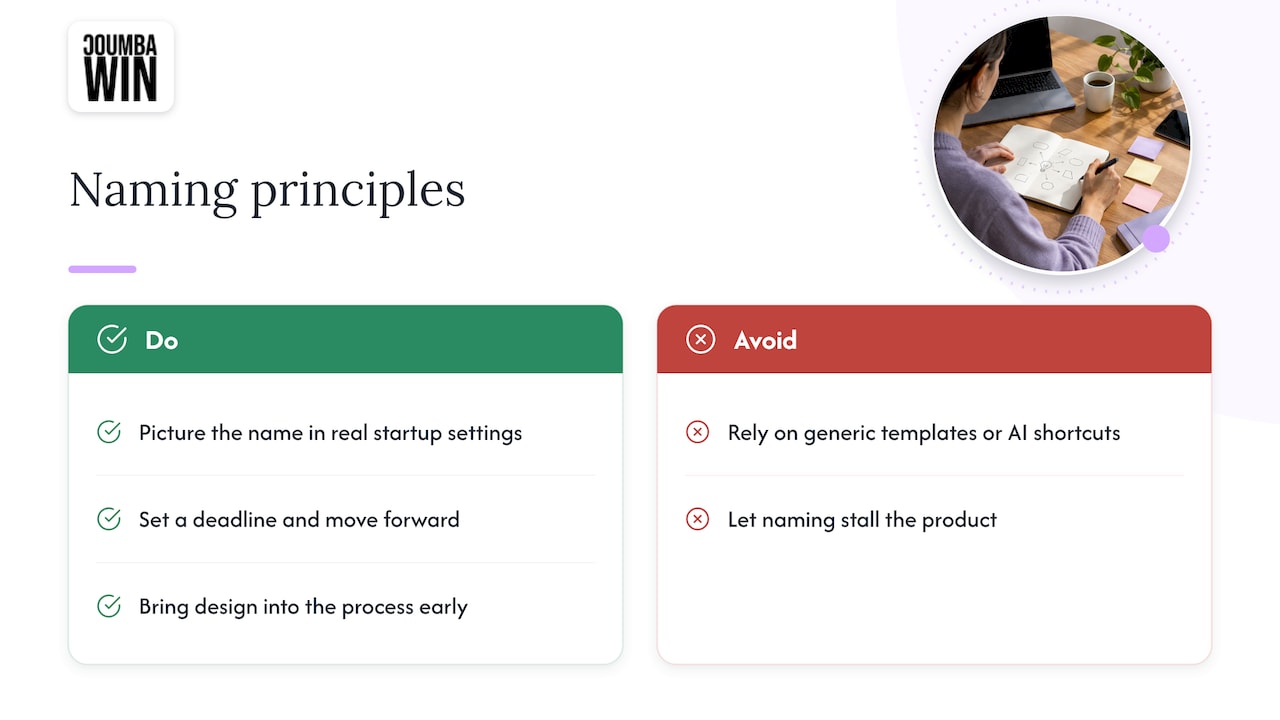
Second, don’t let naming become a stall tactic. Founders can burn months on it while the product waits. Set a deadline, run the process above, and move. A good name that exists beats a perfect one that doesn’t.
Third, loop in design early. The way a name looks in lowercase, how it sits next to a logo, whether it’s accessible to read aloud and on screen: those are design questions, and they’re much cheaper to answer before the name is final than after.
— Coumba Evelyn
When you’d like a partner for the next step
Once the name is locked, you need the brand and the website to match it. That’s what we do for startups: custom branding, website design and development, UI and UX design, pitch deck design, and more, with a collaborative approach built for founders who want design to move the business. If your name is settled and your site is next, take a look at our web design and development services, or see what we’ve built in Webflow on our Webflow development page.
Not sure whether your positioning is ready to name against? Start with our guides on brand architecture for startups and brand differentiation strategies, then come back with a brief in hand.
FAQ
How do I name a startup if I have no budget?
Run the same process in a lighter form. Write a one-page brief, generate 50 or more names with your team, score them against written criteria, and test the top three with 15 to 20 people from your target market. Then check trademark databases, your domain and social handles before you commit.
How long does the brand naming process take?
For a small startup, a focused version can take two to four weeks: a few days for positioning and the brief, a week of generation and screening, then testing and legal checks. The timeline stretches when there’s no agreed criteria or when several decision-makers have to sign off. Fixing a deadline up front helps more than any tool.
Do I need a trademark attorney to choose a name?
You can do a first pass yourself by searching the USPTO’s records for similar marks in related goods or services. If the results are complex or ambiguous, or the name is central to your company, bring in an IP lawyer before you invest in branding. They can assess the likelihood-of-confusion risk better than a keyword search can.
Should my startup name include keywords for SEO?
Usually it shouldn’t be the main driver. Literal, keyword-heavy names tend to be more descriptive, which can make them harder to protect and less memorable. A distinctive name with strong content and a good website builds search visibility on its own, and you can still weigh search in your criteria.
Is the .com domain a must-have?
Not a must, but ownability matters. Aim to secure a matching domain and consistent social handles so customers can find you easily. If the exact .com is taken, consider whether a different name from your shortlist serves you better before settling for an awkward workaround.
What’s the strangest name your team almost went with? Tell us. We promise not to judge (much). ✌️
Sources
- Chapter 3: The Basic Naming Process, Brand Naming (Rob Meyerson)
- Brand naming: an art and a science, Atlassian
- What’s in a Name? A Lot, Actually, First Round Review
- The 6-Step Framework We Used to Name SurveyMonkey LaunchPad
- How to Evaluate Brand Names
- Name Testing: How to Validate a Brand or Product Name, SurveyMonkey
- Choose your business name, U.S. Small Business Administration
- Trademark basics for small businesses, USPTO
- USPTO Startup Certification Course Transcript
- Common problems in applications, USPTO
- How to Pick a Name For Your Startup, Stripe
- How to Start a Craft Business, U.S. Small Business Administration