Brand Audit Checklist: A Step-by-Step Guide for Startups
Brand Audit Checklist: A Step-by-Step Guide for Startups
A brand audit is a structured review of how your brand looks, sounds and performs, checked against what you say you stand for. The checklist below walks you through it in eight steps: strategy, visuals, touchpoints, customer perception, competitors, performance data, scoring, and a fix list you can actually finish. Grab coffee. Maybe snacks. It’s less scary than your cap table, promise. ☕
We built this for founders who suspect their brand has drifted (a pitch deck here, a landing page there, three slightly different blues) and want a clear way to find out.
TL;DR
- A solid audit covers strategy and identity, visual assets, marketing materials, web and social, customer perception, and performance numbers.
- Work in order: set goals, collect assets, check consistency, ask real people, study competitors, then score everything.
- Score each finding by impact and effort, so you fix the loud problems first instead of redoing the whole brand.
- Put the next audit on the calendar before you finish this one.
- Not sure you can judge your own brand fairly? Bring in an outside pair of eyes.
Table of Contents
- What a brand audit actually covers
- Step 1: Set goals and get ready
- Step 2: Audit your strategy and positioning
- Step 3: Inventory and review your visual identity
- Step 4: Walk through every touchpoint
- Step 5: Ask customers and your own team
- Step 6: Check competitors and the market
- Step 7: Measure visibility and performance
- Step 8: Score findings and turn them into a plan
- Our perspective
- When you’d rather not do the fixes alone
- How often to repeat the audit
- FAQ
- Sources
What a brand audit actually covers
The classic definition: a brand audit analyzes your brand and how well it is managed and marketed, and it surfaces strengths, weaknesses, opportunities and threats. According to Brand Aid’s appendix on brand audits, that means looking at mission, values and positioning, visual assets like logos, typography and colors, marketing materials, web and social performance, customer perceptions, and hard numbers such as revenue and market share.
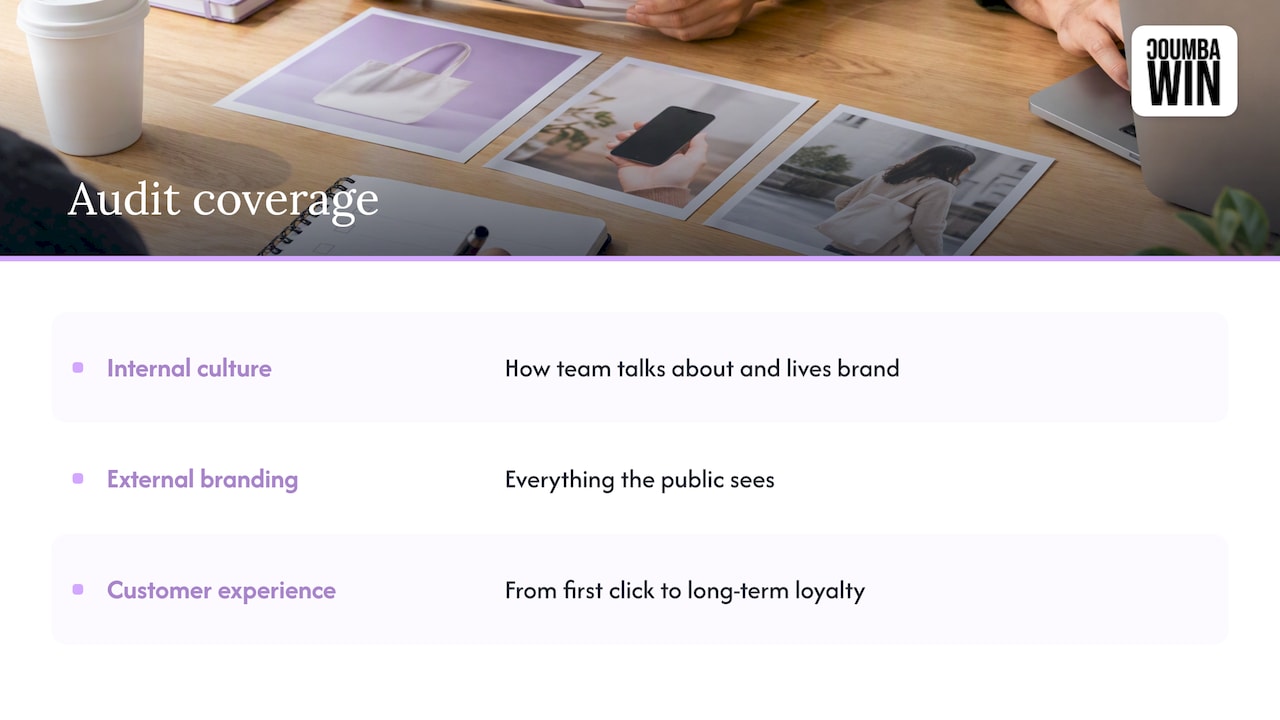
That’s a lot of ground. A practical way to keep it manageable is to sort it into three buckets, which is how Shopify’s audit framework organizes a checklist: internal culture, external branding, and customer experience. Internal culture is how your team talks about and lives the brand. External branding is everything the public sees. Customer experience is what happens between first click and long-term loyalty, from onboarding and communications to service and delivery.
If you want the longer definition first, our post on what a brand audit is and how to act on it covers it. Otherwise, keep going.
Step 1: Set goals and get ready
An audit with no goal turns into a very long spreadsheet that nobody reads. Start here.
Preparation, as Brandwatch’s audit guide describes it, begins by clarifying mission, vision and core values, setting specific objectives, gathering a team, assigning roles, and making sure everyone can reach the data and tools they need.
Your checklist for this step:
- Write down why you’re auditing. Pre-fundraise polish? Rebrand? Conversion rates flatlining? Pick one primary reason.
- Write the mission, vision and values as they stand today, in plain sentences. If your team can’t agree on them, that is already your first finding.
- Name an owner, plus two or three people from different corners (sales, product, support). Fresh eyes spot what the founder stopped seeing two years ago.
- Decide the scope. Whole brand, or just the website and pitch materials? For a startup, a tight scope you finish beats a grand one you abandon.
- Pick a few KPIs to compare against. Brand audits typically measure performance by comparing existing data to goals and KPIs, so you need goals before you can measure the gap.
One honest note: we’re all a little biased about our own baby. Brandfolder suggests that an unbiased third party can appraise brand assets and keep the audit as neutral as possible. Even a friendly founder from another company, armed with this checklist, counts.
Step 2: Audit your strategy and positioning
Before you look at a single logo, check the thinking underneath it.
- Can you state who you serve, what you do for them and why you’re different in two sentences?
- Does the stated positioning match what your product actually does today (not what it did at seed stage)?
- Do your values show up in decisions, hiring, support replies, or do they just live on the About page?
- Is your brand voice written down, with examples of what it sounds like and what it never does?
- Does your audience definition match who is actually buying?
If the positioning feels mushy, a structured statement helps. We lay out a six-part brand positioning statement for startups and design teams that makes a good scoring rubric: if you can’t fill in each part, mark it red.
Step 3: Inventory and review your visual identity
Now the fun, slightly chaotic part. Collect every brand asset you can find. Everything. The old logo in that one Google Drive folder, the favicon nobody updated, the sticker from the conference you attended in a different era.
Brandfolder’s primer lists evaluating brand assets as a core step, and the consistency test is simple: confirm that personality, tone of voice and visual elements like logos, fonts and colors are applied uniformly across web, digital and print.
Checklist:
- Logo: Are there multiple versions in circulation? Is there a clear-space rule, a minimum size, a one-color version and a dark-background version?
- Color: Are exact values documented (HEX, RGB, CMYK for print)? Do text and background combinations stay readable?
- Typography: Are the same typefaces used for headings and body across site, deck and docs? Any rogue fonts from a template?
- Imagery and iconography: Do photos, illustrations and icons feel like one family, or a stock-photo yard sale?
- Layout and spacing: Do pages and slides follow a recognizable grid?
- Guidelines: Does a brand guide exist, and can a new hire find it in under a minute?
Tip: print everything out or drop screenshots on one big board. Drift is obvious side by side and invisible one asset at a time. Our guide to building a consistent visual brand language goes deeper on fixing what you find.
Step 4: Walk through every touchpoint
This is where you check the brand in the wild. Think like a stranger who just heard your name.
Website
- Does the homepage say what you do and for whom within a few seconds of landing?
- Do headlines, buttons and microcopy sound like the same person wrote them?
- Is navigation clear, and do key pages (pricing, product, contact) load and read well on mobile?
- Are accessibility basics covered: contrast, alt text, keyboard navigation, readable type sizes?
- Is the page title and meta description on your key pages written for humans, not just stuffed with keywords?
Social and content
- Do profile images, bios, banners and handles match across platforms?
- Does the tone on LinkedIn sound like the tone on X, only adjusted to fit the room?
- Is posting regular enough that a visitor doesn’t think you vanished in 2024?
Sales and fundraising materials
- Does your pitch deck use the same visual language as your site? Investors notice when it doesn’t.
- Do your one-pagers, media kit and proposals feel like one family? (Our post on media kit design for founders shows what to include.)
- Do email signatures, templates and invoices carry the current logo and colors? If your emails need work, see how to build three brand email templates fast.
Print and events
- Do business cards, banners, booth materials and swag match the digital brand? Nothing says battle royale like a tablecloth in last year’s color palette. 😅
For a deeper pass on this step, our online brand consistency best practices post gives you a ready-made set of rules to check against.
Step 5: Ask customers and your own team
Your assets can be perfectly consistent and still say the wrong thing. Perception is where you find out.
Per Brandfolder, to understand audience perception you should survey your best customers, lapsed customers and potential customers who fit your persona, to learn why they buy (or don’t) and whether the branding resonates. Add your employees to that list: they’re your most honest critics and your most underused channel.
Questions that earn their keep:
- In your own words, what do we do?
- What three words would you use to describe us?
- Who would you compare us to?
- What nearly stopped you from buying?
- What would you tell a friend about us?
- (For lapsed customers) What made you leave, and what would have changed that?
Five to ten short interviews will teach you more than a 40-question survey nobody finishes. Keep the answers verbatim. Quotes become your messaging later.
A gap check helps here: put what you say you are next to what people say you are. The distance between those two columns is your brand problem, usually.
Step 6: Check competitors and the market
Brandwatch’s guidance on competitor review is to identify direct and emerging competitors, then compare product offerings, pricing, messaging and visual branding with your own. It also suggests looking at SEO rankings, share of voice in online conversations and marketing channel use to reveal advantages or gaps.
For a startup, keep it lean:
- Pick three to five competitors: two direct, one or two emerging, and maybe one adjacent brand you admire.
- Screenshot their homepage, pitch language and social presence.
- Make a grid: positioning line, tone, color and type, main promise, proof they show (logos, numbers, case studies).
- Circle what is generic across the category. If every competitor uses the same blue and the word platform, your opening is the opposite.
- Note what they do badly. That’s your white space.
A Shopify-style SWOT analysis is a handy way to wrap this up: strengths and weaknesses from your audit, opportunities and threats from the market scan. Shopify’s framework recommends it for objectively evaluating brand performance and positioning.
Step 7: Measure visibility and performance
Now let numbers weigh in. Compare your current data with the goals you set in Step 1. Depending on what you have, pull:
- Website traffic by source, conversion rates on key pages, bounce rates on landing pages
- Branded search volume (are people looking for you by name?)
- Social engagement and follower growth, with reach if you have it
- Email open and click rates
- Sales cycle length, win rate and lead quality
- Revenue and market share, where you can measure them
If you’re not sure which of these actually track brand health, a guide on measuring SEO performance can help you pick the numbers worth watching. For awareness and recall, we’ve also written about brand lift measurement, which is useful once you run campaigns at scale.
Don’t panic if your data is thin. A young startup often has three months of analytics and a spreadsheet of Stripe exports. Record what you have, note what you’re missing, and start tracking it. A gap in your data is a finding, too.
Step 8: Score findings and turn them into a plan
This is where most audits die: a pile of observations, no decisions. Here’s the method we’d use. It’s our own working approach, not a formal standard, so adapt it.
- List every finding in one sheet, one row each. Example: three different logo files in use; homepage doesn’t say who it’s for; deck colors don’t match the site.
- Score impact (1 to 3): how much does this hurt trust, conversion or clarity? Anything investors or customers see first scores higher.
- Score effort (1 to 3): 1 is an afternoon, 3 is a multi-week project.
- Sort. High impact, low effort goes first (quick wins). High impact, high effort becomes a scheduled project. Low impact, high effort goes to the someday pile, with no guilt.
- Assign an owner and a date to each quick win and project.
- Group fixes into sprints. A 30-day sprint of quick wins (logo files, bios, email signatures, homepage headline), then a 90-day project list (site rework, deck redesign, guidelines).
Brandfolder’s step list ends with creating an action plan and monitoring it. That monitoring half matters. Put a review on the calendar at 30 and 90 days, and re-check your Step 1 KPIs.
A worked example: a seed-stage SaaS startup finds that its site calls customers teams, its deck calls them enterprises, and its sales emails call them users. Impact: 3. Effort: 1 (it’s copy). That goes in the first sprint. Meanwhile, the website’s navigation is confusing on mobile. Impact: 3. Effort: 3. That one gets a project slot with a design owner. Same audit, two different timelines.
Our perspective
We’ve seen the same pattern again and again: a startup builds fast, ships fast, and the brand gets stitched together from whatever was nearby. A template site. A deck from a different founder’s era. Swag in a color that no longer exists anywhere else. Nobody did anything wrong, it’s just what speed looks like.
That’s why we treat an audit as a strategy tool, not a design critique. The question isn’t whether your brand is pretty. It’s whether it helps you win the next investor meeting, the next customer, the next hire. We believe custom, outcome-oriented design built with founders (not generic templates or AI-generated shortcuts) is how a brand becomes a real competitive advantage.
Our advice: run the audit, score it honestly, and then fix things in the order that moves the business. Bold beats busy. And if you want a nerdy wingwoman for the redesign part, you know where to find us. 🙌
Coumba Evelyn
When you’d rather not do the fixes alone
Auditing is the easy half, honestly. The harder half is rebuilding the site, the deck, the identity or the event materials so they work together. That’s what we do at Coumba Win: custom branding, website design and development, UI and UX design, pitch deck design, print and graphic design, accessibility audits, SEO optimization, email marketing, ad management and more, for startups that treat design as a growth lever.
If your audit turned up a long list, see what we offer at Coumba Win or look at our Webflow development work to see how we build sites for startups.
How often to repeat the audit
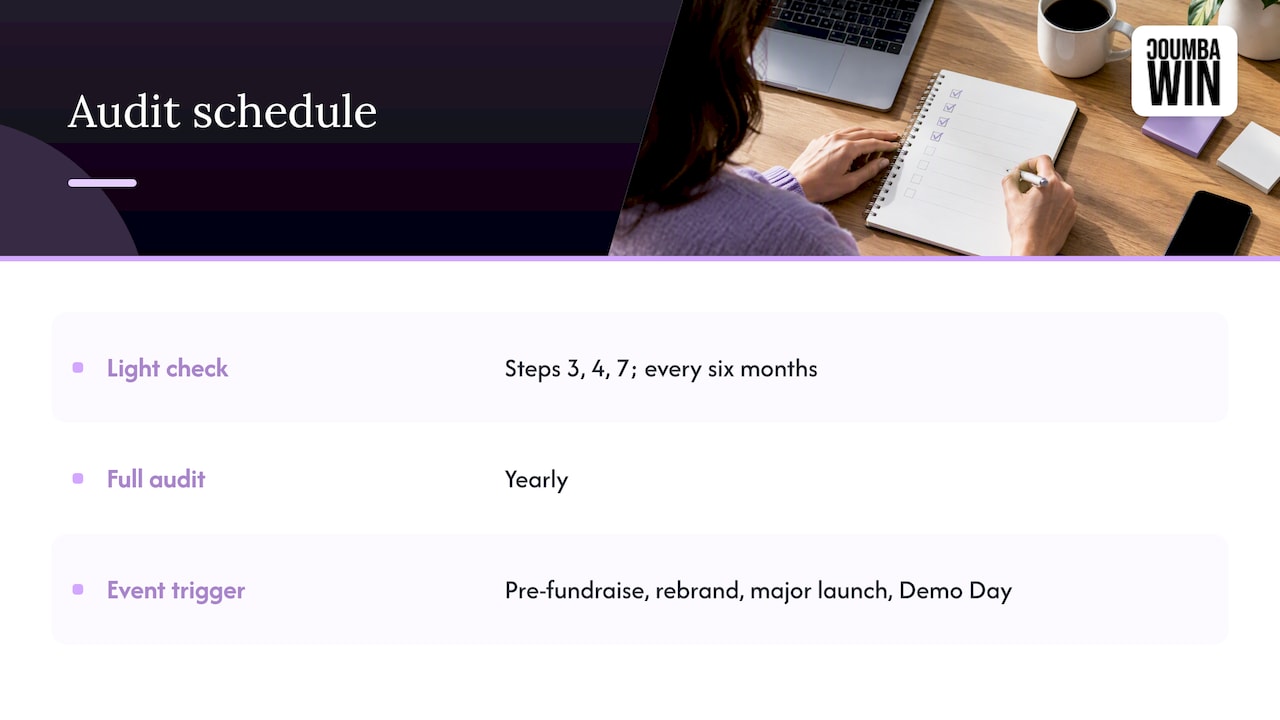
Brandfolder’s advice is plain: set a schedule for audits and stick to it. For a startup, a light check (Steps 3, 4 and 7) every six months and a full one yearly is a sensible rhythm. Also run a full audit before a big moment: a fundraise, a rebrand, a major launch or a Demo Day. Put it in your calendar now, while you still feel virtuous.
FAQ
What should a brand audit include?
A good audit covers your strategy and identity (mission, values, positioning), visual assets, marketing materials, website and social channels, customer perceptions, and performance metrics such as revenue and market share. Sorting it into internal culture, external branding and customer experience keeps it organized.
What are the steps to conduct a brand audit?
Set goals, evaluate brand assets, gather customer and employee feedback, analyze sales and engagement data, review competitors, organize and assess everything, then create and monitor an action plan. Our version adds a scoring step so fixes are ranked by impact and effort.
How long does a brand audit take?
It depends on scope and how scattered your assets are. A focused startup audit (website, deck, social and a handful of customer interviews) can be done in a couple of weeks of part-time effort. A company-wide audit with surveys takes longer, so decide your scope in Step 1.
Should I audit my own brand or hire someone?
You can absolutely start yourself with this checklist. An outside reviewer is worth it when you’re too close to the work, when the team disagrees about what the brand is, or before a big rebrand, because a neutral view keeps the audit honest.