Budget $125 per Template: Accessibility Audit Costs for Startups

Budget $125 per Template: Accessibility Audit Costs for Startups
Expect costs ranging from free for a basic automated scan to a substantial sum for a comprehensive manual enterprise audit. Most small and mid-market businesses typically pay a moderate amount for a proper hybrid audit. A quick heuristic: budget roughly $125 per representative page, though that number bends hard based on complexity. And here’s the part nobody tells you upfront: remediation usually costs one to three times the audit itself, plus ongoing monitoring after that.
TL;DR:
- Smaller audits, typically costing $1,500 to $3,000, combine automated scans with human review to identify roughly 70 to 80 percent of accessibility issues.
- Pricing is driven by unique templates rather than page count, with more complex assets like ecommerce sites or apps reaching $6,000 or more for thorough testing.
- Remediation costs usually double or triple the audit price, requiring 40 to 120 developer hours, plus ongoing monitoring to prevent regressions.
- Automated tools alone detect only about 30 to 40 percent of WCAG criteria, making hybrid and manual audits essential for compliance in regulated or enterprise environments.
- A realistic accessibility budget should allocate at least 60 percent of total costs to fixing issues and verifying fixes, not just the initial audit.
Table of Contents
- How Much Does an Accessibility Audit Cost by Tier?
- What Actually Drives Accessibility Audit Pricing
- Per-Page Pricing and a Quick Formula for Your Budget
- Budgeting for Remediation and Ongoing Monitoring
- How to Get a Quote You Can Actually Trust
- How Coumba Win Design Approaches Accessibility Pricing
- The Gap Between Audit Reports and Actual Compliance
- Get a Straight Answer on What Your Accessibility Work Will Cost
- Sources
- FAQ
How Much Does an Accessibility Audit Cost by Tier?
Okay, let’s talk real numbers, because this is the part where I’ve watched founders either panic or completely underestimate what they’re getting into.
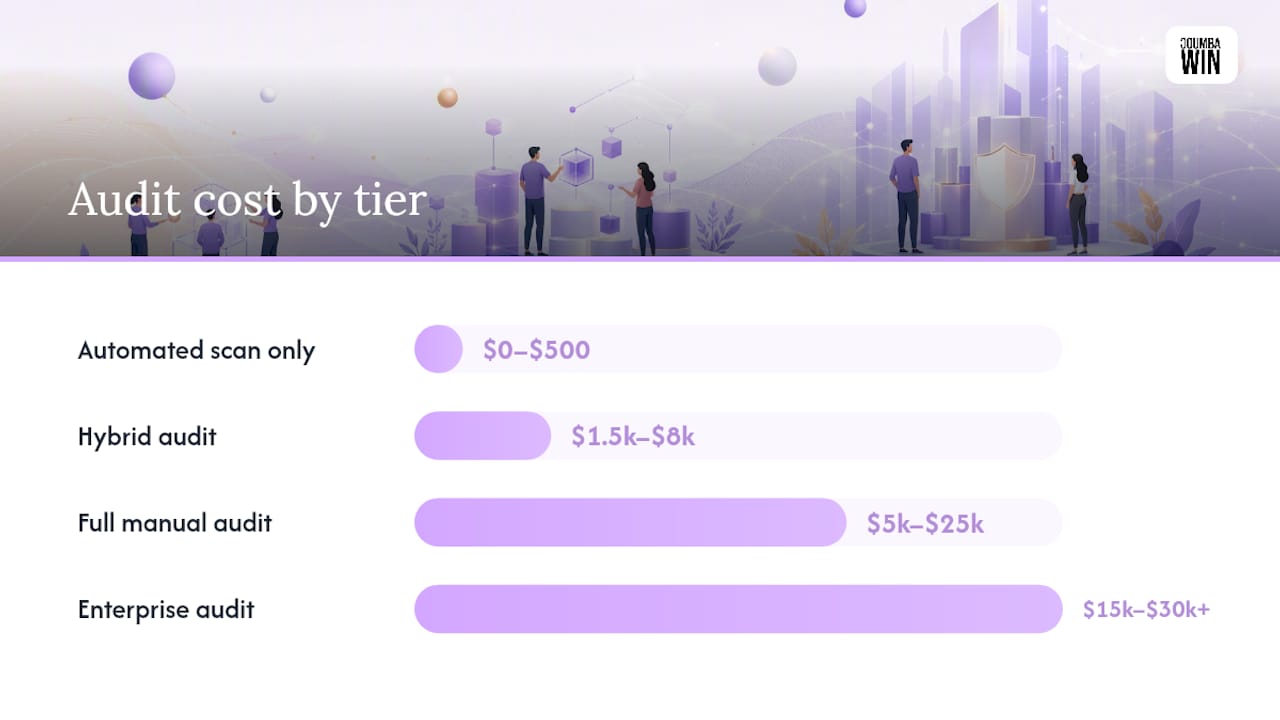
Accessibility audits come in four rough tiers, and each one buys you something different:
- Automated scan only: $0 to $500 (often monthly subscriptions in the $0–$69+ range for tools that crawl your site and flag code-level issues)
- Hybrid audit: $1,500 to $8,000, blending automated scanning with human review of key pages
- Full manual audit: $5,000 to $25,000 for mid-market sites, including testing with actual assistive technology
- Enterprise audit: $15,000 and up, sometimes climbing past $30,000 for complex platforms with regulatory exposure
Here’s why the gap between “automated” and “manual” is so wide: automated tools only catch about 30 to 40 percent of WCAG criteria. They’re great at flagging missing alt text or contrast failures, but they cannot tell you whether a screen reader user can actually complete your checkout flow. A hybrid approach typically catches 70 to 80 percent of issues, which is why most credible auditors won’t sell you a scan-only report and call it a real audit.
For a small brochure site with five unique page types, a hybrid audit in the $1,500 to $3,000 range is usually appropriate. A regulated SaaS product with authenticated dashboards, dynamic components, and a legal defense requirement needs the full manual tier, because manual expert testing catches roughly 60 to 70 percent of issues that automated tools miss entirely, and those are exactly the issues that end up in demand letters. If you’re selling into government or large enterprise procurement, you’re likely stepping straight into enterprise territory, because those buyers usually require formal documentation on top of the testing itself.
What Actually Drives Accessibility Audit Pricing
Auditors don’t price by page count. They price by unique templates, because a 200-page site built from six templates costs far less to audit properly than a 40-page site where every page is hand-coded differently. Template count, not raw page volume, is the real cost driver, and it’s the first thing a competent quote should ask about.
Beyond templates, several variables move the price up or down:
- Asset type: a marketing site is cheaper to audit than an ecommerce platform, which is cheaper than a native mobile app or a PDF-heavy document library
- Interactivity: forms, filters, modals, and authenticated flows (think logged-in dashboards) all need separate testing because they behave differently for keyboard and screen reader users
- Environments: testing across desktop, mobile, multiple browsers, and multiple assistive technologies (JAWS, NVDA, VoiceOver, TalkBack) multiplies the testing matrix
- WCAG version: auditing against WCAG 2.2 adds new success criteria around focus visibility and drag interactions that 2.1-only audits skip, and this generally shows up as a modest scope increase rather than a major price jump
- VPAT requirements: if you need a formal Accessibility Conformance Report for procurement, that’s a documentation deliverable added on top of testing, not folded into the base fee
User testing with actual people with disabilities is the one add-on worth flagging separately. It’s not standard in most audits, but when it’s included, expect it to add a few thousand dollars depending on sample size and task complexity. It’s the closest thing to ground truth you can buy, because no amount of expert review perfectly predicts how a real screen reader user will navigate your interface.
Pro Tip: Before requesting quotes, count your unique page templates, not your total page count. A vendor who prices off total pages without asking about templates is either inexperienced or padding the estimate.
Per-Page Pricing and a Quick Formula for Your Budget
Per-page rates give you a fast way to sanity-check any quote you receive. Most vendors price light, low-interaction pages differently from complex, high-traffic ones.
- Light pages (static content, minimal interaction): $25 to $100 per page
- Primary pages (home page, checkout, key conversion flows): $100 to $250 per page
- Mobile app screens: $75 to $250 per screen, depending on how many assistive tech environments get tested
A simple formula gets you a starting number fast: multiply your count of representative, unique templates by $125, then adjust up if you have authenticated flows or complex widgets, and down if most of your pages are static and simple. This is a heuristic, not a quote. It ignores things like assistive technology coverage and VPAT needs, so treat it as a planning tool for your first internal budget conversation, not a number to hand a vendor as a target.
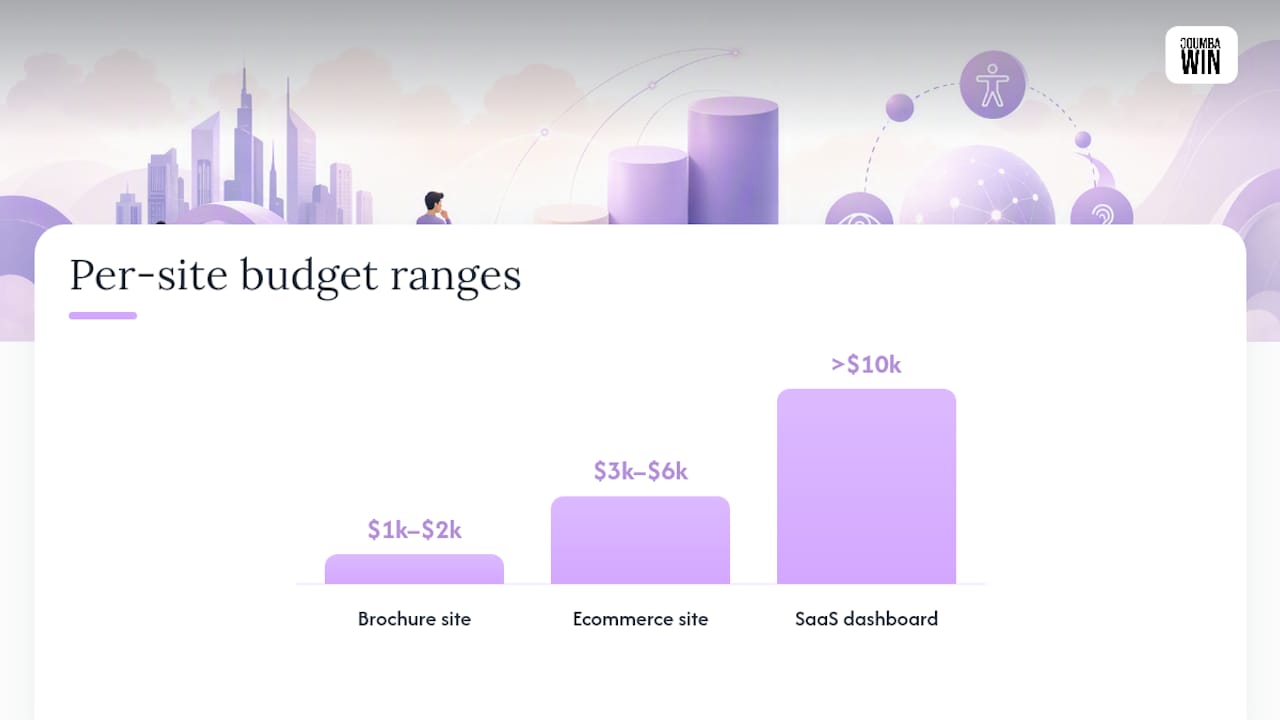
Three quick examples show how differently this plays out. A small brochure site with eight unique templates and no interactive forms lands around $1,000 to $2,000, comfortably inside the hybrid tier. An ecommerce site with product listings, cart, checkout, and account pages, maybe 12 templates with real interactivity, runs closer to $3,000 to $6,000 because checkout flows need careful keyboard and screen reader testing. A SaaS dashboard with authenticated states, data visualizations, and custom components can push past $10,000 once you’re testing multiple user roles and interactive widgets across several assistive technology combinations.
Budgeting for Remediation and Ongoing Monitoring
The audit is the diagnosis. Remediation is the treatment, and it’s usually the bigger bill. Plan on remediation costing one to three times the original audit price, depending on how many issues surface and how tangled your codebase is.
A few numbers to anchor your planning:
- Developer time to fix accessibility issues typically runs at standard hourly development rates, and a mid-size audit often surfaces enough issues to require 40 to 120 hours of fix work
- Retest and validation fees (confirming fixes actually resolved the issues) usually run a fraction of the original audit cost, and most teams schedule a retest immediately after remediation, then again after any major redesign
- Monitoring subscriptions break into three familiar bands: starter tools around $50 to $150 per month, mid-tier monitoring around $150 to $400 per month, and enterprise-grade continuous monitoring at $400 or more per month
- VPAT and formal documentation add-ons are priced as a scope expansion, not a simple multiplier, since they require structured conformance reporting against WCAG success criteria
Here’s the number that should change how you think about this: teams that keep monitoring active instead of running one-off audits repeatedly tend to lower their total cost of ownership over time, because catching a regression in a new feature costs far less than discovering it two redesigns later. If your product ships updates weekly, a monitoring subscription almost always beats paying for a fresh full audit every year.
How to Get a Quote You Can Actually Trust
Getting three wildly different quotes for the “same” audit usually means three vendors scoped three different things. Before you request pricing, put together a short checklist so every quote answers the same question.
Your scope checklist should cover:
- Total unique templates (not raw page count) across desktop and mobile
- Authenticated flows: logged-in dashboards, account settings, checkout
- PDFs, downloadable documents, and third-party embedded widgets (chat tools, payment forms)
- Which assistive technologies and browser combinations get tested
- Whether you need multiple languages tested if your site is localized
Then ask every vendor the same discovery questions: which assistive technologies do they actually test with, what’s their sample size for pages tested manually versus scanned, how many human hours are included, what does the final deliverable look like, do they include a retest after fixes, and is a VPAT included or billed separately?
Watch for red flags. A vendor pitching an automated-only scan as a full audit is selling you a fraction of what you need, since scans alone catch roughly 30 to 40 percent of issues. Vague sampling (“we’ll review the whole site”) without naming specific templates usually means inconsistent coverage. No retest policy means you’re paying to find problems with no built-in way to confirm they got fixed.
Pro Tip: Ask for a sample report from a past client (with names redacted). A vendor with nothing to show you after multiple audits is a bigger red flag than any price on the table.
How Coumba Win Design Approaches Accessibility Pricing
We treat accessibility work the way we treat any design problem worth solving properly: audit first, then roadmap, then remediation, then verification. That phased structure matters because it stops businesses from getting a report full of issues with no plan for fixing them. Our work on accessibility in UX design and inclusive digital experiences reflects the same philosophy we bring to audits: findings only matter if they connect to a build plan a startup can actually execute against its runway.
The Gap Between Audit Reports and Actual Compliance
Here’s what most pricing guides won’t say out loud: the audit price is the easy number. The real budgeting mistake is treating the audit as the finish line instead of the starting gun.
Businesses fixate on getting the “right” audit price, then get blindsided by remediation costs that dwarf what they paid for the report. If you’re budgeting for accessibility in 2026, put roughly 60 percent of your total budget toward fixing issues and verifying fixes, not toward the diagnostic phase. That’s the inverse of how most companies mentally allocate the spend.
The other overlooked piece: template-based scoping isn’t just a pricing mechanic, it’s the difference between a quote you can compare and one you can’t. Two vendors quoting “$3,000” for your site could mean completely different depths of testing if one counted templates and the other guessed off total pages.
My honest read: if you’re a startup with limited runway, spend your money on a hybrid audit with a clear remediation roadmap before you spend it on a full enterprise-grade audit you don’t yet need. Fix real issues first. Scale the rigor as your user base and legal exposure grow.
— Coumba Evelyn
Get a Straight Answer on What Your Accessibility Work Will Cost
Coumba Win Design is the alternative to guessing your way through vendor quotes: instead of a bare compliance report you have to interpret yourself, you get an audit tied directly to a remediation roadmap your team can actually execute, priced around your real templates and interactive flows rather than a generic page count.

That matters most for startups where design and engineering hours are scarce and every dollar spent on accessibility needs to also improve the product, not just the compliance file. Our work spans branding, UI/UX, and platform development, which means accessibility findings get handed to people who can fix the underlying components, not just flag them. If your product includes reusable interface pieces, our component development work shows how fixes get built once and applied everywhere instead of patched page by page. For a broader look at how design investment pays back for growing companies, our piece on the business impact of a website redesign breaks down the return side of this equation. Accessibility work also carries real SEO upside worth factoring into your budget, as this breakdown of accessibility’s impact on search performance lays out clearly.
If you’re ready to turn your audit findings into an actual fix plan, start a conversation with Coumba Win Design about scoping your site or app the right way from the first quote.
Sources
- Accessible
- Website Accessibility Audit Cost: 2026 Pricing Guide - eSEOspace
- WCAG Audit Cost: A 2026 Budgeting Guide for Leaders
FAQ
What Is the Average Cost of an Accessibility Audit?
Most businesses pay between $1,250 and $2,750 for a standard hybrid audit on a small to mid-size site, though full manual audits on larger platforms often run $5,000 to $25,000.
How Much Should a Single Audit Cost for a Small Business?
A small business with a handful of unique page templates and no complex authenticated flows typically pays $1,500 to $3,000 for a proper hybrid audit that combines automated scanning with human review.
What Is an Accessibility Audit?
An accessibility audit evaluates a website, app, or document against WCAG success criteria, using a mix of automated scanning tools and manual testing (often with assistive technology like screen readers) to identify barriers people with disabilities encounter.
How Much Do Enterprise-Level Audits Cost?
Enterprise accessibility audits typically start at $15,000 and can exceed $30,000 once you factor in multiple assistive technology environments, formal VPAT documentation, and broad authenticated flow testing.
Is Remediation Included in the Audit Price?
No. Remediation, meaning the actual code and content fixes, is billed separately and typically costs one to three times the original audit price depending on issue volume and codebase complexity.